754-800-4115Get a quote

Florida Solar & Energy Engineering Guide

What Is Low-E Glass? The Complete Florida Impact Window & Door Guide

Low-E (low-emissivity) glass is window and door glass treated with a microscopically thin, virtually invisible metallic silver or metal-oxide coating that reflects infrared solar heat back outside while letting natural visible daylight pass through. Uncoated glass has an emissivity of about 0.84, so it readily absorbs and gives off heat. Low-E coatings cut that to 0.02–0.04, lowering the Solar Heat Gain Coefficient (SHGC) from ~0.62 on clear laminated glass down to 0.18–0.25 to satisfy the Florida Building Code — Energy Conservation (Table R402.1.2) mandate of SHGC ≤ 0.25 across Climate Zone 1 (Broward, Miami-Dade, and Monroe) and Climate Zone 2 (Palm Beach, Lee, Collier, Charlotte, and Sarasota).

Republic’s recommendation: Low-E glass is one of the most powerful tools for Florida weather, and we always encourage homeowners to add Low-E to all impact windows (single-hung, horizontal roller, casement, and fixed picture) and impact doors. Adding Low-E makes windows and doors 8% to 15% more expensive upfront—just ~$72–$135 on a ~$900 fixed window or ~$88–$165 on a ~$1,100 single-hung. Spread across a 15- to 20+ year replacement cycle, it is a tiny fraction of the total project cost that pays back every summer in reduced AC runtime and 99% UV protection. Under F.S. § 720.3035(6) and § 718.113(5), an HOA or condo board can’t refuse code-compliant impact windows, and a clear, spectrally selective Low-E usually passes appearance review.

· State-certified general contractor CGC1533058 (verify on Florida DBPR).

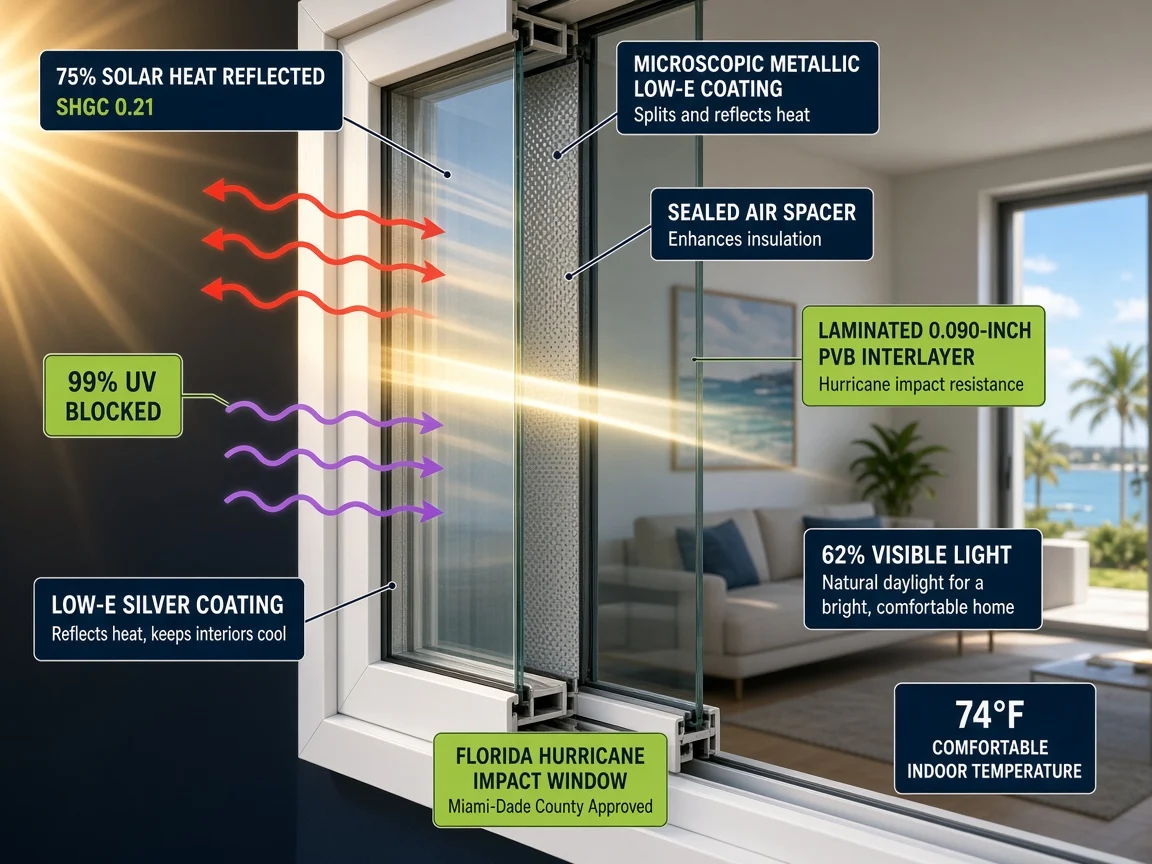
Technical cutaway of a Florida hurricane impact window with Low-E coating reflecting 75% of solar infrared heat (SHGC 0.21) and blocking 99% of UV rays while transmitting 62% natural visible daylight into a cool 74-degree Florida living room.Solar Physics · SHGC ≤ 0.25 · 99% UV Block
How Low-E works on Florida impact glass: A microscopically thin metallic silver coating reflects long-wave infrared solar heat (bringing SHGC down to 0.20–0.25) while pairing with the 0.090" laminated interlayer to block 99%+ of UV rays—all while keeping natural daylight clear and bright.
  • SHGC ≤ 0.25Florida Building Code max solar heat gain (Table R402.1.2) — Low-E hits 0.18–0.25 vs. 0.62 clear
  • +8% to 15%Typical Low-E price adder (~$72–$195 per standard window) — tiny over a 15–20+ yr lifespan
  • 99%+ UV Block0.090" laminated interlayer + Low-E stops UV fading on hardwood floors, rugs & furniture
  • HOA FriendlyClear, spectrally selective Low-E meets FBC ≤ 0.25 without dark or mirror tints

At-a-glance summary

Low-E impact glass vs. untreated clear impact glass in 60 seconds

Both glass packages use the exact same hurricane-rated laminated safety glass tested to the large-missile test: a 9-lb 2×4 at 50 ft/s (ASTM E1996 calls it Missile Level D; TAS 201 uses the same missile) under a Miami-Dade NOA or Florida Product Approval (FL#). The difference is what happens to Florida solar heat 365 days a year across single-hung, horizontal roller, casement, and fixed picture windows.

Laminated Impact / Hurricane Glass (5/16" – 9/16")

Envelope stays sealed after 2×4 strike

9-lb 2×450 ft/s (34 mph)1Outer Heat-Strengthened LiteAbsorbs kinetic strike; cracks in spiderweb20.090" PVB or SentryGlas (SGP) CoreHolds glass in frame across 9,000 wind cycles3Inner Glass Lite + Low-E OptionInterior stays sealed; blocks 99% of UV rays

Result: Zero breach. Wind and rain stay outside, preventing catastrophic internal roof uplift.

Standard Non-Impact Dual-Pane Glass

Shatters on impact & pressurizes home

Debris Strike!No Structural Polymer CoreAir space insulates heat, but stops zero debris!Internal PressurizationWind rushes inside, doubling uplift load on roof!Fails Code & OIR-B1-1802Requires approved shutters or panels to pass

Result: Open breach unless covered by approved hurricane shutters before the storm.

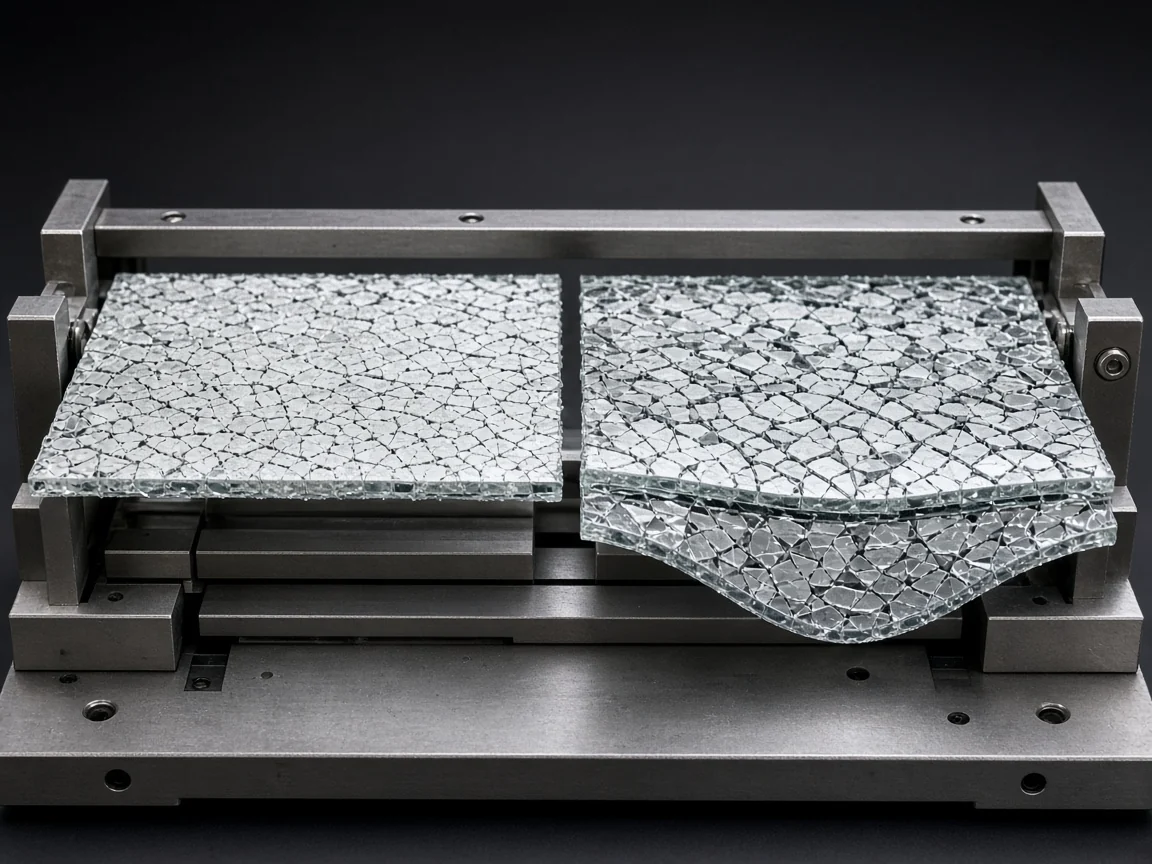
Side-by-side laboratory test rig comparing a shattered laminated glass panel with a rigid SentryGlas SGP interlayer staying completely flat on the left versus a shattered PVB interlayer panel flexing downward on the right.Interlayer Rigidity · SGP (Left) vs. PVB (Right)
SentryGlas (SGP) vs. standard PVB after glass fracture: Even when both glass lites are completely shattered, the ionoplast SGP core (left, ~5× stiffer) stays flat and rigid in the frame, while standard PVB (right) flexes under load while holding the shards together.
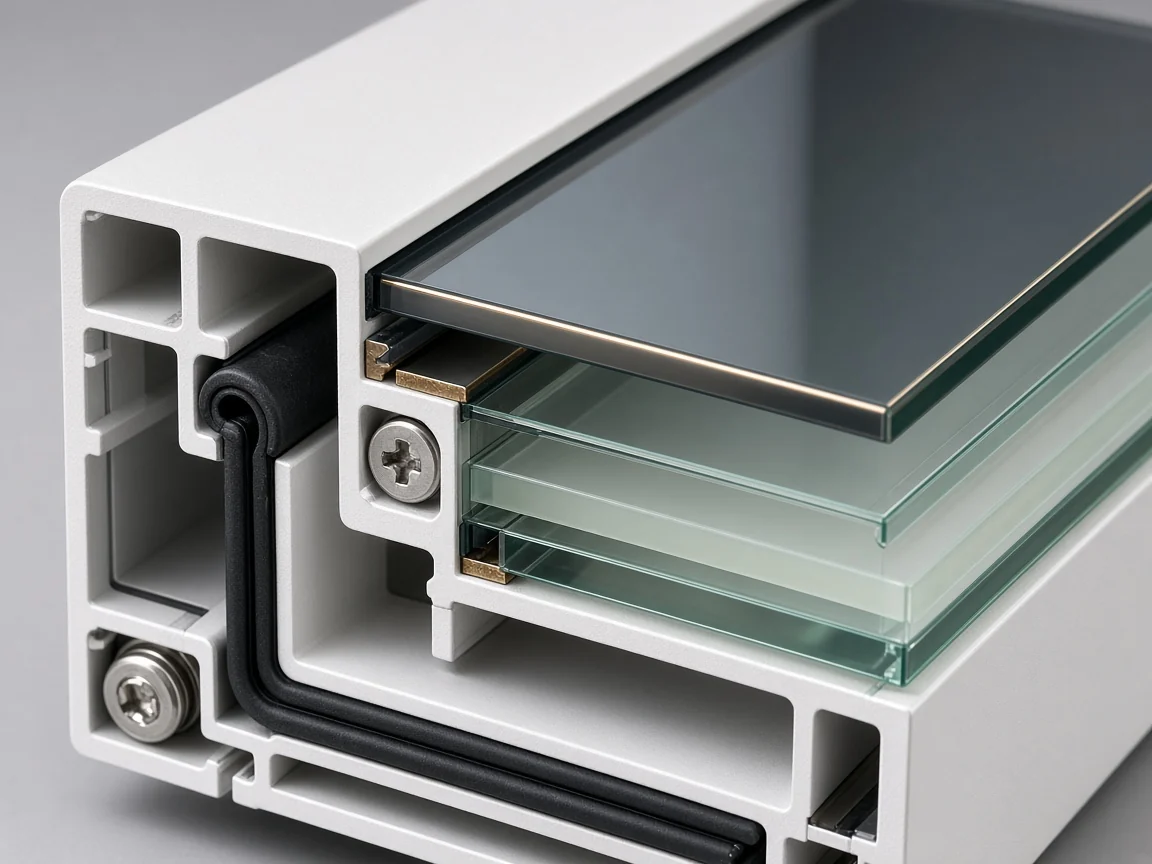
Macro corner cutaway of an insulated laminated hurricane window showing Low-E outer glass, warm-edge spacer air gap, laminated inner glass with 0.090-inch interlayer, and multi-chamber aluminum frame.Corner Cutaway · Low-E + Air Gap + Laminated Core
Insulated laminated glass vs. standard dual-pane: Standard dual-pane glass only has two thin panes and an air gap. An insulated impact window adds a 0.090-inch laminated interlayer inside a heavy-wall aluminum extrusion with dual compression seals.
Side-by-side comparison of Low-E Laminated Impact Glass vs. Untreated Clear Laminated Impact Glass in FloridaVerified against NFRC 100/200, FBC Energy Conservation Table R402.1.2 & Republic 2026 pricing
Side-by-side comparison of Low-E Laminated Impact Glass vs. Untreated Clear Laminated Impact Glass in Florida
Performance / Cost MetricLow-E Laminated Impact Glass (Republic Recommended)Untreated Clear Laminated Impact Glass (No Low-E)
What It IsLaminated hurricane glass (0.090" PVB or SentryGlas interlayer) treated with a microscopic metallic silver or pyrolytic metal-oxide low-emissivity coating.Two panes of standard clear glass bonded to a 0.090" PVB or SentryGlas interlayer with zero solar-reflective coating.
Surface Thermal Emissivity0.02–0.04 (soft-coat) or ~0.15 (hard-coat) — cuts how much radiant heat the glass surface gives off.About 0.84 — uncoated glass readily absorbs and gives off heat.
Solar Heat Gain Coefficient (SHGC)0.18 to 0.25 — blocks 75% to 82% of total solar heat; satisfies Florida Building Code Table R402.1.2 (SHGC ≤ 0.25 in both Climate Zones 1 and 2).0.60 to 0.70 — admits up to 3× more solar heat; fails Florida's 0.25 SHGC prescriptive energy code unless dark tint or whole-building energy calc is used.
U-Factor & Why South FL Impact Windows Don't Carry ENERGY STAR~0.84 in non-insulated laminated aluminum (FBC Climate Zone 1 — Broward, Miami-Dade, and Monroe — has no U-Factor cap: 'NR') or ~0.29–0.38 in insulated laminated IGU (Climate Zone 2 — Palm Beach, Lee, Collier, Charlotte, and Sarasota — sets U-Factor ≤ 0.40). Rated by NFRC, not ENERGY STAR.~1.00 to 1.08 in non-insulated laminated aluminum — uncoated glass readily absorbs and gives off heat.
Visible Light Transmittance (VT)0.52 to 0.65 — bright, natural daylight with a clear neutral exterior look (no dark cave effect).0.75 to 0.80 — bright light, but severe afternoon glare and 100°F+ floor/sofa hot spots on south and west exposures.
Ultraviolet (UV) Ray Block99%+ of UV-A and UV-B blocked by the 0.090" interlayer + Low-E metallic layers.~98%–99% UV blocked by the 0.090" laminated interlayer alone, but near-infrared heat still fades fabrics.
Upfront Installed Price Difference+8% to +15% over baseline clear impact glass (~$72–$135 on a ~$900 fixed window; ~$88–$165 on a ~$1,100 single-hung).Baseline installed price ($0 glass coating upgrade, but much higher 15–20 year AC electricity cost).
15- to 20-Year Florida VerdictEssential for Florida weather. Fraction of a price per year over a 15–20+ year window lifespan; keeps rooms cool and passes FBC & HOA rules.Not recommended for air-conditioned living spaces in South or Southwest Florida.

Solar spectrum physics

What does 'Low-E' mean, and how does the microscopic silver coating work?

According to the U.S. Department of Energy (DOE), 'Low-E' stands for Low Thermal Emissivity. Sunlight reaching your Florida windows is made of three bands of energy: ultraviolet (UV) light, visible daylight, and near-infrared thermal heat. A spectrally selective Low-E coating acts like an optical filter—letting visible light through while bouncing infrared heat away.

  • Emissivity 0.84 → 0.02–0.04

    Reflects long-wave infrared heat

    Uncoated glass has an emissivity of about 0.84, so it readily absorbs and gives off heat. Low-E coatings cut that to 0.02–0.04, reflecting long-wave radiant heat before it warms the room.

  • SHGC 0.18 to 0.25

    Stops solar heat before it enters

    Solar Heat Gain Coefficient (SHGC) measures the fraction of solar heat admitted from 0 to 1. In Florida's cooling-dominated climate, dropping SHGC from 0.62 (clear) to ≤0.25 (Low-E) cuts window solar heat gain by more than 60%.

  • 60%+ Visible Daylight (VT)

    Bright rooms without dark tint

    Before Low-E existed, the only way to block Florida heat was dark bronze or gray glass that made rooms feel dim. Spectrally selective Low-E separates light from heat—transmitting crisp daylight while rejecting infrared heat.

  • 99%+ UV Rejection

    Protects floors, art & furniture

    Combining a 0.090-inch PVB or SentryGlas (SGP) hurricane interlayer with a Low-E coating blocks over 99% of UV radiation (300–380 nm), preventing sun-bleaching on hardwood floors, leather sofas, rugs, and cabinetry.

Low-E Laminated Impact Glass (SHGC 0.20–0.25)

Reflects 75%+ solar heat & blocks 99% UV

75%+ IR HEAT BOUNCED62% DAYLIGHT PASSES1Microscopic Silver Low-E LayerEmissivity 0.02–0.04 — reflects infrared solar heat20.090" PVB / SGP Hurricane CoreStops 9-lb 2×4 missile + blocks 99%+ UV rays3Cool 74°F Interior Glass SurfaceMeets FBC Table R402.1.2 (SHGC ≤ 0.25)

Result: Cool floors & sofas next to sunny windows, lower AC runtime, and 100% FBC & HOA compliance.

Untreated Clear Laminated Impact Glass (SHGC ~0.62)

Admits ~3× more solar heat into your home

62% HEAT ENTERS!0.84 Emissivity (No Heat Mirror)Readily absorbs and gives off heat (vs. 0.02–0.04)!104°F+ Interior Glass & Floor Hot SpotForces air conditioner to run non-stop all afternoon!Fails FBC SHGC ≤ 0.25 Prescriptive LimitCannot pass FL energy code without dark tint/calc

Result: Stops hurricane debris, but turns south- and west-facing rooms into solar greenhouses.

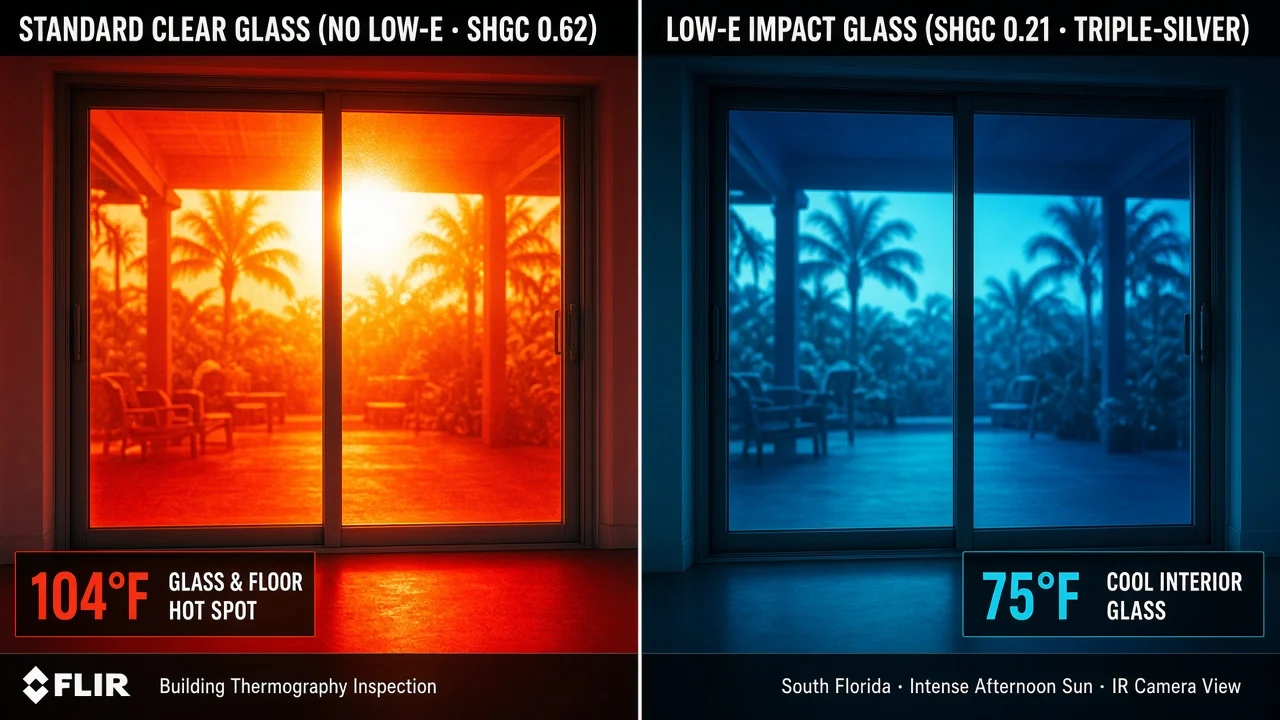
Split-screen FLIR thermal infrared camera inspection of two South Florida sliding glass doors in afternoon sun: standard clear glass on the left glowing red-hot at 104 degrees Fahrenheit versus Low-E impact glass on the right staying cool blue at 75 degrees Fahrenheit.Building Thermography · 104°F Untreated Clear vs. 75°F Low-E Impact Glass
Why you feel the difference immediately: Under an afternoon thermal infrared camera, an untreated clear laminated sliding glass door (left, SHGC 0.62) turns into a 104°F radiant heater baking the floor and sofa. The identical opening with Low-E impact glass (right, SHGC 0.21) stays at a cool 75°F—a 29°F surface temperature drop.

Real South Florida engineering nuance

NFRC ratings in Florida: Why South Florida impact windows focus on SHGC ≤ 0.25 (not ENERGY STAR)

If you have shopped for impact windows in Miami-Dade, Broward, or Palm Beach County, you may have noticed that standard South Florida aluminum impact windows do not carry an ENERGY STAR sticker—even when upgraded with premium Low-E glass. Here is the exact engineering truth behind NFRC ratings in Florida:

1. The Florida Building Code Rule

SHGC ≤ 0.25 is what Florida law requires

Under the Florida Building Code — Energy Conservation (8th Edition 2023 & 9th Edition 2026, Table R402.1.2), both Climate Zone 1 (Broward, Miami-Dade, and Monroe) and Climate Zone 2 (Palm Beach, Lee, Collier, Charlotte, and Sarasota) mandate a maximum glazed fenestration SHGC of 0.25. In Climate Zone 1, the required U-Factor is 'NR' (Not Required), because solar heat gain (SHGC) is the primary driver of cooling load.

See how FBC & NOA rules work

2. Why No ENERGY STAR Sticker?

Single-laminated aluminum vs. U-Factor ≤ 0.32

To earn an EPA ENERGY STAR Version 7.0 label in the Southern zone, a window must hit BOTH SHGC ≤ 0.23 AND U-Factor ≤ 0.32. Standard South Florida HVHZ impact windows use heavy-wall aluminum frames and a single 5/16" or 7/16" non-insulated laminated pane (two glass lites bonded to a 0.090" interlayer with no air gap). Even with Low-E (which easily achieves SHGC ≤ 0.25), a single laminated aluminum window has a U-Factor around 0.84–1.02—so it is certified via its NFRC rating label for Florida code, not ENERGY STAR. (Only thick insulated laminated IGUs in vinyl or thermally broken frames hit U-Factor ≤ 0.32.)

Compare PGT vs. ES Windows glass packages

3. What Inspectors Check on the Label

Always read the NFRC temporary label

Every permitted impact window in Florida ships with two labels on the glass: the permanent Miami-Dade NOA / FL# structural sticker and the National Fenestration Rating Council (NFRC) energy performance sticker listing certified SHGC, U-Factor, and Visible Transmittance (VT). Your municipal building inspector checks that the NFRC SHGC is 0.25 or lower (or matches your Form R402 energy calculation) before signing off on final inspection.

See full window cost breakdown
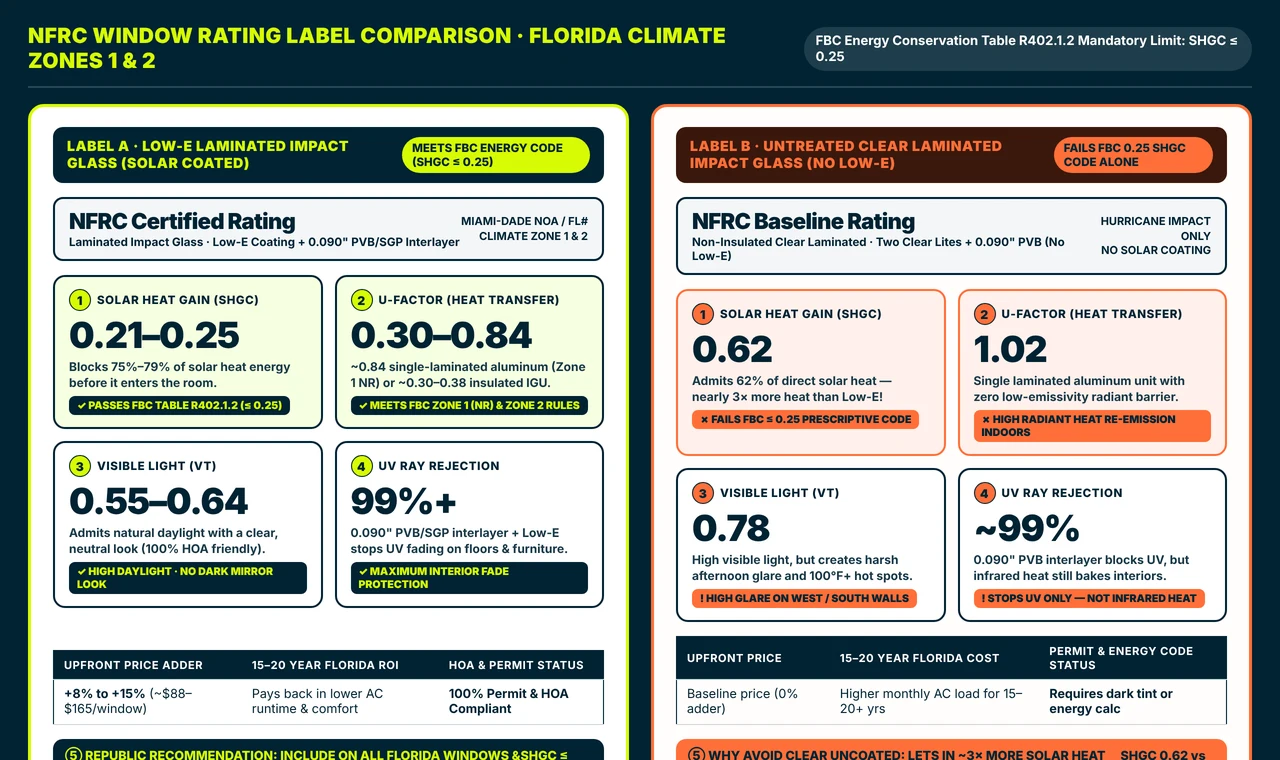
Side-by-side comparison of NFRC certified window rating labels in Florida: Label A showing Low-E Laminated Impact Glass with SHGC 0.21-0.25 passing FBC Table R402.1.2 versus Label B showing Untreated Clear Laminated Glass with SHGC 0.62 failing the 0.25 prescriptive limit.
How to read the NFRC sticker on Florida impact windows: Across Climate Zone 1 (Broward, Miami-Dade, and Monroe) and Climate Zone 2 (Palm Beach, Lee, Collier, Charlotte, and Sarasota), building inspectors check Solar Heat Gain Coefficient (SHGC ≤ 0.25) on the NFRC label rather than an ENERGY STAR sticker—because standard single-laminated aluminum HVHZ windows have a U-Factor around 0.84 (where Zone 1 U-Factor is NR), while Low-E drops their SHGC from 0.62 down to a code-passing 0.21–0.25.

Impact glass configurations

How Low-E is built into Florida impact glass: Non-insulated laminated vs. Insulated Laminated (IGU)

In Northern states, windows are simply two panes of thin glass separated by an air gap. In Florida, hurricane impact glass requires two panes laminated together with a 0.090-inch structural polymer interlayer. That creates two distinct ways manufacturers apply Low-E coating to impact windows and doors:

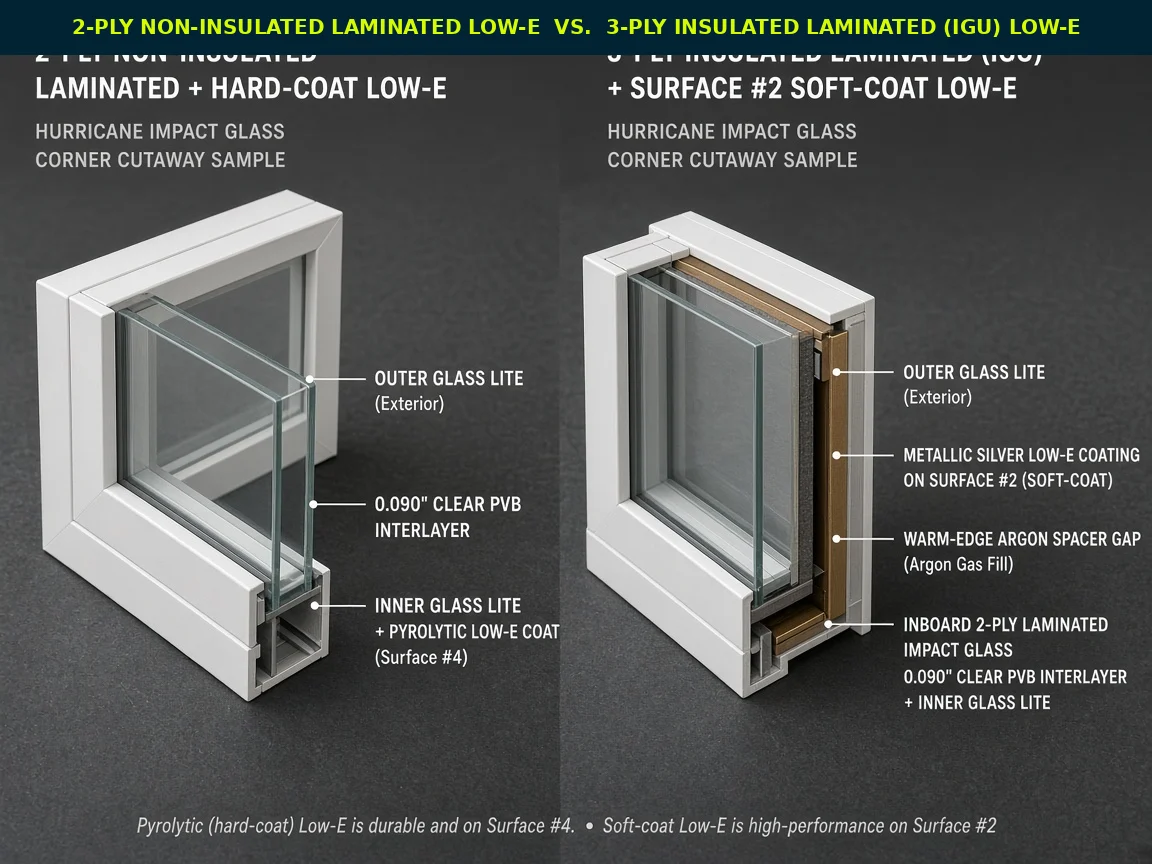
Technical comparison of Florida Low-E impact glass builds: 2-Ply Non-Insulated Laminated vs. 3-Ply Insulated Laminated (IGU)Covers PGT WinGuard, ES Windows (Energía Solar), ECO Window Systems & CWS configurations
Technical comparison of Florida Low-E impact glass builds: 2-Ply Non-Insulated Laminated vs. 3-Ply Insulated Laminated (IGU)
Engineering Feature2-Ply Non-Insulated Laminated + Hard-Coat Low-E3-Ply Insulated Laminated (IGU) + Soft-Coat Low-E (e.g. LoĒ-366)
Glass Makeup & Thickness2 glass lites bonded directly to a 0.090" PVB or SGP interlayer (typically 5/16", 7/16", or 9/16" overall; no air space).3 glass lites total: 1 outer lite + sealed air/Argon spacer gap + 2-ply inboard laminated impact unit (typically 3/4" to 1" overall).
Type of Low-E Coating UsedPyrolytic 'Hard-Coat' Low-E (tin-oxide fused into hot float glass during manufacturing) or solar-reflective coated interlayer.Sputtered 'Soft-Coat' Double- or Triple-Silver Low-E (such as Cardinal LoĒ-272 or LoĒ-366) vacuum-deposited in microscopic silver layers.
Which Glass Surface Carries Low-E?Surface #4 (room-side face of the inner glass lite) because hard-coat pyrolytic Low-E is durable enough to be exposed to indoor air and cleaning.Surface #2 (inner face of the exterior glass lite, sealed inside the dry air/Argon cavity where the delicate silver layers are permanently protected).
Typical NFRC SHGC (Solar Heat)0.24 to 0.28 (often paired with subtle Gray, Bronze, or Green tint to reach ≤ 0.25 in clear-forbidden exposures).0.18 to 0.23 even with completely clear, untinted glass — blocks nearly 80% of solar heat with zero dark tint.
Typical NFRC U-Factor (Insulation)0.80 to 0.90 in aluminum frame (satisfies FBC Climate Zone 1 — Broward, Miami-Dade, and Monroe — where U-Factor is 'NR').0.28 to 0.38 (cuts conductive heat transfer by ~65%, meets Climate Zone 2 U-Factor ≤ 0.40, and adds extra noise deadening).
Best Florida ApplicationValue-engineered HVHZ replacements in Miami-Dade & Broward (Climate Zone 1) where standard 5/16"–7/16" aluminum frames are preferred.West/south exposures, waterfront homes, floor-to-ceiling glass, Climate Zone 2 (Palm Beach, Lee, Collier, Charlotte, Sarasota), and HOAs restricting dark tints.

Interactive Florida Low-E Glass Package & ROI Explorer

Compare the 4 impact glass packages installed across South & Southwest Florida

Best Overall Thermal & Acoustic · Surface #2 Triple-Silver Low-E

Insulated Laminated Impact (IGU) + Soft-Coat Low-E (e.g. LoĒ-366)

FL Solar GradeA+
Solar Heat Gain (SHGC)
0.18 to 0.23 (Passes FBC Table R402.1.2 ≤ 0.25 with clear neutral glass)
U-Factor & Thermal Transfer
0.28 to 0.36 (Sealed air/Argon spacer cavity cuts conductive heat transfer by ~65%)
Visible Light (VT) & Clarity
0.55 to 0.64 (Crisp natural daylight; zero dark mirror look from the street)
Florida HOA & Permit Status
100% HOA & Condo friendly — clear neutral appearance satisfies uniform facade rules
Upfront Cost & 20-Yr Math
+10% to +15% upfront (~$90–$195/window) · Costs ~$5–$10/yr over a 20-year window life
Most Popular South FL HVHZ Build · Surface #4 Pyrolytic Low-E

Non-Insulated Laminated Impact (5/16" or 7/16") + Hard-Coat Low-E

FL Solar GradeA
Solar Heat Gain (SHGC)
0.23 to 0.25 (Meets FBC ≤ 0.25 solar heat limit in Climate Zones 1 & 2)
U-Factor & Thermal Transfer
~0.84 in aluminum frame (Meets FBC Climate Zone 1 — Broward, Miami-Dade & Monroe — where U-Factor is 'NR')
Visible Light (VT) & Clarity
0.52 to 0.62 (Clean daylight; available in clear or paired with subtle neutral tint)
Florida HOA & Permit Status
Approved across South Florida HOAs & HVHZ municipalities (Miami-Dade & Broward NOA)
Upfront Cost & 20-Yr Math
+8% to +12% upfront (~$72–$156/window) · Costs ~$4–$8/yr over a 20-year window life
Maximum West-Sun Glare & Coastal Sea-Turtle Compliance

Laminated Impact Glass + Low-E + Gray / Bronze / Turtle Tint

FL Solar GradeA
Solar Heat Gain (SHGC)
0.16 to 0.21 (Blocks up to 84% of intense afternoon solar heat on west/water exposures)
U-Factor & Thermal Transfer
0.30 (IGU) to 0.84 (2-ply laminated) depending on frame and spacer build
Visible Light (VT) & Clarity
0.38 to 0.45 (Meets Florida coastal Sea-Turtle Code ≤ 45% VLT on beachfront homes/condos)
Florida HOA & Permit Status
Required on beachfront turtle-zone condos; check HOA rules before using dark tint inland
Upfront Cost & 20-Yr Math
+10% to +15% upfront · Eliminates blinding sunset water glare and hot rooms
Baseline Hurricane Impact Only · Not Recommended for Living Spaces

Untreated Clear Laminated Impact Glass (Two Clear Lites + 0.090" PVB)

FL Solar GradeD
Solar Heat Gain (SHGC)
0.60 to 0.70 (Admits nearly 3× more solar heat; fails FBC ≤ 0.25 prescriptive energy code alone)
U-Factor & Thermal Transfer
1.00 to 1.08 (Uncoated 0.84 emissivity glass readily absorbs and gives off heat)
Visible Light (VT) & Clarity
0.78 (Harsh afternoon glare; creates 100°F+ interior glass & floor hot spots)
Florida HOA & Permit Status
Often fails municipal energy permit inspection unless paired with dark tint or energy calc
Upfront Cost & 20-Yr Math
0% upfront coating adder, but costs far more in summer AC electricity over 15–20+ years
Side-by-side studio cutaway comparing 2-ply non-insulated laminated impact glass with Surface #4 pyrolytic hard-coat Low-E on the left against 3-ply insulated laminated impact glass (IGU) with Surface #2 soft-coat silver Low-E and warm-edge argon spacer on the right.Cutaway · 2-Ply Hard-Coat (#4) vs. 3-Ply IGU Soft-Coat (#2)
Where the Low-E coating sits inside the glass: On a 2-ply non-insulated laminated window (left), a durable pyrolytic hard-coat Low-E sits on Surface #4. On a 3-ply insulated laminated IGU (right), a triple-silver soft-coat Low-E is sealed inside the dry Argon/air gap on Surface #2.
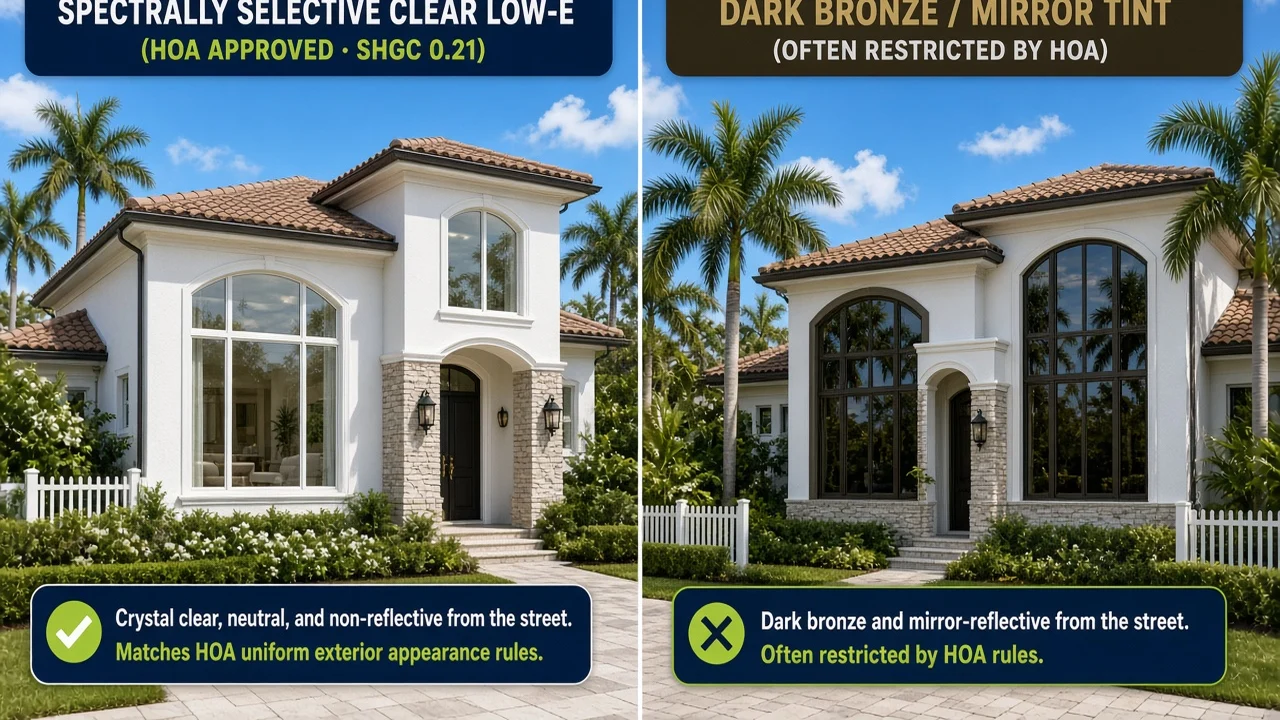
Exterior architectural comparison on a Florida white stucco home showing crystal-clear spectrally selective Low-E impact windows on the left (HOA approved, SHGC 0.21) versus dark bronze mirror-tinted glass on the right (often restricted by HOAs).HOA Curb Appeal · Clear Low-E vs. Dark Reflective Tint
Why Florida HOAs approve clear Low-E: Spectrally selective Low-E (left) looks crystal-clear and non-reflective from the street—complying with strict HOA uniform facade rules under F.S. § 720.3035(6) while still hitting SHGC ≤ 0.25 without dark bronze or mirror tint (right).

Republic's recommendation & real math

How much does Low-E glass add to impact window & door prices? (+8% to +15% upfront math)

At Republic Windows, Doors & Roofing, we always encourage our customers to add Low-E coating to all impact windows and impact doors. Upfront, adding Low-E makes your windows and doors 8% to 15% more expensive. Because you only replace windows every 15 to 20+ years, that 8%–15% addition is a tiny fraction of the price (~$5 to $11 per year per window) that every Florida homeowner should include.

2026 Florida Low-E Glass Upgrade Math (+8% to +15%) & 20-Year Amortized Cost across Republic's 4 Window Styles and Whole-Home ProjectsBased on Republic's published 2026 installed prices — includes frame, laminated glass, installation & lifetime original-owner warranty
2026 Florida Low-E Glass Upgrade Math (+8% to +15%) & 20-Year Amortized Cost across Republic's 4 Window Styles and Whole-Home Projects
Window Style / Project ScopeCommon SizeStandard Installed PriceLow-E Upgrade (+8% to +15%)Total with Low-ECost Per Year Over 20 Years
Fixed Picture Impact Window37×50 in.~$900+$72 to $135~$972 – $1,035Only ~$3.60 – $6.75 / yr for Low-E
Single-Hung Impact Window37×63 in.~$1,100+$88 to $165~$1,188 – $1,265Only ~$4.40 – $8.25 / yr for Low-E
Horizontal Roller (XO / XOX)53×50 in.~$1,250+$100 to $188~$1,350 – $1,438Only ~$5.00 – $9.40 / yr for Low-E
Casement Impact Window37×50 in.~$1,300+$104 to $195~$1,404 – $1,495Only ~$5.20 – $9.75 / yr for Low-E
Average Per-Window RangeStandard to large$800 – $1,800 ($3,000+ oversized)+8% to +15% on glass~$864 – $2,070~$4 – $13 / yr per opening
Whole-Home Window & Door Project10 to 20+ openings$12,000 – $35,000+$960 to $5,250 total$12,960 – $40,250~$48 – $262 / yr for whole-house Low-E

Why waiting to add Low-E later doesn't work: Low-E is fused or vacuum-sputtered onto the raw glass sheets at the factory before the laminated interlayer is autoclaved. You cannot 'spray on' true Low-E after installation—choosing it when ordering your windows (once every 15–20 years) is the only way to get factory NFRC performance and warranty coverage.

Verified Florida statutes & building code

How Florida HOAs and Condo Associations handle Low-E glass

Homeowners in Palm Beach (Boca Raton, Wellington, Delray Beach), Broward (Weston, Parkland, Coral Springs), Miami-Dade (Coral Gables, Aventura, Doral), Collier (Naples), and Lee County often ask how HOA and condo rules apply to Low-E glass. A board can’t refuse code-compliant impact windows, but it can set appearance rules such as frame color and tint—here is how the rules work together:

  1. 01

    1. Florida Building Code — Energy Conservation (Table R402.1.2) Sets SHGC ≤ 0.25

    Every permitted residential window and door replacement in Climate Zone 1 (Broward, Miami-Dade, and Monroe) and Climate Zone 2 (Palm Beach, Lee, Collier, Charlotte, and Sarasota) must comply with the Florida Building Code. Table R402.1.2 sets a maximum Solar Heat Gain Coefficient of SHGC ≤ 0.25. Because untreated clear laminated glass has an SHGC around 0.62, windows need either a Low-E coating or a solar tint (unless a whole-building energy calculation applies) to pass municipal building inspection.

  2. 02

    2. Florida Statute § 720.3035(6) (HB 293 — HOA Hurricane Protection Rules)

    Under Florida Statute § 720.3035(6)(a)–(b), an HOA board must adopt hurricane protection specifications that comply with the applicable building code, and may not deny an owner's application for hurricane protection that conforms to the board's specifications. At the same time, the board can require the exterior frame color, style, and glass tint to match the community's uniform appearance standards.

  3. 03

    3. Florida Statute § 718.113(5) (Condominium Hurricane Protection Rules)

    For condominiums, Florida Statute § 718.113(5) requires the board to adopt code-compliant hurricane protection specifications and states that a board may not refuse to approve an installation that conforms to those specifications. When a condo building prohibits dark bronze or reflective mirror tints so all units match from the street, a clear, spectrally selective Low-E coating lets you meet the SHGC ≤ 0.25 energy code while keeping a neutral, clear glass appearance.

  4. 04

    4. Sea Turtle Lighting Zones on the Coast (FBC § 3109 & Local Ordinances)

    On oceanfront and Gulf-front properties visible from nesting beaches (such as Miami Beach, Fort Lauderdale beach, Boca Raton, Sanibel, Marco Island, and Naples), coastal sea-turtle ordinances require 'Turtle Code' glass with a Visible Light Transmittance (VT) of ≤ 0.45 (45%). For beachfront condos and homes, Republic pairs Low-E with an association-approved Gray or Bronze turtle-code tint that meets both VT ≤ 0.45 and SHGC ≤ 0.25.

What Florida HOAs CAN regulate on your windows

  • Frame color uniformity (e.g., requiring white, bronze, or black aluminum frames to match the community exterior scheme under F.S. § 720.3035(6)).
  • Window style and colonial grid/muntin pattern on the front street elevation (e.g., matching single-hung or horizontal roller sightlines).
  • Restricting dark bronze/gray tints or mirror-reflective films when the community standard is clear/neutral glass.
  • Requiring an ARC/ARB application packet with your contractor's license (CGC1533058), insurance certificate, NFRC spec sheet, and Miami-Dade NOA / FL# drawings.

How to pass HOA review with Low-E

  • A board can't refuse code-compliant impact windows that conform to its adopted specifications (F.S. § 720.3035(6) & § 718.113(5)).
  • All HOA hurricane-protection specifications must comply with the Florida Building Code (including FBC Energy Conservation Table R402.1.2).
  • Choose a clear, spectrally selective Low-E coating when your HOA prohibits dark or reflective tints—it hits SHGC ≤ 0.25 while looking clear from the street.
  • Include the manufacturer's NFRC and NOA/FL# spec sheet in your ARC packet so the board can see the Visible Transmittance (VT) and neutral appearance.

Estimates

The Real Cost

Calculate what this project will really cost you, and your return on investment.

Pick your windows

Add a count to see the average installed price.

Average installed price, estimate, for these common sizes. Other sizes and types are quoted after a free in-home measure. The project cost below fills in from your picks; change it if you have a quote.

Your numbers

The wind or hurricane part of your homeowners premium, shown on your declarations page.

Est. monthly payment

$0.00

As low as 8.99% APR for 20 years.

Est. insurance savings / mo

$0.00

Estimate only. Assumes 10% of your windstorm premium. Your insurer's Notice of Premium Discounts shows your actual credits.

Est. electric savings / mo

$0.00

Estimate. Assumes 12% of the monthly bill, ENERGY STAR's Southern-zone average for replacing single-pane windows with ENERGY STAR certified ones (about 8% from double-pane).

Est. real monthly cost

$0.00

Payment minus the insurance and electric savings.

Est. payback

0.0 years

Project cost divided by yearly insurance and electric savings.

Estimates only. The insurance and electric percentages are assumptions, not quotes. Actual savings depend on the insurer, the home, and usage. Not a guarantee. Financing is subject to credit approval.

Questions

12 Frequently Asked Questions About Low-E Impact Glass in Florida

Direct, verified answers on how Low-E glass works, the 8%–15% cost math, why South Florida impact windows use NFRC ratings rather than ENERGY STAR, and Florida HOA rules.

What is Low-E glass and how does it work in Florida?

Low-E (low-emissivity) glass is impact window or impact door glass coated with a microscopically thin, transparent metallic silver or metal-oxide layer. In Florida’s hot climate, the Low-E coating reflects infrared solar heat back outdoors—lowering the Solar Heat Gain Coefficient (SHGC) from ~0.62 down to 0.18–0.25—while allowing 55%–65% of natural visible daylight inside and blocking 99%+ of UV rays when paired with a 0.090" laminated impact interlayer.

How much more expensive is Low-E glass on impact windows and doors?

Adding Low-E glass makes impact windows and impact doors about 8% to 15% more expensive upfront. On Republic’s standard installed prices, that equals roughly +$72–$135 on a ~$900 fixed picture window (37×50), +$88–$165 on a ~$1,100 single-hung window (37×63), +$100–$188 on a ~$1,250 horizontal roller (53×50), and +$104–$195 on a ~$1,300 casement window (37×50). Over a 15- to 20+ year lifespan, that upgrade is a tiny fraction of the total price—about $4 to $10 per window per year.

Does Republic recommend Low-E glass for all Florida homes?

Yes. Republic always encourages homeowners to add Low-E coating to all impact windows and doors. Because you only replace windows once every 15 to 20+ years, and Low-E cannot be factory-applied after the glass is manufactured, the 8%–15% upfront cost is tiny compared to 20 summers of lower air-conditioning runtime, cooler rooms next to sunny glass, and 99% UV fade protection.

Are South Florida impact windows with Low-E ENERGY STAR certified?

Usually no—and that is an important South Florida engineering truth. To get an ENERGY STAR Version 7.0 sticker in the Southern climate zone, a window must achieve both SHGC ≤ 0.23 and a U-Factor ≤ 0.32. Standard South Florida HVHZ impact windows use heavy-wall aluminum frames and a single non-insulated laminated glass unit (two panes bonded to a 0.090-inch interlayer with no air gap). Even with Low-E coating (which brings SHGC down to ≤ 0.25), a single-laminated aluminum window has a U-Factor around 0.84 to 1.02, so it does not carry an ENERGY STAR sticker. Instead, Florida building departments verify NFRC-rated SHGC (≤ 0.25) under the Florida Building Code — Energy Conservation across Climate Zone 1 (Broward, Miami-Dade, and Monroe, where U-Factor is 'NR' — Not Required) and Climate Zone 2 (Palm Beach, Lee, Collier, Charlotte, and Sarasota). Only specialized insulated laminated (IGU) windows in vinyl or thermally broken frames reach U-Factor ≤ 0.32.

Can a Florida HOA or condo board prohibit Low-E impact glass?

A board can't refuse code-compliant impact windows, but it can set appearance rules such as frame color and tint. A clear, spectrally selective Low-E usually passes, so show the board the product's spec sheet.

Does Low-E glass make my windows look dark, green, or mirrored from the street?

No, when you choose a spectrally selective clear Low-E coating. Unlike old-school dark bronze or reflective mirror tints, modern double- and triple-silver Low-E coatings transmit 55% to 65% of natural visible light (VT) and look virtually indistinguishable from clear glass from the street—which is why Florida HOAs that ban dark tints readily approve clear Low-E.

What is the difference between hard-coat (pyrolytic) Low-E and soft-coat (sputtered) Low-E on impact windows?

Hard-coat (pyrolytic) Low-E fuses a durable tin-oxide layer onto the glass while it is still molten on the float line; because it is tough enough to touch room air, it can be used on Surface #4 of a 2-ply non-insulated laminated impact window. Soft-coat (sputtered MSVD) Low-E deposits multiple microscopic silver layers in a vacuum chamber; it blocks significantly more solar heat while staying clearer (SHGC ~0.18–0.23), but it must be sealed inside the air/argon gap on Surface #2 of a 3-ply insulated laminated impact glass unit (IGU).

What SHGC rating is required by the Florida Building Code in Miami-Dade, Broward, Palm Beach, Lee, and Collier?

Under Table R402.1.2 of the Florida Building Code — Energy Conservation, both Climate Zone 1 (Broward, Miami-Dade, and Monroe) and Climate Zone 2 (Palm Beach, Lee, Collier, Charlotte, and Sarasota) require a maximum glazed fenestration Solar Heat Gain Coefficient (SHGC) of ≤ 0.25.

Does Low-E glass change the hurricane impact rating or Miami-Dade NOA / FL# approval?

No. The hurricane impact rating comes from the heavy-duty frame, glass thickness, and 0.090" PVB or SentryGlas (SGP) interlayer tested under the large-missile test: a 9-lb 2×4 at 50 ft/s (ASTM E1996 calls it Missile Level D; TAS 201 uses the same missile). Adding Low-E is an approved glazing option listed right inside the Miami-Dade NOA or Florida Product Approval (FL#).

Can I combine Low-E coating with gray, bronze, or sea-turtle tint?

Yes. On intense west-facing water views or on coastal properties subject to Florida Sea Turtle Protection lighting ordinances (which require Visible Light Transmittance ≤ 0.45), Low-E can be combined with Gray, Bronze, or Green tinted glass to reduce both glare and solar heat gain (dropping SHGC as low as 0.16–0.20).

Does Low-E glass block cell phone, Wi-Fi, or garage door signals?

Modern residential Low-E impact windows have minimal impact on everyday home Wi-Fi (which originates inside your house) and cellular reception in suburban and urban South Florida. If you live in a fringe cellular area, placing your Wi-Fi router away from exterior window frames or enabling Wi-Fi calling ensures seamless indoor signal.

What warranty covers Low-E impact windows installed by Republic?

Every Low-E impact window and door installed by Republic is backed by the manufacturer's glass and coating warranty (covering seal failure or coating peeling/delamination per PGT, ES Windows, ECO, or CWS terms) plus Republic's own lifetime, original-owner installation labor warranty.
Official sources

Primary Florida codes, statutes & building portals

Every code citation, test protocol, and statutory rule on this page comes directly from the Florida Building Code, Florida Statutes, or official county and state portals below.

  1. U.S. Department of Energy (Energy.gov) — Energy Saver: Window Types and Technologies (Low-Emissivity Coatings)Defines low-emissivity (Low-E) microscopically thin metallic coatings, thermal emissivity reduction (0.84 to 0.02–0.04), and solar heat reflection physics.
  2. Florida Building Code — Energy Conservation, 8th Edition (2023) & 9th Edition (2026), Section R402.1.2 & Table R402.1.2Mandates maximum glazed fenestration SHGC ≤ 0.25 in Climate Zone 1 (Broward, Miami-Dade, Monroe) and Climate Zone 2 (Palm Beach, Lee, Collier, Charlotte, Sarasota), with Climate Zone 1 U-Factor listed as NR (Not Required).
  3. National Fenestration Rating Council (NFRC) — Understanding NFRC Certified Window Ratings (SHGC, U-Factor, VT)Establishes NFRC 100 (U-Factor) and NFRC 200 (SHGC & Visible Transmittance) testing and temporary window certification label standards required by Florida building departments.
  4. Florida Statutes § 720.3035(6) — Architectural Control Covenants & HOA Hurricane Protection Specifications (HB 293)Requires Florida HOAs to adopt hurricane-protection specifications that comply with the Florida Building Code and prohibits denying applications that conform to those specifications.
  5. Florida Statutes § 718.113(5) — Condominium Hurricane Protection & Code-Compliant SpecificationsGoverns residential and mixed-use condominium hurricane-protection specifications and prohibits refusing unit-owner applications that conform to the board's specifications.

Financing

Pay over time

12

Months

No interest if paid in full

20

Years

at 8.99% APR

10

Years

at 6.99% APR

Lenders

  • Sunlight Financial
  • Service Finance Company
  • Upgrade
  • Renew Financial

Get Qualified

12-month offer is deferred interest: if not paid in full by the end of the promotion, interest is charged back to the purchase date. Subject to credit approval.

Project films

Hear it from our customers

Reviews and licenses

Rated 4.8, licensed and insured

Google rating

4.8

4.8 on Google

What South Florida homeowners say about their new windows and doors.

Read beyond our site

Profiles

Our business profiles on independent sites, plus the facts about our company.

Next step · Free in-home measure

24–48 hour turnaround

Get a free in-home quote

We measure every opening, verify the required design pressure and product approval for your address, and return a written, itemized quote within 24–48 hours.

  • 01
    24–48 Hr Written QuoteItemized per opening with Miami-Dade NOA / FL# & design pressures listed.
  • 02
    In-House Permit & HOA PacketLicensed under Certified General Contractor CGC1533058 — over 90% pass first inspection.
  • 03
    Zero-Pressure MeasureFree at-home measure; nothing is agreed until you sign a written contract.
Prefer to talk with a window specialist now?Call 754-800-4115
Free In-Home Quote RequestNo Obligation

Get your free quote

We beat any price — show us a written quote from a licensed contractor and we'll beat it.*

*Applies to written quotes from licensed, legitimate companies at our level or above, for the same products and scope (apples to apples).

CallGet a quote