754-800-4115Get a quote

Florida Structural Engineering Verdict

Aluminum vs. Vinyl Impact Windows in Florida: Which Is Better? (The Clear Verdict)

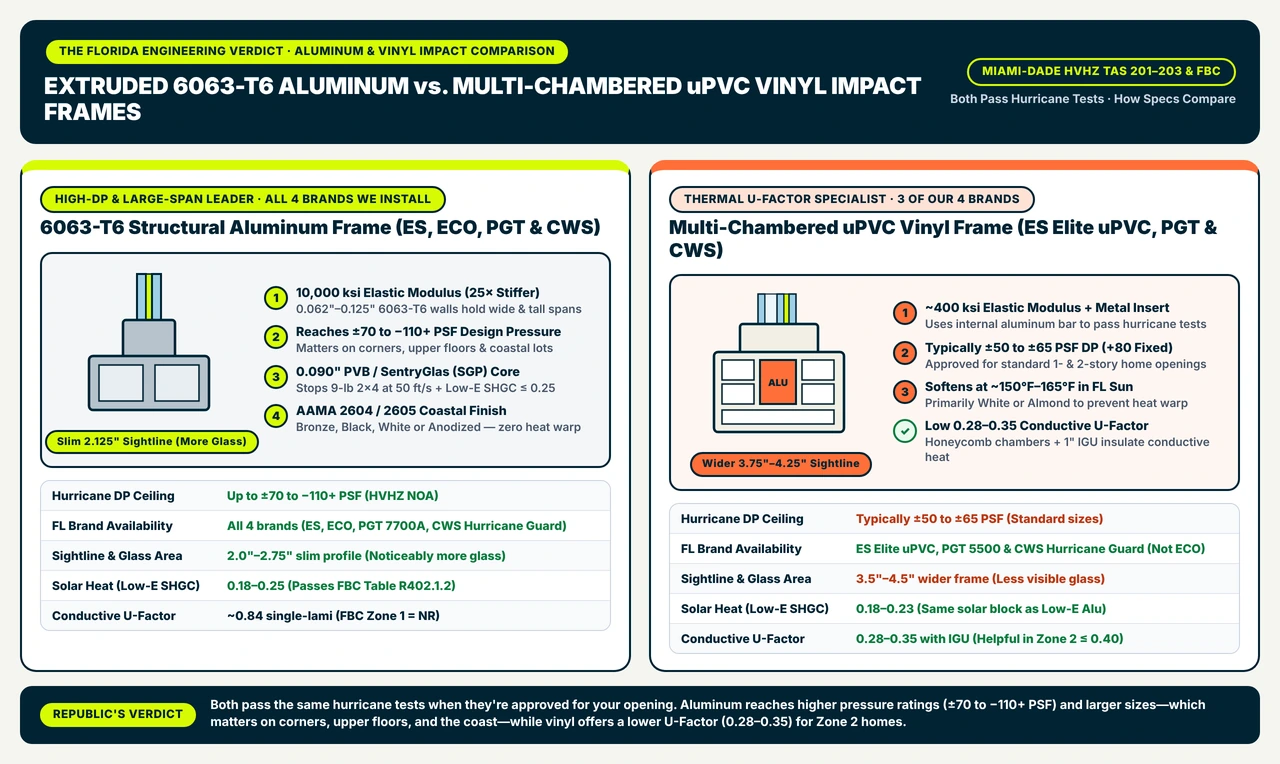
The Verdict: Both pass the same hurricane tests when they’re approved for your opening. Aluminum reaches higher pressure ratings and larger sizes, which matters on corners, upper floors and the coast. That is why most Florida impact window manufacturers build their primary high-pressure hurricane lines in heavy-wall extruded 6063-T5 / 6063-T6 structural aluminum. Across the four brands Republic installs, three offer both aluminum and vinyl impact lines—ES Windows (Elite, Prestige & Multimax Aluminum plus Elite uPVC Vinyl), PGT (PGT WinGuard Aluminum & PGT WinGuard Vinyl), and Custom Window Systems (CWS Hurricane Guard Aluminum & CWS Hurricane Guard Vinyl)—while only ECO Window Systems builds 100% in aluminum.

Extruded 6063-T6 aluminum is roughly 25× stiffer than uPVC (10,000 ksi vs. ~400 ksi elastic modulus), reaches ±70 to −110+ PSF Design Pressure in Miami-Dade HVHZ NOA testing, preserves noticeably more glass area with slim ~2.1" sightlines, and supports dark Bronze, Black, and Charcoal AAMA 2604/2605 finishes. In Climate Zone 1 (Broward, Miami-Dade, and Monroe), the Florida Energy Code (Table R402.1.2) sets U-Factor as NR (Not Required) and mandates SHGC ≤ 0.25—which aluminum paired with Low-E glass satisfies completely. Multi-chambered vinyl (ES Windows Elite uPVC, PGT WinGuard Vinyl, and CWS Hurricane Guard Vinyl) shines on single-story and two-story homes with standard-size openings and white frames, especially in Climate Zone 2 (Palm Beach, Lee, Collier, Charlotte, and Sarasota) where Table R402.1.2 sets U-Factor ≤ 0.40.

· State-certified general contractor CGC1533058 (verify on Florida DBPR).

Side-by-side structural cutaway comparison of a heavy-wall extruded 6063-T6 aluminum impact window frame rated up to DP ±70 to -110+ PSF with a slim 2.125-inch sightline versus a multi-chambered welded uPVC vinyl impact window frame with an internal metal reinforcement bar.The Clear Verdict · Aluminum & Vinyl Impact Comparison
How aluminum and vinyl impact frames compare in Florida: Both pass the same hurricane tests when they are approved for your opening. Extruded 6063-T6 aluminum is 25× stiffer than uPVC, reaches higher Design Pressure ratings (±70 to −110+ PSF) and larger sizes on corners, upper floors, and the coast, keeps sightlines slim (~2.1" vs. ~4.0" in vinyl) for noticeably more glass area, and supports dark Bronze or Black finishes under 150°F South Florida sun.
  • Most FL MakersBuild in extruded 6063-T5/T6 structural aluminum (ES, ECO, PGT & CWS)
  • ±70 to −110+ PSFAluminum HVHZ Design Pressure ceiling vs. ±50 to ±65 PSF typical on reinforced vinyl
  • 25× Stiffer6063-T6 aluminum elastic modulus (~10,000 ksi) vs. uPVC vinyl (~400 ksi) — slim 2.1-inch sightlines
  • $800–$1,800Average installed price per window across both frames ($12,000–$35,000 whole home)

Decisive 10-point engineering comparison

The Verdict: Extruded 6063-T6 Aluminum vs. Multi-Chambered Vinyl Impact Windows

Both aluminum and vinyl impact windows installed by Republic pass the same hurricane tests when they’re approved for your opening: a 9-lb 2×4 at 50 ft/s (ASTM E1996 calls it Missile Level D; TAS 201 uses the same missile) under an active Miami-Dade NOA or Florida Product Approval (FL#). Aluminum reaches higher pressure ratings and larger sizes, which matters on corners, upper floors and the coast. Here is how heavy-wall 6063-T6 aluminum and multi-chambered uPVC vinyl compare across all 10 metrics:

10-Point Florida Engineering Scorecard: Structural Aluminum vs. Multi-Chambered uPVC Vinyl Impact WindowsVerified against Miami-Dade NOA charts, FBC Energy Conservation Table R402.1.2 & FGIA/AAMA specs (Oct 2026)
10-Point Florida Engineering Scorecard: Structural Aluminum vs. Multi-Chambered uPVC Vinyl Impact Windows
Engineering / Homeowner MetricExtruded 6063-T6 Aluminum (ES, ECO, PGT WinGuard & CWS Hurricane Guard)Multi-Chambered uPVC Vinyl (ES Elite uPVC, PGT WinGuard & CWS Hurricane Guard)
1. Structural Frame Stiffness (Modulus of Elasticity)~10,000 ksi (extruded 6063-T5 / 6063-T6 aluminum alloy) — roughly 25× stiffer than uPVC; holds heavy laminated glass firmly at high pressures and wide spans.~400 ksi (unplasticized PVC) — uses multi-chambered uPVC walls paired with internal aluminum or steel reinforcement bars inside the sash chambers.
2. Maximum Design Pressure (DP) Rating±70 PSF up to −110+ PSF in Miami-Dade HVHZ testing — handles coastal Velocity Zones, high-rise condos, and ASCE 7 Corner Zone 5 negative suction.Typically ±50 to ±65 PSF (+80/−80 PSF on select fixed units like ES-V150) — passes the same hurricane tests for approved standard openings, while corners, upper floors, and wide coastal spans often require aluminum.
3. Florida Manufacturer Availability (Across Our 4 Brands)Built by most Florida impact manufacturers and all 4 brands we install: ES Windows (Elite, Prestige, Multimax), ECO Window Systems (100% aluminum), PGT WinGuard Aluminum (7700A), and CWS Hurricane Guard Aluminum.Offered by 3 of our 4 brands: ES Windows Elite uPVC (ES-V100, ES-V150, ES-V200, ES-V500), PGT WinGuard Vinyl (5500 series), and CWS Hurricane Guard Vinyl. Only ECO Window Systems does not make vinyl.
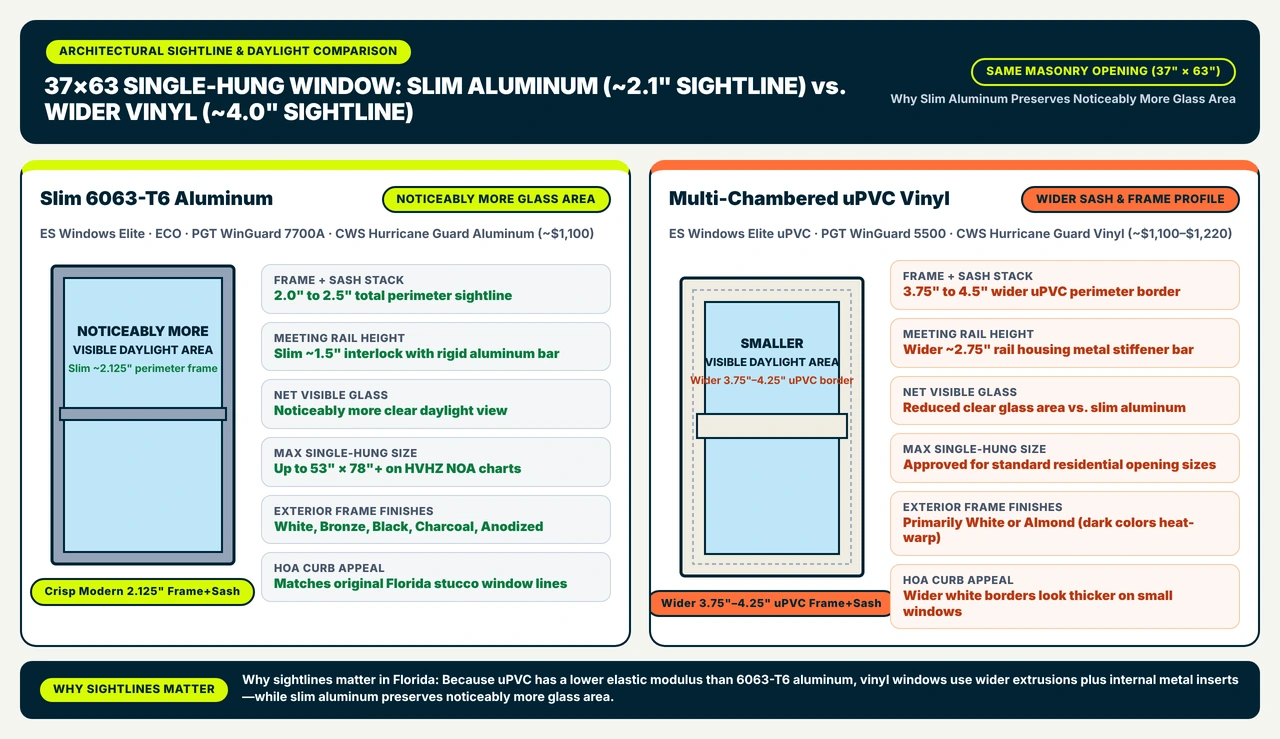
4. Frame Sightline & Visible Daylight Glass AreaSlim 2.0-to-2.75-inch frame + sash sightline — preserves noticeably more glass area on a standard 37×63 single-hung window.Thicker 3.0-to-4.5-inch frame + sash stack — wider multi-chambered uPVC walls and reinforced meeting rails reduce visible glass area compared to slim aluminum.
5. Maximum Certified Opening Sizes (NOA / FL#)Certified for wide XOX horizontal rollers (up to 111-inch×63-inch+), tall single-hung units, floor-to-ceiling picture windows, and 8 ft–10 ft sliding glass doors.Approved for standard residential width/height combinations on NOA/FL# charts; oversized spans and high-elevation openings typically require aluminum.
6. Heat Resistance & Dark Frame Colors (HOA Rules)Melting point >900°F; low thermal expansion. Standard in White, Architectural Bronze, Matte Black, Charcoal, and Clear Anodized without warping.uPVC heat-deflection point is ~150°F–165°F and expands ~2.7× more than aluminum. Primarily offered in White or Almond because dark frames absorb solar heat.
7. Solar Heat Gain Coefficient (SHGC ≤ 0.25)0.18 to 0.25 with Low-E glass — blocks 75%–82% of radiant solar heat and meets FBC Table R402.1.2 across both Climate Zones 1 and 2.0.18 to 0.23 with Low-E IGU — solar heat blockage comes from the Low-E glass coating, so both frames perform nearly identically on SHGC.
8. Conductive Thermal Insulation (NFRC U-Factor)~0.84–1.02 on standard non-insulated single-laminated aluminum (passes Climate Zone 1 — Broward, Miami-Dade & Monroe — where U-Factor is 'NR' Not Required; thermally broken/IGU aluminum reaches ~0.38–0.48).0.28 to 0.35 with a 1-inch insulated laminated glass unit (IGU) — vinyl's #1 advantage; easily passes Climate Zone 2 (Palm Beach, Lee, Collier, Charlotte & Sarasota) prescriptive U-Factor ≤ 0.40.
9. Coastal Salt-Air & Weathering DurabilityAAMA 2604 powder coat (inland) or AAMA 2605 70% PVDF / Kynar finish + 300-series stainless fasteners engineered specifically for <1 mile coastal salt spray.Fusion-welded uPVC corners never pit or oxidize in salt air, though coastal Exposure D wind pressures often require aluminum's higher DP rating on oceanfront lots.
10. 2026 Installed Price in South Florida$800–$1,800 per window avg (~$900 fixed 37×50, ~$1,100 single-hung 37×63, ~$1,250 roller 53×50, ~$1,300 casement 37×50; $12,000–$35,000 whole home).Typically within 5% to 12% of aluminum (~$880–$1,950 per window installed) because vinyl impact windows usually bundle a 3-ply insulated glass unit (IGU).

Both pass hurricane tests · Why aluminum reaches higher DP & larger sizes

4 engineering reasons most Florida hurricane installations use extruded aluminum

Both aluminum and vinyl impact windows pass the same hurricane tests when they're approved for your opening. Aluminum reaches higher pressure ratings and larger sizes, which matters on corners, upper floors, and the coast.

  • 10,000 ksi vs. 400 ksi

    1. 25× greater structural stiffness

    6063-T6 architectural aluminum has an elastic modulus of ~10,000 ksi compared to ~400 ksi for uPVC vinyl. Under 9,000 cycles of hurricane pressure (TAS 203), aluminum holds the glass bite firmly across larger spans.

  • ±70 to −110+ PSF DP

    2. Corner Zone 5 suction capacity

    Negative leeward suction is highest at building corners (Zone 5), upper floors, and coastal lots. Heavy-wall aluminum reaches −90 to −110+ PSF where reinforced vinyl typically tops out around −50 to −65 PSF.

  • Noticeably More Glass

    3. Slim 2.1-inch architectural sightlines

    Multi-chambered vinyl uses wider frame and sash profiles plus metal inserts to hold impact glass. Aluminum achieves higher strength in a crisp 2.0-inch–2.5-inch profile that gives you noticeably more glass area.

  • Zero 150°F Heat Warp

    4. Built for intense Florida sun & dark colors

    Unplasticized PVC softens around 150°F–165°F and expands nearly 3× more than aluminum. Extruded aluminum wears Bronze, Black, and Charcoal AAMA 2604/2605 finishes without warping or binding.

6063-T6 Structural Aluminum Frame (ES, ECO, PGT & CWS)

25× stiffer · Slim 2.125" sightline · Reaches ±70 to −110+ PSF

Slim 2.125" Sightline
  • 1
    10,000 ksi Modulus of Elasticity25× stiffer than uPVC; holds large spans at −110 PSF
  • 2
    Slim 2.0"–2.5" Frame + Sash StackPreserves noticeably more visible daylight glass
  • 3
    AAMA 2604 / 2605 Coastal FinishWhite, Bronze, Black or Anodized — zero heat warp

Why most FL makers lead with aluminum: Higher DP ratings and larger sizes on corners, upper floors, and the coast.

Multi-Chambered uPVC Vinyl (ES Elite uPVC, PGT & CWS)

Low 0.30 U-Factor · Reinforced chambers · Wider sightline

Wider 3.75"–4.25" Sightline
  • 1
    ~400 ksi Modulus + Metal ReinforcementPasses hurricane tests for standard openings (±50–65 PSF)
  • 2
    Wider 3.75"–4.25" Perimeter SightlineMulti-chambered uPVC walls reduce visible glass area
  • ✓
    Real Advantage: 0.28–0.35 IGU U-FactorGreat for white-frame single-story Zone 2 homes

Offered by 3 of our 4 brands: ES Windows Elite uPVC, PGT WinGuard Vinyl & CWS Hurricane Guard Vinyl (only ECO is 100% aluminum).

Side-by-side elevation comparison of a 37x63 single-hung window in slim 2.125-inch extruded aluminum preserving noticeably more visible daylight glass area versus a wider 4.0-inch multi-chambered vinyl frame.Sightline Comparison · Slim 2.1" Aluminum vs. Wider 4.0" Vinyl
Why aluminum windows look brighter inside: On a standard 37×63 single-hung window, a slim 2.125" aluminum frame + sash preserves noticeably more visible daylight glass area than a wider 3.75"–4.25" multi-chambered vinyl frame.
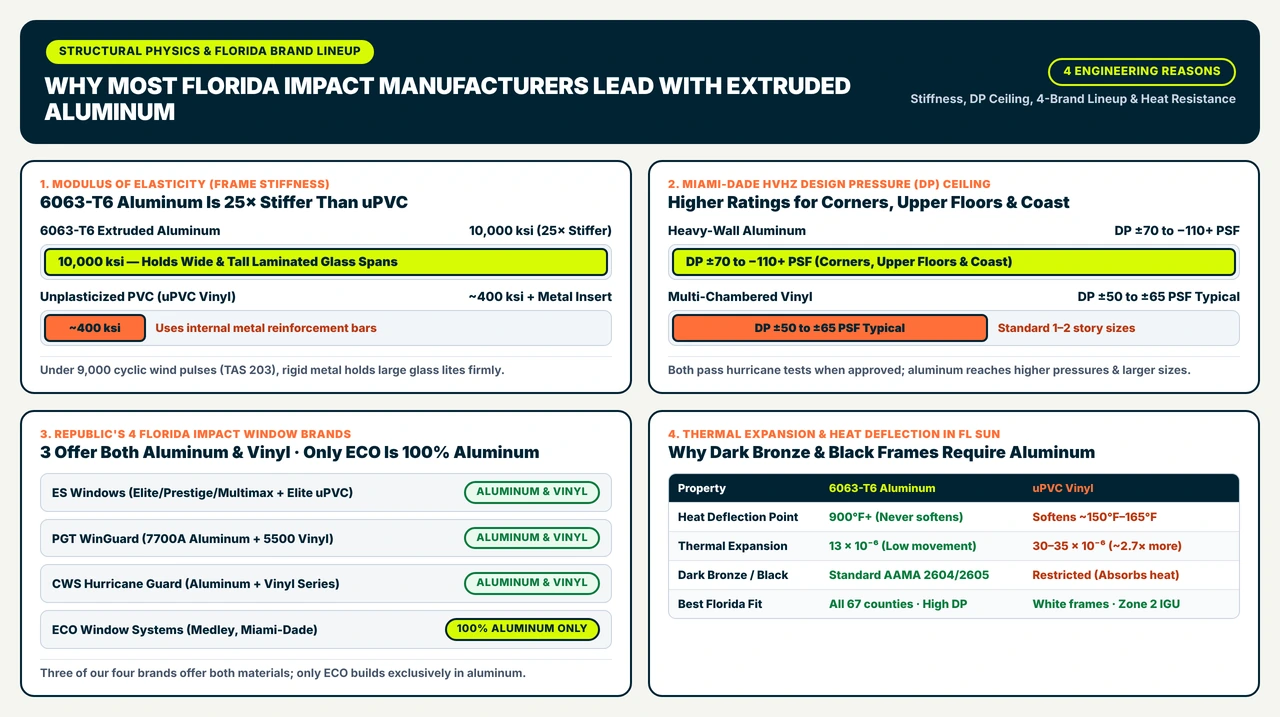
4-panel engineering chart comparing 6063-T6 aluminum versus uPVC vinyl on elastic modulus (10,000 ksi vs 400 ksi), HVHZ Design Pressure (±70 to -110+ PSF vs ±50-65 PSF), our 4 Florida brands (ES, PGT, CWS offer both; ECO is 100% aluminum), and 150°F heat deflection.Engineering Data · Stiffness, DP Ceiling, 4-Brand Lineup & Heat Resistance
Why most Florida manufacturers lead with aluminum: Both pass the same hurricane tests when approved for your opening, while 6063-T6 aluminum is 25× stiffer than uPVC, certifies up to −110+ PSF for Corner Zone 5 suction, and never softens under 150°F afternoon sun.

What our 4 manufacturers build

Why most Florida impact window manufacturers build in aluminum (and how our 4 brands compare)

Look inside the Miami-Dade NOA and Florida Product Approval (FL#) databases and a clear pattern emerges: most HVHZ-certified residential and commercial window lines are extruded aluminum. Across the four brands Republic installs—ES Windows, PGT, ECO Window Systems, and Custom Window Systems (CWS)—three manufacture both aluminum and vinyl impact lines, while only ECO is 100% aluminum:

ES Windows · Aluminum (Elite / Prestige / Multimax) & Vinyl (Elite uPVC)

ES Windows (Offers Both Aluminum & Elite uPVC Vinyl)

ES Windows is famous for its heavy-wall architectural aluminum lines—Elite (ES-EL100, ES-EL200, ES-EL300), Prestige, and Multimax—reaching DP ±75 to −100+ PSF with slim modern sightlines, and also manufactures the ES Windows Elite uPVC vinyl impact line (ES-V100 single-hung, ES-V150 fixed, ES-V200 horizontal roller, ES-V500 casement, and ES-V400 sliding door) with aluminum-reinforced chambers and 1-inch insulated laminated glass.

View ES Windows Elite brochure

ECO Window Systems · 100% HVHZ Aluminum (Only Brand Without Vinyl)

ECO Window Systems (Built in Medley, Miami-Dade — 100% Aluminum)

Manufactured right in Miami-Dade County for the High-Velocity Hurricane Zone, ECO Window Systems is the only one of our four brands that builds 100% in heavy-gauge 6063-T5/T6 extruded aluminum (no vinyl line)—delivering strong HVHZ NOA Design Pressures at an outstanding whole-home value.

View ECO Residential brochure

PGT WinGuard · Aluminum (7700A) & Vinyl (5500)

PGT Innovations (Venice, FL — Offers Both)

PGT engineers top-tier HVHZ lines in both materials: PGT WinGuard Aluminum (SH7700A, HR7710A, CA740, PW7720A) for high-DP coastal, large-span, and dark-frame projects, and PGT WinGuard Vinyl (SH5500, HR5510, CA5540, PW5520) with multi-chambered welded uPVC and 1-inch insulated glass for low U-Factor jobs.

Read PGT vs. ES Windows guide

Custom Window Systems (CWS) · Hurricane Guard Aluminum & Vinyl

Custom Window Systems (Ocala, FL — Offers Both)

Built in Ocala, Custom Window Systems manufactures both CWS Hurricane Guard Vinyl (pairing fusion-welded multi-chambered vinyl frames with insulated laminated Low-E glass to hit Climate Zone 2 U-Factor ≤ 0.40) and CWS Hurricane Guard Aluminum for higher Design Pressure and slim-sightline openings.

View CWS Hurricane Guard brochures
How Republic's 4 Impact Window Brands Compare on Aluminum vs. Vinyl AvailabilityVerified against active Miami-Dade NOA, Florida Product Approval & Republic /brochures listings (October 2026)
How Republic's 4 Impact Window Brands Compare on Aluminum vs. Vinyl Availability
Manufacturer & Plant LocationAluminum Impact LinesVinyl Impact LinesTypical HVHZ / FL# DP RangeBest Homeowner Fit
ES Windows (Barranquilla / Medley distribution)ES Windows Elite Line (ES-EL100/200/300), Prestige & Multimax AluminumES Windows Elite uPVC (ES-V100, ES-V150, ES-V200, ES-V500) & Multimax uPVCAlu: up to +90 / −110+ PSF · uPVC: ±60 PSF (+80/−80 fixed)Slim modern aluminum frames & dark HOA colors, or aluminum-reinforced Elite uPVC with 1-inch IGU.
ECO Window Systems (Medley, Miami-Dade, FL)100% Aluminum (ECO Residential 100 / 200 / 300 / 500 series)None — only brand of the 4 that is 100% HVHZ aluminum+60 / −75 PSF up to +80 / −95 PSFMiami-Dade & Broward HVHZ homes seeking rugged aluminum strength and strong value.
PGT WinGuard (Venice, FL)PGT WinGuard Aluminum (SH7700A, HR7710A, CA740, PW7720A)PGT WinGuard Vinyl (SH5500, HR5510, CA5540, PW5520 — HVHZ IGU)Alu: up to +80 / −110 PSF · Vinyl: up to ±60–65 PSFHomeowners who want a Florida-made brand in either heavy coastal aluminum or insulated vinyl.
Custom Window Systems / CWS (Ocala, FL)CWS Hurricane Guard AluminumCWS Hurricane Guard VinylAlu: up to ±75 PSF · Vinyl: up to ±55–65 PSFSingle-story Climate Zone 2 homes (Palm Beach, Lee, Collier) prioritizing white vinyl + low U-Factor, or Florida-built aluminum.

Florida Building Code — Energy Conservation (Table R402.1.2)

The energy efficiency truth: why vinyl's lower U-Factor matters less in South Florida than SHGC

When national window blogs claim vinyl is "more energy-efficient than aluminum," they are talking about U-Factor (conductive heat loss during northern winters). In Florida, most window cooling load comes from radiant solar heat measured by Solar Heat Gain Coefficient (SHGC). Here is how Low-E glass and frame material interact under Florida Building Code — Energy Conservation Table R402.1.2:

  • Climate Zone 1 · U-Factor = NR

    Broward, Miami-Dade & Monroe require SHGC ≤ 0.25 only

    In FBC Climate Zone 1 (Broward, Miami-Dade, and Monroe), Table R402.1.2 lists the window U-Factor requirement as "NR" (Not Required) and mandates SHGC ≤ 0.25. A single-laminated aluminum window with Low-E glass hits SHGC 0.20–0.25 and passes code completely.

  • Climate Zone 2 · U-Factor ≤ 0.40

    Palm Beach, Lee, Collier, Charlotte & Sarasota rules

    In FBC Climate Zone 2 (Palm Beach, Lee, Collier, Charlotte, and Sarasota), Table R402.1.2 sets prescriptive limits of SHGC ≤ 0.25 and U-Factor ≤ 0.40. Homeowners can either choose an insulated glass unit (IGU) in CWS Hurricane Guard Vinyl, PGT WinGuard Vinyl, or ES Windows Elite uPVC, or permit standard Low-E aluminum using a routine Florida R405 energy calculation.

  • Glass Dominates the Opening

    Low-E glass does the heavy lifting on solar heat

    Uncoated glass has an emissivity of about 0.84, so it readily absorbs and gives off heat. Low-E coatings cut that to 0.02–0.04, reflecting most infrared solar heat whether the perimeter frame is aluminum or vinyl.

  • NFRC Sticker vs. ENERGY STAR

    Why Florida inspectors check NFRC, not ENERGY STAR

    Standard South Florida non-insulated single-laminated aluminum windows have a U-Factor around 0.84–1.02, so even with Low-E (SHGC ≤ 0.25) they do not carry an ENERGY STAR sticker (which requires U-Factor ≤ 0.32). Municipal inspectors check the NFRC label for SHGC ≤ 0.25.

Salt spray, dark frames & association rules

Coastal salt air, AAMA 2605 finishes, dark frame colors & Florida HOA rules

Under Florida Statutes § 720.3035(6) (HOAs) and § 718.113(5) (condos), a board can't refuse code-compliant impact windows, but it can set appearance rules such as frame color, sightline width, and tint. That is another reason aluminum wins in most South Florida communities.

  1. 01

    1. Dark Bronze, Matte Black & Anodized Frames Require Aluminum

    Thousands of HOAs and condo buildings in Boca Raton, Coral Gables, Weston, Parkland, Fort Lauderdale, Miami Beach, and Naples require Architectural Bronze, Matte Black, or Clear Anodized frames. Because uPVC vinyl softens around 150°F–165°F and expands ~2.7× more than aluminum, dark-colored vinyl absorbs intense solar heat and risks warping or sash binding. Extruded aluminum in AAMA 2604 or AAMA 2605 powder/PVDF coating handles dark colors effortlessly.

  2. 02

    2. How Coastal Aluminum Defeats Salt Air (< 1 Mile from the Coast)

    While raw untreated aluminum can oxidize near saltwater, coastal-grade impact windows use AAMA 2604 super-durable polyester powder coat or AAMA 2605 fluoropolymer (70% PVDF / Kynar) finishes, 300-series stainless steel fasteners, and non-conductive composite shims that isolate the aluminum frame from alkaline concrete block—giving you both coastal corrosion resistance and ±80 to −110 PSF hurricane strength.

  3. 03

    3. HOA Sightline & Uniform Facade Rules (§ 720.3035(6) & § 718.113(5))

    In condominiums and zero-lot-line HOA communities, boards require replacement windows to match the original building's slim frame profile. Replacing a 2-inch aluminum frame with a wider 4-inch white vinyl frame changes the exterior elevation and can trigger architectural review objections.

  4. 04

    4. When Multi-Chambered Vinyl Is the Right Call

    If you own a single-story home in Climate Zone 2 (Palm Beach, Lee, Collier, Charlotte, or Sarasota) or an inland suburb, your HOA uses White window frames, your openings are standard residential sizes (such as 37×63 single-hung or 53×50 horizontal rollers), and you want a 1-inch insulated laminated glass unit (IGU) for maximum thermal U-Factor (0.30–0.35) and extra street-noise reduction, ES Windows Elite uPVC, PGT WinGuard Vinyl (5500), or CWS Hurricane Guard Vinyl is an excellent choice.

Choose Extruded 6063-T6 Aluminum if your home has:

  • High-Velocity Hurricane Zone (Miami-Dade or Broward) or coastal high-wind exposure requiring DP ±65 to −110+ PSF.
  • Wide horizontal rollers (XOX), tall floor-to-ceiling fixed picture windows, or 8 ft–10 ft sliding glass doors.
  • An HOA, condo board, or modern architectural design requiring Bronze, Black, Charcoal, or Anodized frames.
  • Standard-size bedroom or kitchen windows where you want slim ~2.1-inch sightlines and noticeably more glass area.
  • Multi-story or condo openings where negative Corner Zone 5 suction exceeds vinyl's structural ceiling.

Choose Multi-Chambered uPVC Vinyl when:

  • Your home is a 1- or 2-story inland/suburban residence with moderate Design Pressure requirements (±50 to ±60 PSF).
  • You want White (or Almond) frames and don't mind a thicker perimeter sash border.
  • Your home is in Climate Zone 2 (Palm Beach, Lee, Collier, Charlotte, Sarasota) and you want prescriptive U-Factor ≤ 0.40 via an IGU.
  • Your openings are standard residential sizes that fall comfortably inside ES Windows Elite uPVC, PGT WinGuard Vinyl, or CWS Hurricane Guard Vinyl NOA/FL# size charts.

Interactive Florida Verdict & Application Explorer

Select your home scenario to see whether Aluminum or Vinyl wins

Both Pass Hurricane Tests · Aluminum Reaches Higher DP & Larger Sizes

Extruded 6063-T6 Structural Aluminum (Built by All 4 Brands We Install)

Republic CallHIGH DP
Engineering Verdict
HIGH-DP LEADER: Heavy-Wall 6063-T6 Aluminum (ES Windows, ECO, PGT WinGuard Aluminum & CWS Hurricane Guard Aluminum)
Design Pressure (DP) & Stiffness
±70 to −110+ PSF Design Pressure · 10,000 ksi elastic modulus (25× stiffer than uPVC)
Sightlines & Opening Spans
Slim 2.0-to-2.75-inch architectural frame + sash · Preserves noticeably more visible daylight glass area
FBC Energy Code (SHGC & U-Factor)
SHGC 0.18–0.25 with Low-E glass · Passes FBC Climate Zone 1 (U-Factor NR) & Zone 2 (with IGU or R405 calc)
Colors, Coastal Finish & HOA Fit
Approved in White, Architectural Bronze, Matte Black, Charcoal & Clear Anodized — zero 150°F heat warp
Miami-Dade & Broward (170–175 mph) · Wide XOX Rollers & Picture Windows

High-Velocity Hurricane Zone, Multi-Story Condos & Oversized Openings

Republic CallALU LEAD
Engineering Verdict
ALUMINUM RECOMMENDED: Reaches higher pressure ratings & larger sizes on corners and upper floors
Design Pressure (DP) & Stiffness
Handles −85 to −110+ PSF Corner Zone 5 suction where vinyl typically tops out around ±50 to ±65 PSF
Sightlines & Opening Spans
Spans wide 111×63 XOX rollers, floor-to-ceiling picture windows & 8 ft–10 ft sliding glass doors
FBC Energy Code (SHGC & U-Factor)
Pair 7/16-inch or 9/16-inch PVB/SGP laminated glass with Low-E (SHGC ≤ 0.25) for cool interior rooms
Colors, Coastal Finish & HOA Fit
Matches slim condo & HOA facade profiles required under Florida Statutes § 718.113(5) & § 720.3035(6)
Oceanfront, Intracoastal & Barrier Islands · Exposure C / D

Coastal Homes & Condos Within 1 Mile of Saltwater

Republic CallAAMA 2605
Engineering Verdict
COASTAL PICK: AAMA 2605 (70% PVDF / Kynar) Or Anodized 6063-T6 Aluminum
Design Pressure (DP) & Stiffness
Coastal Exposure D wind loads demand ±75 to −110 PSF strength across wide waterfront openings
Sightlines & Opening Spans
Slim frames maximize ocean, bay, and canal views with noticeably more glass area
FBC Energy Code (SHGC & U-Factor)
Available with Low-E + Sea-Turtle compliant tint (≤ 45% VLT) where required by coastal lighting ordinances
Colors, Coastal Finish & HOA Fit
AAMA 2605 fluoropolymer finish + 300-series stainless hardware + composite shims prevent salt & masonry corrosion
Climate Zone 2 (Palm Beach, Lee, Collier) & White-Frame Homes

Multi-Chambered uPVC Vinyl + 1-Inch IGU (ES Windows Elite uPVC, PGT WinGuard Vinyl & CWS Hurricane Guard Vinyl)

Republic CallLOW U-FACTOR
Engineering Verdict
GREAT THERMAL FIT: Offered by 3 of our 4 brands (ES Windows, PGT & CWS — only ECO is 100% aluminum)
Design Pressure (DP) & Stiffness
±50 to ±65 PSF typical (+80/−80 fixed on ES-V150) — passes the same hurricane tests for approved standard openings
Sightlines & Opening Spans
Wider multi-chambered uPVC frame profile, best suited for standard residential window sizes
FBC Energy Code (SHGC & U-Factor)
U-Factor 0.28–0.35 + SHGC 0.18–0.23 — passes Climate Zone 2 prescriptive U-Factor ≤ 0.40 out of the box
Colors, Coastal Finish & HOA Fit
Best for communities that specify White or Almond frames and allow wider vinyl sash profiles
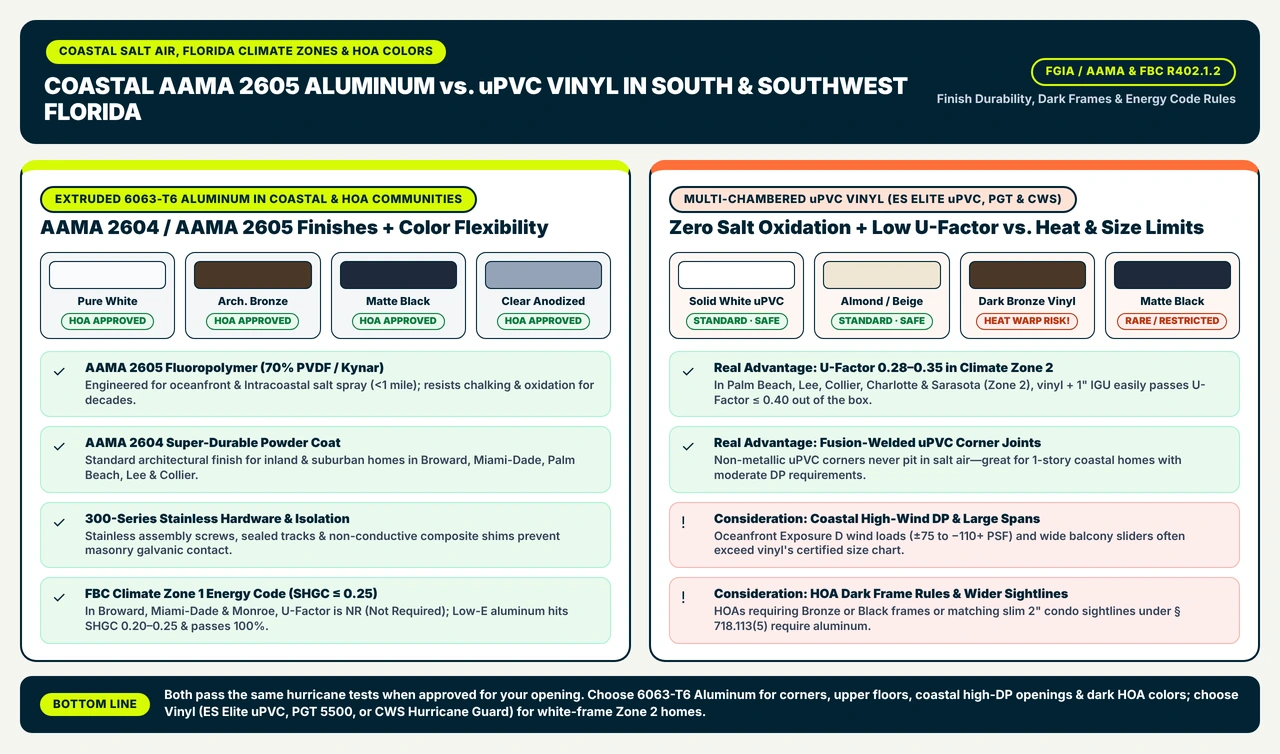
Comparison of Coastal AAMA 2604 and AAMA 2605 70% PVDF Kynar aluminum finishes in White, Bronze, Black, and Clear Anodized versus uPVC vinyl color restrictions, heat-warp risk in dark colors, and Climate Zone 1 vs Zone 2 rules.
Coastal salt air, HOA dark frames & Climate Zone 1 vs. 2: Extruded 6063-T6 aluminum with AAMA 2604 / AAMA 2605 (70% PVDF / Kynar) finish and 300-series stainless hardware handles coastal salt spray AND dark HOA frame colors (Bronze, Matte Black, Charcoal), whereas uPVC vinyl is restricted primarily to White or Almond to prevent thermal warping above 150°F.

Published October 2026 installed pricing

Aluminum vs. vinyl impact window prices across all 4 styles we install

Republic installs four impact window styles across South and Southwest Florida: single-hung, horizontal roller (XO/XOX), casement, and fixed picture windows. Standard installed prices run $800–$1,800 per window on average (some oversized or high-DP openings cost $3,000+), and whole-home projects typically run $12,000–$35,000.

2026 Installed Price & DP Comparison: Structural Aluminum vs. Multi-Chambered Vinyl Across Republic's 4 Window StylesPublished October 2026 — includes frame, laminated impact glass, municipal permit, installation & lifetime original-owner labor warranty
2026 Installed Price & DP Comparison: Structural Aluminum vs. Multi-Chambered Vinyl Across Republic's 4 Window Styles
Window Style / ScopeCommon SizeStandard Installed PriceAluminum DP & Sightline AdvantageVinyl IGU Note & Price Difference
Fixed Picture Impact Window37×50 in.~$900 installedDP up to ±80 to −115 PSF; slim ~2-inch frame maximizes pool & water views.Vinyl IGU typically +5%–10% (~$950–$990); smaller max span than aluminum.
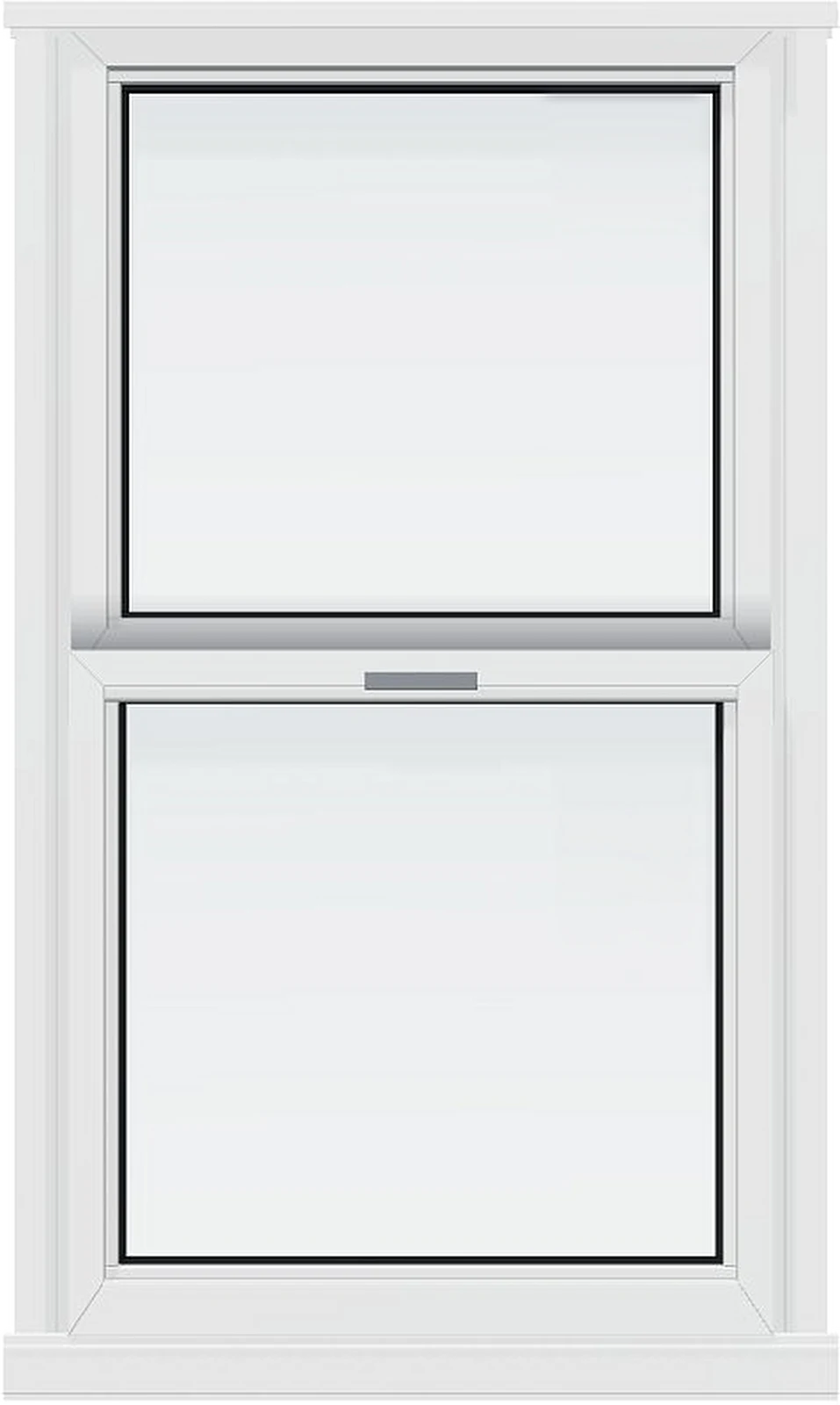
Single-Hung Impact Window37×63 in.~$1,100 installedDP ±65 to −90 PSF; slim 2.1-inch sightline preserves noticeably more visible glass than vinyl.Vinyl IGU typically ~$1,100–$1,220; thicker white frame & lower max DP.
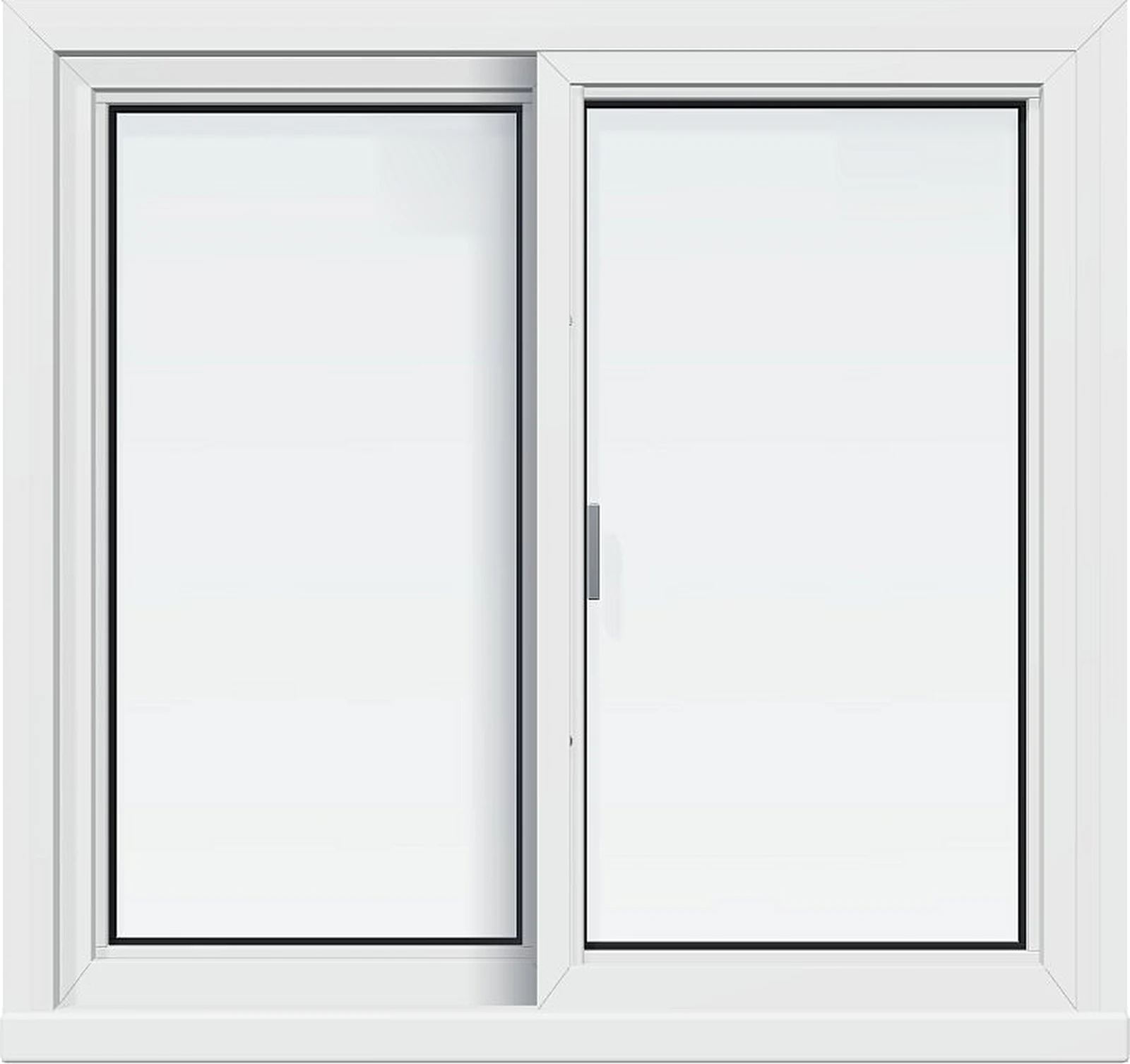
Horizontal Roller (XO / XOX)53×50 in.~$1,250 installedDP ±60 to −85 PSF; rigid aluminum meeting rail prevents wide-span sash bow.Vinyl IGU typically ~$1,280–$1,390; XOX spans are more size-limited in vinyl.
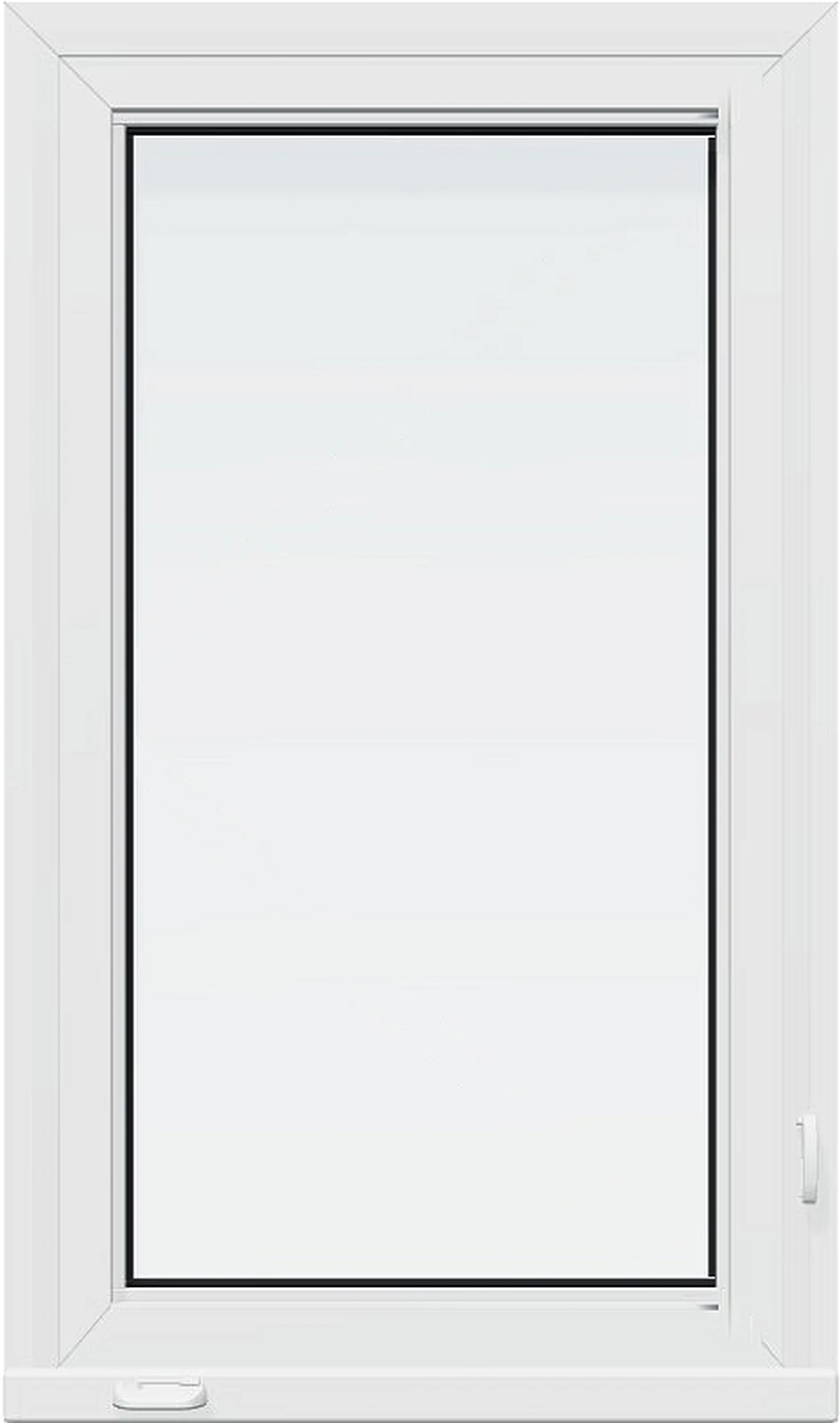
Casement Impact Window37×50 in.~$1,300 installedDP ±75 to −110 PSF; multi-point locks + rigid 6063-T6 sash excel in Zone 5.Vinyl IGU typically ~$1,350–$1,460; provides low 0.30 U-Factor + tight compression seal.
Average Per-Window InstalledStandard to large$800 – $1,800 ($3,000+ oversized)Available in White, Bronze, Black & Anodized across ES, ECO, PGT & CWS Hurricane Guard Aluminum.Available in ES Windows Elite uPVC, PGT WinGuard Vinyl & CWS Hurricane Guard Vinyl.
Whole-Home Window Project10 to 20+ openings$12,000 – $35,000Chosen on most South Florida whole-home, coastal, and condo replacements.Chosen on single-story & Zone 2 homes prioritizing white frames and U-Factor ≤ 0.40.

Can you mix aluminum and vinyl on the same quote, or compare both side by side? Yes. Because Republic is an authorized dealer for ES Windows (Aluminum & Elite uPVC), ECO Window Systems (100% Aluminum), PGT WinGuard (Aluminum & Vinyl), and Custom Window Systems (CWS Hurricane Guard Aluminum & Vinyl), our written quote can price heavy-wall aluminum right alongside insulated vinyl so you can compare the exact approval numbers, sightlines, and dollar totals opening by opening.

Estimates

The Real Cost

Calculate what this project will really cost you, and your return on investment.

Pick your windows

Add a count to see the average installed price.

Average installed price, estimate, for these common sizes. Other sizes and types are quoted after a free in-home measure. The project cost below fills in from your picks; change it if you have a quote.

Your numbers

The wind or hurricane part of your homeowners premium, shown on your declarations page.

Est. monthly payment

$0.00

As low as 8.99% APR for 20 years.

Est. insurance savings / mo

$0.00

Estimate only. Assumes 10% of your windstorm premium. Your insurer's Notice of Premium Discounts shows your actual credits.

Est. electric savings / mo

$0.00

Estimate. Assumes 12% of the monthly bill, ENERGY STAR's Southern-zone average for replacing single-pane windows with ENERGY STAR certified ones (about 8% from double-pane).

Est. real monthly cost

$0.00

Payment minus the insurance and electric savings.

Est. payback

0.0 years

Project cost divided by yearly insurance and electric savings.

Estimates only. The insurance and electric percentages are assumptions, not quotes. Actual savings depend on the insurer, the home, and usage. Not a guarantee. Financing is subject to credit approval.

Questions

10 Frequently Asked Questions: Aluminum vs. Vinyl Impact Windows in Florida

Straight engineering answers on why most Florida manufacturers build in aluminum, which brands offer both aluminum and vinyl, how Design Pressure and sightlines compare, Climate Zone 1 vs. Zone 2 energy rules, and 2026 installed prices.

Are aluminum or vinyl impact windows better for South Florida?

Both pass the same hurricane tests when they’re approved for your opening. Aluminum reaches higher pressure ratings and larger sizes, which matters on corners, upper floors and the coast. Most Florida impact window manufacturers build their primary hurricane lines in extruded 6063-T5 and 6063-T6 structural aluminum because aluminum is roughly 25× stiffer than uPVC vinyl (~10,000 ksi vs. ~400 ksi), achieves higher Design Pressure ratings (±70 to −110+ PSF vs. ±50 to ±65 PSF for vinyl), supports larger openings with slim ~2.1" sightlines (noticeably more glass area), and handles dark Bronze or Black finishes without heat-warping.

Why do most Florida impact window companies manufacture in aluminum instead of vinyl?

In the High-Velocity Hurricane Zone (Miami-Dade and Broward) and coastal Florida, windows must survive the large-missile test (a 9-lb 2×4 at 50 ft/s under TAS 201 / ASTM E1996 Missile Level D) followed by 1.5× structural overload (TAS 202) and 9,000 cyclic wind pulses (TAS 203). Because uPVC has a lower elastic modulus (~400 ksi vs. 10,000 ksi for aluminum) and softens in high heat, vinyl frames require wider walls and internal metal reinforcement bars—and reach their size and pressure limits sooner than extruded aluminum. Among the four brands Republic installs, ES Windows, PGT, and CWS manufacture both aluminum and vinyl impact lines, while only ECO Window Systems builds 100% in aluminum.

Are vinyl impact windows more energy-efficient than aluminum in Florida?

Vinyl frames have a lower conductive U-Factor (0.28–0.35 with a 1-inch insulated glass unit vs. ~0.84–1.02 on non-insulated single-laminated aluminum). However, in South Florida, most window heat gain is radiant solar heat measured by Solar Heat Gain Coefficient (SHGC). In Climate Zone 1 (Broward, Miami-Dade, and Monroe), Florida Building Code Table R402.1.2 sets U-Factor as NR (Not Required) and mandates SHGC ≤ 0.25—which an aluminum window with Low-E glass satisfies just as effectively as vinyl.

When does it make sense to choose vinyl impact windows in Florida?

Multi-chambered vinyl impact windows (such as ES Windows Elite uPVC, PGT WinGuard Vinyl 5500 series, or CWS Hurricane Guard Vinyl) make sense for single-story or two-story inland and suburban homes with standard-size openings, moderate Design Pressure requirements (±50 to ±60 PSF), white or almond frame colors, and homeowners in Climate Zone 2 (Palm Beach, Lee, Collier, Charlotte, and Sarasota) who want a 1-inch insulated glass unit (IGU) that meets the prescriptive U-Factor ≤ 0.40 table limit and adds extra acoustic insulation.

Do aluminum impact windows corrode near the ocean in South Florida?

Not when properly specified and installed for coastal exposure. Coastal aluminum impact windows use heavy-wall 6063-T6 extrusions protected by AAMA 2604 super-durable powder coat or AAMA 2605 fluoropolymer (70% PVDF / Kynar) coastal finishes, 300-series stainless steel fasteners, and composite isolation shims that prevent dissimilar-metal or masonry galvanic contact. While uPVC vinyl corners cannot oxidize in salt spray, oceanfront homes also face extreme Exposure D wind pressures (±75 to −110 PSF) that typically require structural aluminum.

How much do aluminum vs. vinyl impact windows cost in Florida in 2026?

In South Florida, standard HVHZ aluminum impact windows and impact-rated vinyl windows cost within 5% to 12% of each other. Across Republic’s lineup, installed prices average $800–$1,800 per window ($3,000+ oversized) and $12,000–$35,000 for a whole home: about $900 for a 37×50 fixed picture window, $1,100 for a 37×63 single-hung, $1,250 for a 53×50 horizontal roller, and $1,300 for a 37×50 casement.

Why can't I get dark bronze or black vinyl impact windows for my HOA?

Unplasticized PVC (uPVC) has a heat deflection temperature around 150°F to 165°F and expands roughly 2.5 to 3 times more than aluminum when heated. Under direct South Florida afternoon sun, dark bronze or matte black frames can reach surface temperatures above 160°F, causing dark uPVC extrusions to soften, bow, or bind. Extruded aluminum has a melting point above 900°F and holds dark Bronze, Black, and Charcoal AAMA 2604/2605 finishes without structural distortion.

How do frame sightlines and glass area compare between vinyl and aluminum impact windows?

On a standard 37×63-inch single-hung window, a multi-chambered vinyl impact frame and sash typically use wider extrusions around the perimeter with a thicker meeting rail, whereas a 6063-T6 aluminum impact frame and sash measure just 2.0 to 2.5 inches—giving aluminum noticeably more visible daylight glass area on every window.

Do both aluminum and vinyl impact windows qualify for Florida wind mitigation insurance discounts?

Yes. On Florida’s Uniform Mitigation Verification Inspection Form OIR-B1-1802 (Question 9), wind mitigation insurance discounts depend on every opening carrying an active Miami-Dade NOA or Florida Product Approval (FL#) tested to the large-missile test: a 9-lb 2×4 at 50 ft/s (ASTM E1996 calls it Missile Level D; TAS 201 uses the same missile)—regardless of whether the frame is aluminum or vinyl.

Which aluminum and vinyl impact window brands does Republic install?

Republic installs four Florida-approved brands, three of which manufacture both aluminum and vinyl impact windows while only ECO Window Systems is 100% aluminum: ES Windows (Elite, Prestige, and Multimax Aluminum plus Elite uPVC ES-V100/V150/V200/V500 Vinyl), PGT WinGuard (PGT WinGuard Aluminum 7700A and PGT WinGuard Vinyl 5500 series made in Venice, FL), Custom Window Systems / CWS (CWS Hurricane Guard Aluminum and CWS Hurricane Guard Vinyl made in Ocala, FL), and ECO Window Systems (100% HVHZ Aluminum made in Medley, Miami-Dade). Every installation is backed by Republic's lifetime, original-owner labor warranty.
Official sources

Primary Florida codes, statutes & building portals

Every code citation, test protocol, and statutory rule on this page comes directly from the Florida Building Code, Florida Statutes, or official county and state portals below.

  1. Miami-Dade County Product Control Search — Notices of Acceptance (NOA) & HVHZ TAS 201, TAS 202, TAS 203 ProtocolsOfficial database verifying maximum certified opening sizes, Design Pressure (PSF) limits, and frame extrusion drawings for aluminum and vinyl impact windows.
  2. Florida Building Code — Energy Conservation, 8th Edition (2023) & 9th Edition (2026), Table R402.1.2Establishes Climate Zone 1 (Broward, Miami-Dade, Monroe: SHGC ≤ 0.25, U-Factor NR) and Climate Zone 2 (Palm Beach, Lee, Collier, Charlotte, Sarasota: SHGC ≤ 0.25, U-Factor ≤ 0.40) fenestration standards.
  3. National Fenestration Rating Council (NFRC) — NFRC 100 (U-Factor) & NFRC 200 (SHGC & Visible Transmittance)Standardized thermal test procedures comparing non-insulated single-laminated aluminum, thermally broken aluminum, and multi-chambered uPVC vinyl with insulated glass.
  4. Fenestration and Glazing Industry Alliance (FGIA / AAMA) — AAMA 2604 & AAMA 2605 Architectural Aluminum Finish SpecificationsDefines super-durable powder coating (AAMA 2604) and 70% PVDF / Kynar fluoropolymer coatings (AAMA 2605) for South Florida UV and coastal salt-spray resistance.
  5. Florida Building Commission — Statewide Product Approval Search (floridabuilding.org BCIS)Statewide verification of FL# product approvals, HVHZ designations, and installation anchor schedules across PGT, ES Windows, ECO Window Systems, and CWS.
  6. Florida Statutes § 720.3035(6) & § 718.113(5) — HOA & Condominium Hurricane Protection & Appearance RulesConfirms that boards cannot refuse code-compliant impact windows while allowing community architectural standards for frame color, sightline profile, and tint.

Financing

Pay over time

12

Months

No interest if paid in full

20

Years

at 8.99% APR

10

Years

at 6.99% APR

Lenders

  • Sunlight Financial
  • Service Finance Company
  • Upgrade
  • Renew Financial

Get Qualified

12-month offer is deferred interest: if not paid in full by the end of the promotion, interest is charged back to the purchase date. Subject to credit approval.

Project films

Hear it from our customers

Reviews and licenses

Rated 4.8, licensed and insured

Google rating

4.8

4.8 on Google

What South Florida homeowners say about their new windows and doors.

Read beyond our site

Profiles

Our business profiles on independent sites, plus the facts about our company.

Next step · Free in-home measure

24–48 hour turnaround

Get a free in-home quote

We measure every opening, verify the required design pressure and product approval for your address, and return a written, itemized quote within 24–48 hours.

  • 01
    24–48 Hr Written QuoteItemized per opening with Miami-Dade NOA / FL# & design pressures listed.
  • 02
    In-House Permit & HOA PacketLicensed under Certified General Contractor CGC1533058 — over 90% pass first inspection.
  • 03
    Zero-Pressure MeasureFree at-home measure; nothing is agreed until you sign a written contract.
Prefer to talk with a window specialist now?Call 754-800-4115
Free In-Home Quote RequestNo Obligation

Get your free quote

We beat any price — show us a written quote from a licensed contractor and we'll beat it.*

*Applies to written quotes from licensed, legitimate companies at our level or above, for the same products and scope (apples to apples).

CallGet a quote