Short answers to what homeowners ask most about the interlayer inside laminated impact glass.
What is the difference between PVB and SGP impact glass?
Both are laminated glass: two lites bonded to a polymer interlayer. PVB (polyvinyl butyral) is a flexible film. SGP (SentryGlas) is an ionoplast that Kuraray rates about five times stronger and up to 100 times stiffer than conventional PVB.
Is SGP better than PVB for hurricane windows?
Not automatically. Both are used in impact glass that passes large-missile testing. SGP adds stiffness, clarity and edge durability, which helps with large glass and demanding designs. What matters is that the complete window, with its specific glass make-up, is tested and approved.
Does PVB impact glass meet Miami-Dade requirements?
Yes, when it is part of an approved product. Eastman lists 0.090 in. Saflex, 0.100 in. Saflex HP and 0.075 in. Saflex Storm glass make-ups for large-missile TAS 201/203 and ASTM E1996 testing, and Saflex HP has a Miami-Dade Component NOA. Check the window itself on the NOA & FL approvals page.
Is SGP more expensive than PVB?
Yes. The Southern California Glass Management Association notes SGP is typically more expensive than other laminates, while PVB's lower cost is one reason it is the most common interlayer. How much more depends on the glass size, make-up and product.
Does SGP glass turn yellow?
Kuraray reports SentryGlas starts with a Yellowness Index of 1.5 or less, compared with 6 to 12 for PVB alternatives, and says it is much less vulnerable to yellowing over time.
What happens when laminated impact glass breaks?
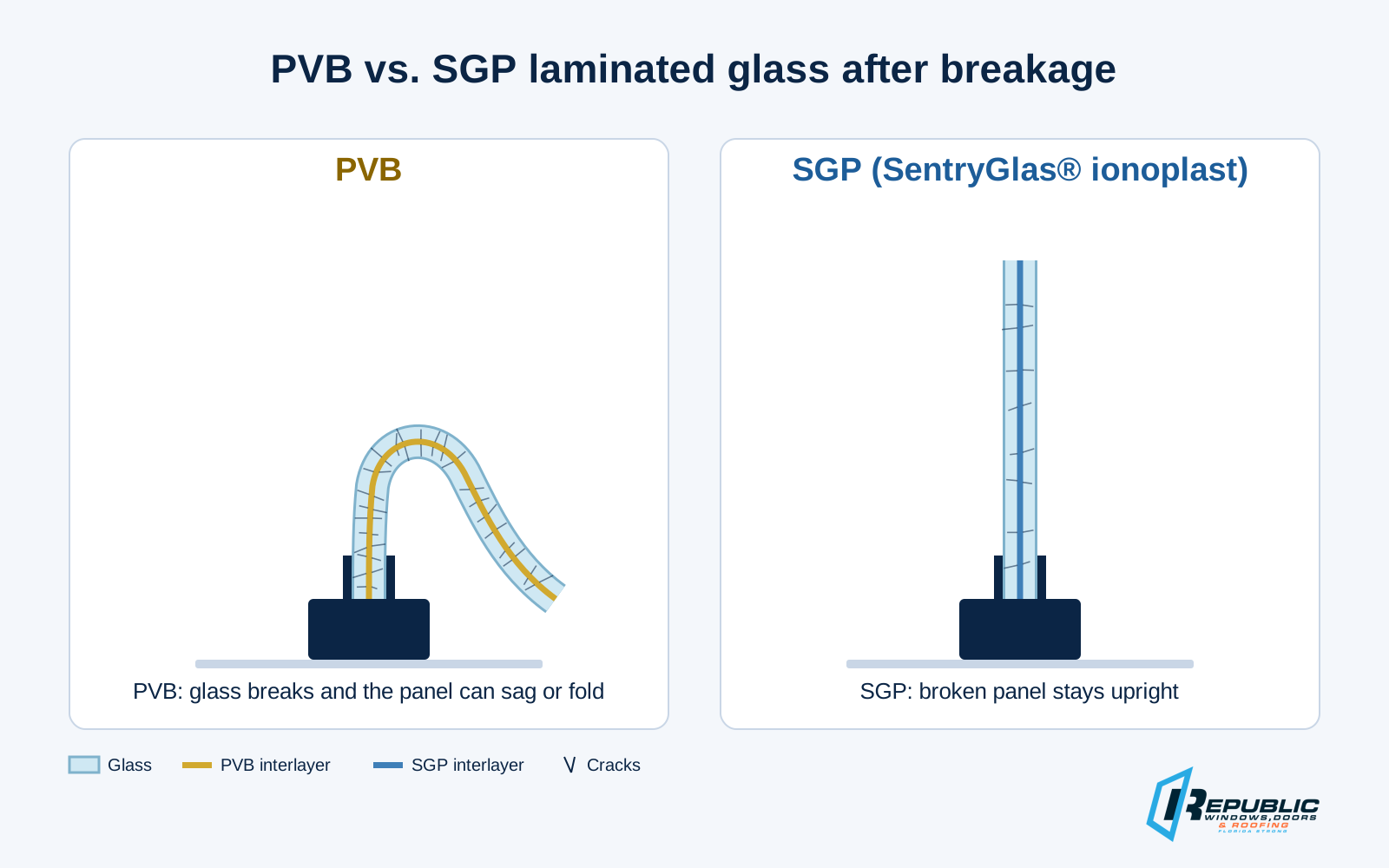
The glass may crack, but the fragments stay bonded to the interlayer, which resists penetration. The SCGMA notes that if both lites break, PVB will not remain rigid and may fold in the opening if not properly supported, while SGP is used where the barrier must stay in place after both lites break.
Which interlayer is better at exposed or wet glass edges?
SGP. The SCGMA advises against common PVB where the laminate has prolonged moisture exposure because of possible edge degradation, and Kuraray reports PVB laminates showed edge clouds after 500 hours of salt spray while SentryGlas samples stayed unchanged.
Do both interlayers block UV?
Yes. The SCGMA says laminated glass interlayers inherently filter 99% of harmful UV radiation, and Eastman says Saflex Storm filters more than 99% of UV rays.
How thick is the interlayer in impact glass?
Eastman says a typical large-missile system uses PVB at least 0.090 in. (2.29 mm) thick, and a typical small-missile system (above 30 ft) uses about 0.060 in. (1.52 mm). Kuraray supplies SentryGlas sheet at 0.89, 1.52 and 2.28 mm.
Can I choose SGP or PVB for my new windows?
Only within what the product is approved for. Each approved window is tested with a specific glass make-up, so ask which interlayer is in the approved glass option you are quoted. Call us at 754-800-4115 or request a free quote.

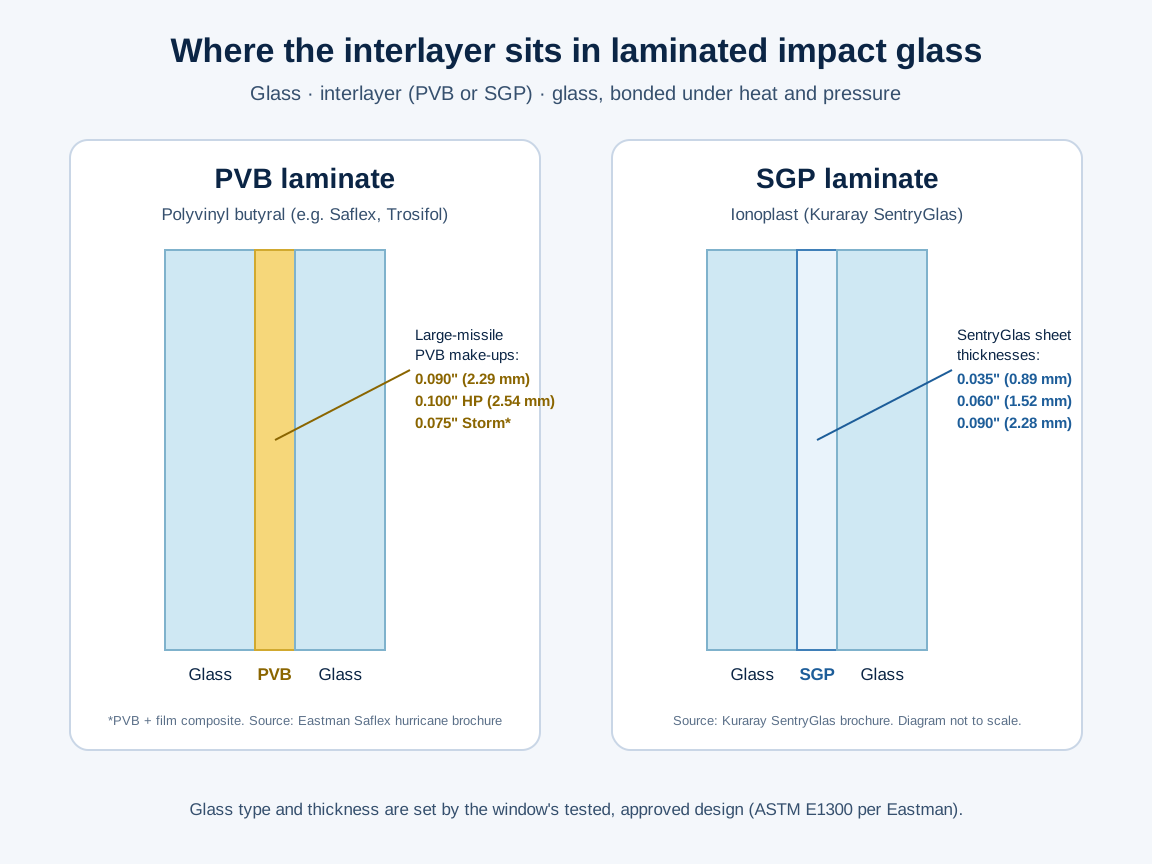 Glass · Interlayer · Glass