Hurricane-Proof Windows: What They Are and What They Actually Do
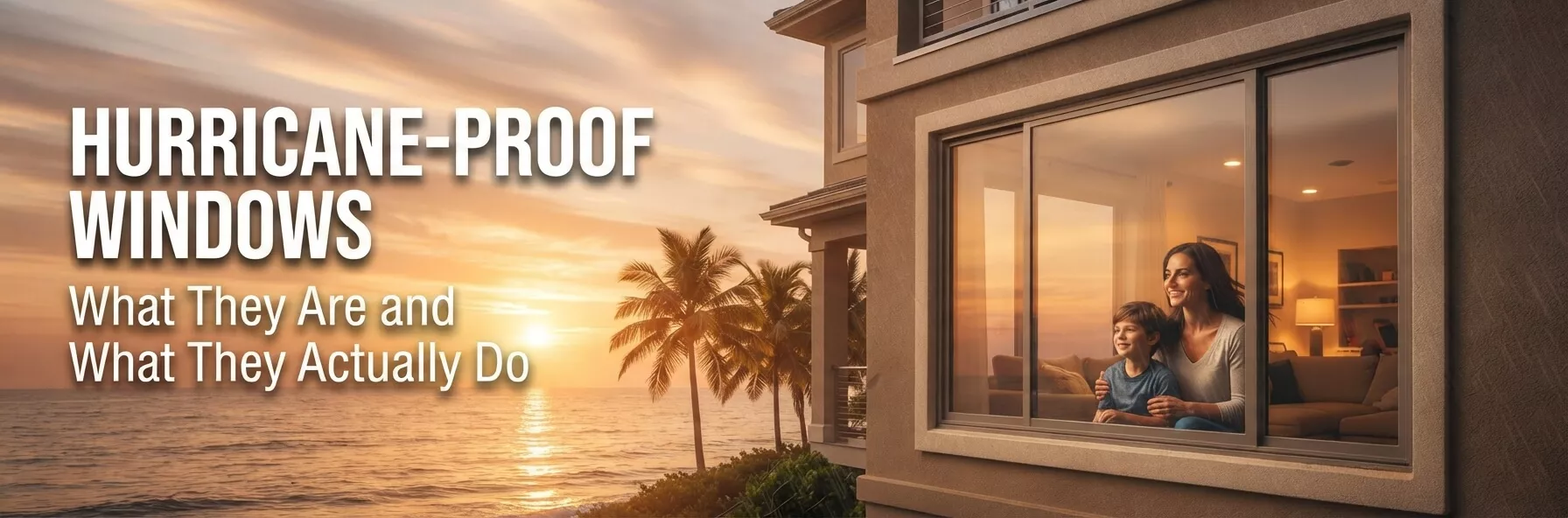
Hurricane safe windows are more aptly called impact resistant windows and are designed to protect homes from strong storms. They use laminated glass, stronger frames and tested construction to withstand the strain of wind and flying debris. There is no such thing as a storm-proof window but when correctly built, impact windows can prevent breakage, limit wind-driven rain and assist protect the interior of your home during today’s hurricanes and tropical storms.
Are windows ever truly hurricane-proof?
No, window is really hurricane proof . Under any conditions . Impact-resistant windows are built and tested to withstand certain levels of wind pressure and impact from debris, although damage can still occur under extreme conditions. In South Florida, shop for materials that have been tested and approved for the necessary storm criteria and have them professionally installed. For optimal function, it must be properly framed, installed and constructed around.
No, and no manufacturer promises that in the documentation, only in advertising.”Hurricane-proof” means a window that a hurricane can not harm. The standards are not worded that way, and no product is tested to that claim. Impact windows are tested to specified missile weights at specific speeds . Then they are tested to specific pressure loads . A passing window proved it can hang tough in those conditions. Anything over that is not what anybody was tested on.
What windows are actually rated to do is stay in the hole. If you hit the glass with anything heavy it should fracture . What important is that the fractured glass is still attached to its interlayer, and the unit is still fixed to the wall. An open breach turns a storm into structural damage. That’s how roofs come off. Wind comes in a house and pushes against the roof and the walls simultaneously while the storm is pushing in.
So the right description is an impact window can break and still accomplish its job. It could have to be replaced after a really bad storm. Your house will be standing motionless.
And there are boundaries to be openly stated. Impact windows do not protect from flooding or storm surge. They don’t compensate for an unsecured garage door, the most typical failure point on a South Florida home. And a specified window for your neighbour’s inland house may be under-rated for your seaside corner opening. Impact-resistant glass is not the only approved way to protect an opening. Code-approved hurricane shutters pass the same impact testing and earn the same insurance credit, and for some homes they are the better answer.
How impact-resistant windows are built?
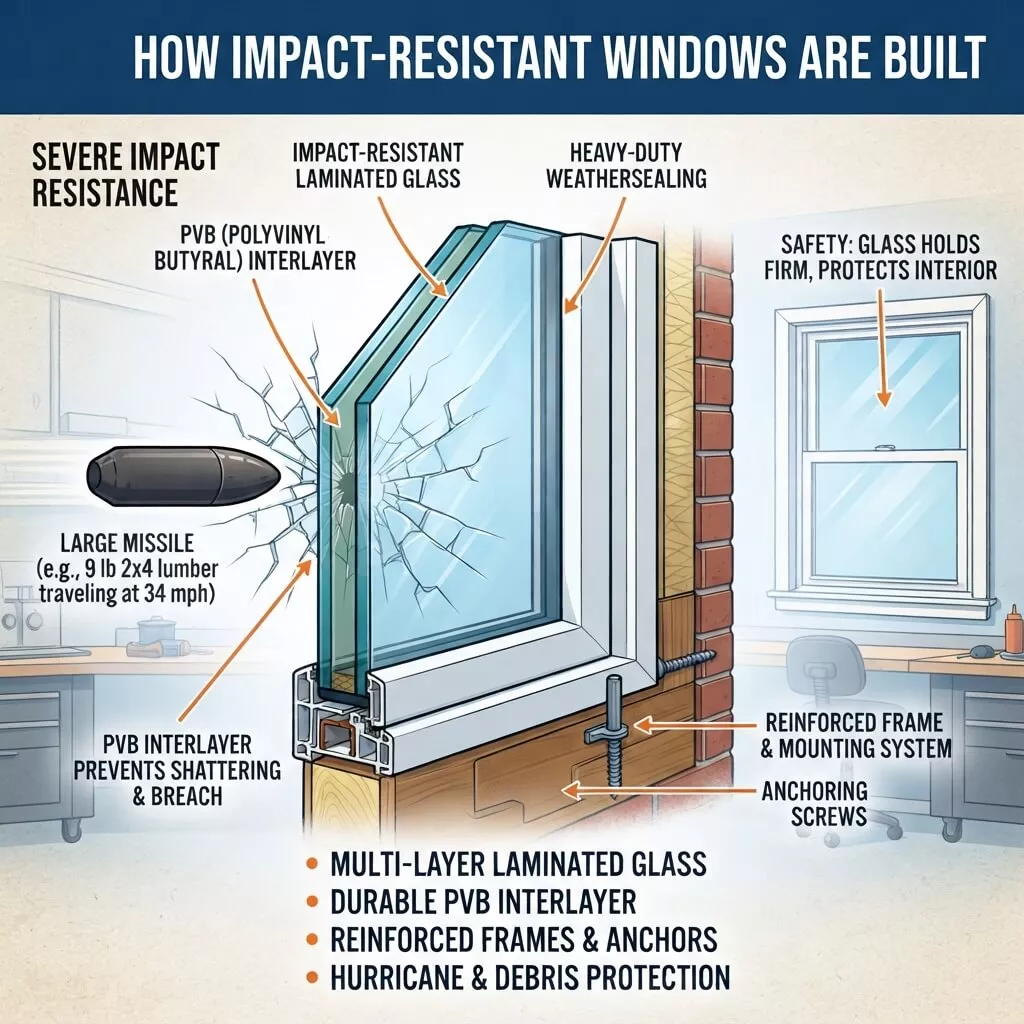
They usually use laminated glass along with sturdy interlayers, reinforced frames and secure fastenings methods. The glass is intended to withstand impact and the interlayer helps retain broken fragments together instead of creating an opening. Frames shall be constructed of reinforced aluminum, vinyl or other suitable material. These components are assembled together to form a window assembly that is designed to withstand wind pressure and flying debris.
It’s a two-part job: laminated glass that holds together when it fractures, and a framing system strong enough to retain the glass in the wall.
Laminated glass and the interlayer
Normal glazing does not behave at all like laminated impact glass, which is two sheets of glass permanently bonded together with a plastic interlayer by heat and pressure to make a single unit.
The active ingredient is the interlayer. The most common is polyvinyl butyral, or PVB, and a stiffer ionoplast substance is utilized where higher performance is required. So when anything hits the glass, the panes break but the pieces stay bonded to the interlayer and don’t fall out of the frame. Impact glazing for big missile applications generally employs an interlayer on the order of 0.090 inch thick, which is far heavier than the film used in vehicle windshields operating on the same principle.
That’s also the reason impact glass appears different when it fails. A toughened window explodes into pellets, clearing the entrance. A spiderweb fracture appears in a laminated window and it stays still, unsightly, but sealed.
Laminated glass is not the same as double pane insulated glass and the two are commonly confused on estimates. Insulated glass is a space of air or gas between the panes to provide thermal performance. Nothing holds the panes together when impacted . Many impact windows are insulated and laminated. Insulated alone provides you zero impact resistance.
Frame and anchoring
The glass unit is held to the building by a frame and anchors . It is the frame and anchors that fail more often than the glass .
Impact window frames, aluminum or reinforced vinyl, are made heavier than conventional frames to resist deflection under wind stress and to keep the glazing in place through the pressure cycling following an impact. Aluminum has higher design pressures and smaller sightlines, making it the material of choice in South Florida coastal construction.
Installations fail at the anchor point. With every product approval it is precisely defined how the window may be fastened: which anchor type, size, spacing, edge distance, embedment depth and into which substrate it is being secured. Those specs are part of the approval, not a request from the manufacturer. A window properly rated but fitted with the wrong anchors is not a rated assembly – it will not pass inspection if the inspector checks, and it will not hold in a storm whether anyone checked or not.
That’s the part of the job you don’t see till the trim is installed, and it’s the major reason that installer choice is as important as product choice.
How impact windows are tested?
Impact windows undergo laboratory testing that replicates hurricane conditions. The testing process may involve pressure cycles that simulate strong winds, followed by repeated impacts from specific debris. Product performance specifications must satisfy applicable standards for structural pressure, air, water, and impact resistance. The certification and approval documents serve to verify that a window assembly has successfully completed the necessary tests for its intended use.
Impact certification is a two-stage sequence, and the second stage is the one most product descriptions leave out. A window must survive a projectile strike and then survive hours of simulated wind pressure with the damage already done.
Large missile impact test
The large missile test fires a nine-pound 2×4 at the window at approximately 50 feet per second, around 34 miles per hour — as a proxy for the structural debris that causes real failures.
The missile is fired at multiple points on the unit, including the centre of the glass and near the corners, where the glazing is most vulnerable. Large missile testing applies to openings within roughly 30 feet of grade, which covers every window on a typical one- or two-storey home. Above that height, small missile testing using high-velocity steel projectiles applies instead, representing roof gravel carried aloft.
Something counterintuitive is worth stating: the missile is deliberately slow and heavy rather than fast and light. Real storm damage is caused by big objects moving at moderate speed, not small objects moving fast.
Cyclic pressure testing
After the impact, the damaged window goes into a pressure chamber and is subjected to thousands of alternating positive and negative pressure cycles, simulating the sustained wind that follows the debris.
This is the stage that separates rated windows from strong-looking ones. A cracked window still has to hold against hours of wind pushing and pulling on a compromised unit. Miami-Dade’s protocol for this is TAS 203; the national equivalent sits within ASTM E1886 and E1996. A window that survives the 2×4 but opens up during cycling does not get approved.
The design pressure rating on the label comes from this phase. It tells you the pressure load the assembly withstood, in pounds per square foot.
On the “200 mph windows” claim: design pressure is measured in pressure, not wind speed, and converting between them depends on building height, exposure and the position of the opening. Any single mph figure attached to a window is an approximation at best. Ask for the DP rating and the approval number instead, those are the numbers on the paperwork.
How to read a Miami-Dade NOA, a Florida Product Approval and a DP rating →
What impact windows ratings to look for in South Florida?
South Florida homeowners should seek impact windows with Florida Product Approval or Miami-Dade County approval when applicable, and performance ratings suitable for the property. Note the certified design pressure, impact certification, water resistance and the fully tested assembly. The selected window must meet local building-code standards for the project’s location and installation conditions, and your contractor should confirm this.
There is no one correct answer for each location, the rating you need varies on the county you are in.
In Miami-Dade and Broward, the so-called High Velocity Hurricane Zone, windows must have a Miami-Dade Notice of Acceptance, or NOA, examined under Miami-Dade’s own criteria. It’s the most stringent product approval in the country.
In Palm Beach, Collier and Lee, windows are Florida Product Approved, and you will be provided with a FL number that corresponds to the design wind speed for your address. Products approved by the NOA are also usually accepted in these counties. The contrary is not true, which is why a FL-only product cannot be used on a Miami-Dade or Broward work.
Beyond the form of approbation, three things should present on any quote worth considering:
There is a design pressure for each opening, not one number for the house. Corners, gable ends and upper levels take on more load than a window in the middle of a wall on the ground floor. Your permit drawings show pressures opening by opening and the products have to meet or beat them individually.
Confirmation that the approval is for your true sizes. Approvals are granted for certain combinations up to specific maximum dimensions. A product line may be totally approved, but the big unit you desire for the living room is outside what was tested.
“Valid, current approval number. You can search Florida Product Approvals at floridabuilding.org and Miami-Dade NOAs using the county’s product control database. Yes approvals do expire and get amended . The number on your quote should be live today .
Republic obtains HVHZ permits from Miami-Dade, Broward, Palm Beach, Collier and Lee counties, and linking approvals to openings is something we do on every work rather than something we search up when asked. If you have a competing quote, we will compare the approval numbers to your openings.
Hurricane-proof windows vs. shutters vs. plywood
Impact windows are permanent storm protection that doesn’t require homeowners to install panels before every storm. Hurricane shutters could cost less upfront and provide some protection, but many need deployment and storage. Plywood is cheap and available, but gives less constant protection and does require some preparation. Impact windows professionally installed provide long-term protection for convenience, security, durability and everyday performance.
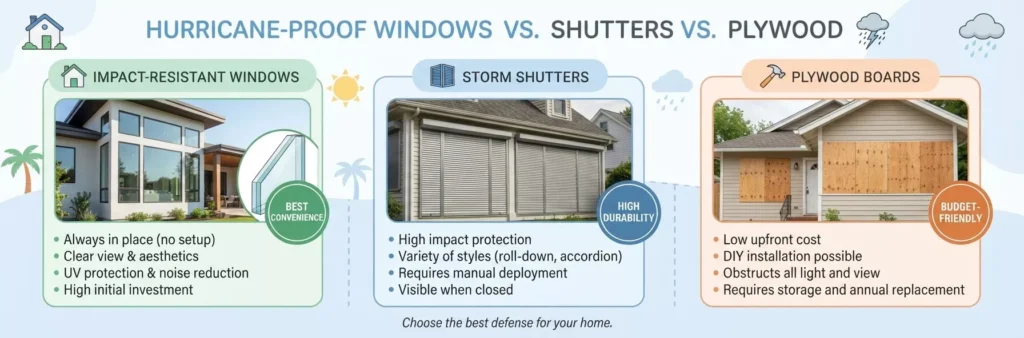
All three are attempts to prevent a break in an opening. They are not the same thing.
Impact windows are permanently installed, always down. No putting up, no taking down, no storage and no decision making when a storm is three days away and you’re not at home. “They’re the most expensive up front and you have to replace the whole window unit. They work every day of the year also, which the other two don’t.
Hurricane shutters offer the same code requirement of opening protection at a reduced cost, and may be installed to existing windows without the expense of replacing windows. The trade-off is in deployment: Someone has to install or close them before every storm and remove them after, and a shutter left down is a gloomy chamber. Accordion and roll-down systems take the burden off; panel systems don’t.
Plywood is no protection. It is not an approved opening protection system, it does not get any insurance wind mitigation credit, and it does not meet code as a permanent solution. Plywood over a window is an emergency measure for someone out of better options, it may assist and it may not, and how it works depends completely on the thickness, the fastener type and how it was attached in a rush.
The practical framing: both shutters and impact windows are valid options, and the decision comes down to how you want to live with the protection. Plywood is what you do when you made not a choice.
One planning point if you’re considering a state grant: If you currently have approved protection on that opening, My Safe Florida Home will generally not pay replacing existing code-compliant shutters with impact windows.
What impact windows do beyond storms?
Impact windows provide advantages beyond storm protection. Laminated construction can help increase home security, reduce outside noise, filter some UV radiation and help keep more acceptable internal temperatures. If placed appropriately, they can help reduce drafts and enhance energy efficiency. That’s because impact windows offer South Florida homes a combination of daily comfort, durability and security and storm protection, making them a smart long-term investment.
The storm performance is why people buy them. The daily performance is why people say they would do it again.
- Noise. Laminated glass damps sound transmission substantially better than single-pane or standard double-pane glazing, because the interlayer absorbs vibration rather than passing it through. Homes near a highway, a flight path or a busy street notice this immediately and permanently.
- UV. The interlayer blocks the large majority of ultraviolet light, which is what fades hardwood floors, rugs, artwork and furniture. This is a property of the lamination itself, not an add-on coating.
- Security. A laminated window is genuinely difficult to get through. Breaking the glass does not open the hole, the interlayer holds and an intruder is left hammering at a cracked but intact barrier in full view of the street. Ordinary glass takes one strike.
- Insurance. Florida law requires residential insurers to provide premium credits for verified wind mitigation features, and impact-rated opening protection is one of them. The credit is documented on the state’s Uniform Mitigation Verification Inspection Form, OIR-B1-1802, completed by a licensed inspector. How much you save varies by carrier, by county and by how much of your home is protected, worth noting that partial opening protection often reduces or eliminates the credit entirely.
- Energy. Impact windows are commonly built with Low-E coatings and insulated glass units, which reduce cooling load. The energy benefit comes from those features rather than from the lamination, so ask what glass package you are actually being quoted.
Frequently Asked Questions
Are windows really hurricane-proof?
No. No window is tested or certified as hurricane-proof, and the term does not appear in any building code or testing standard. The accurate term is impact-resistant: the window is rated to survive a specific impact and a specific pressure load while remaining in the opening. The glass can crack; the opening stays sealed.
Can impact windows break?
Yes. Impact windows are designed to crack rather than to be unbreakable. The laminated interlayer holds the fractured glass together so the unit stays in the frame, which is what prevents storm pressure from entering the house. A window that cracks during a storm has performed correctly and will need replacing afterward.
What wind speed can impact windows withstand?
There is no single answer, because impact windows are rated by design pressure in pounds per square foot rather than by wind speed. Converting pressure to miles per hour depends on building height, exposure and the position of the opening, so any specific mph claim is an approximation. Ask for the design pressure rating and the approval number instead.
How are impact windows made?
Two panes of glass are bonded to a plastic interlayer, usually PVB, under heat and pressure, producing laminated glass that holds together when fractured. That glazing is set into a reinforced aluminum or vinyl frame and anchored to the structure using the fastener type, spacing and embedment specified in the product’s approval. The anchoring is part of the rating.
How are impact windows tested?
In two stages. A nine-pound 2×4 is fired at the window at roughly 50 feet per second, then the damaged unit is subjected to thousands of alternating pressure cycles simulating sustained storm wind. Passing both stages earns the approval. Windows above roughly 30 feet are tested against small high-velocity projectiles instead of the 2×4.
Are impact windows better than hurricane shutters?
Both satisfy the code requirement for opening protection, so this is a question of how you want to live with it. Impact windows are permanently deployed and add noise, UV and security benefits year-round, at higher cost. Shutters cost less and can be added to existing windows, but require deployment before every storm.
Is plywood enough to protect my windows in a hurricane?
No. Plywood is not an approved opening protection system, does not satisfy code as a permanent solution, and earns no insurance wind mitigation credit. Its performance depends entirely on panel thickness, fastener choice and installation quality. Treat it as a last-resort emergency measure, not protection.
Do impact windows lower my insurance?
Florida law requires residential insurers to give premium credits for verified wind mitigation features, and impact-rated opening protection qualifies. A licensed inspector documents it on form OIR-B1-1802 for your carrier. The amount varies by insurer, county and scope — and protecting only some openings often reduces or eliminates the credit.