Hurricane Windows vs. Impact Windows: What's the Difference?
Hurricane windows and impact windows are commonly interchanged, but they aren’t always the same thing. “Impact window” is a common term that defines a window tested and intended to withstand impact from flying debris, while “hurricane-rated” is a more general term for a window that meets a certain set of performance requirements for extreme wind and storm conditions. A window may be impact-resistant, yet not meet all the requirements of a certain hurricane-rated product.
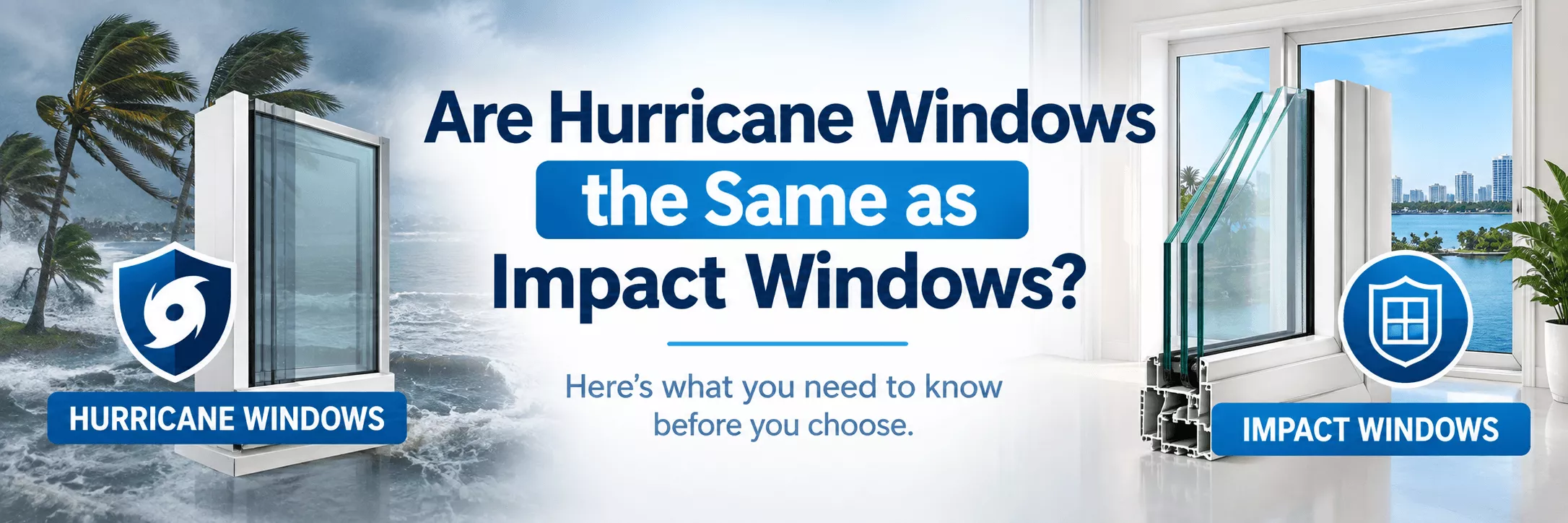
Are Hurricane Windows and Impact Windows the Same Thing?
Impact windows and hurricane windows are similar yet they are not quite the same. Impact windows are designed to withstand penetration from flying debris. A hurricane rated window is one that meets applicable performance standards for wind pressure, impact, water, air infiltration and others. “For South Florida, it’s not the marketing name that matters but whether the particular window assembly has been tested and authorized for the requisite construction requirements.
Neither phrase is a product category in the Florida Building Code. The code does not certify “hurricane windows.” This is verified through product approvals and test reports, which never use the phrase “hurricane” to describe the window itself, and it requires impact-resistant glazing or an approved protective system for openings in a windborne debris region.
Manufacturers and dealers use both phrases because both sell. “Hurricane” names the threat and sells the buying rationale. “Impact” seems technical, names the construction. Both of these ships are the identical window under both brands and typically from the same factory in the same week.
Practical consequence: you learn nothing by comparing two quotes on the words in the product name. Two windows labeled “hurricane windows” can have vastly different pressure ratings and be permitted for completely different jurisdictions.
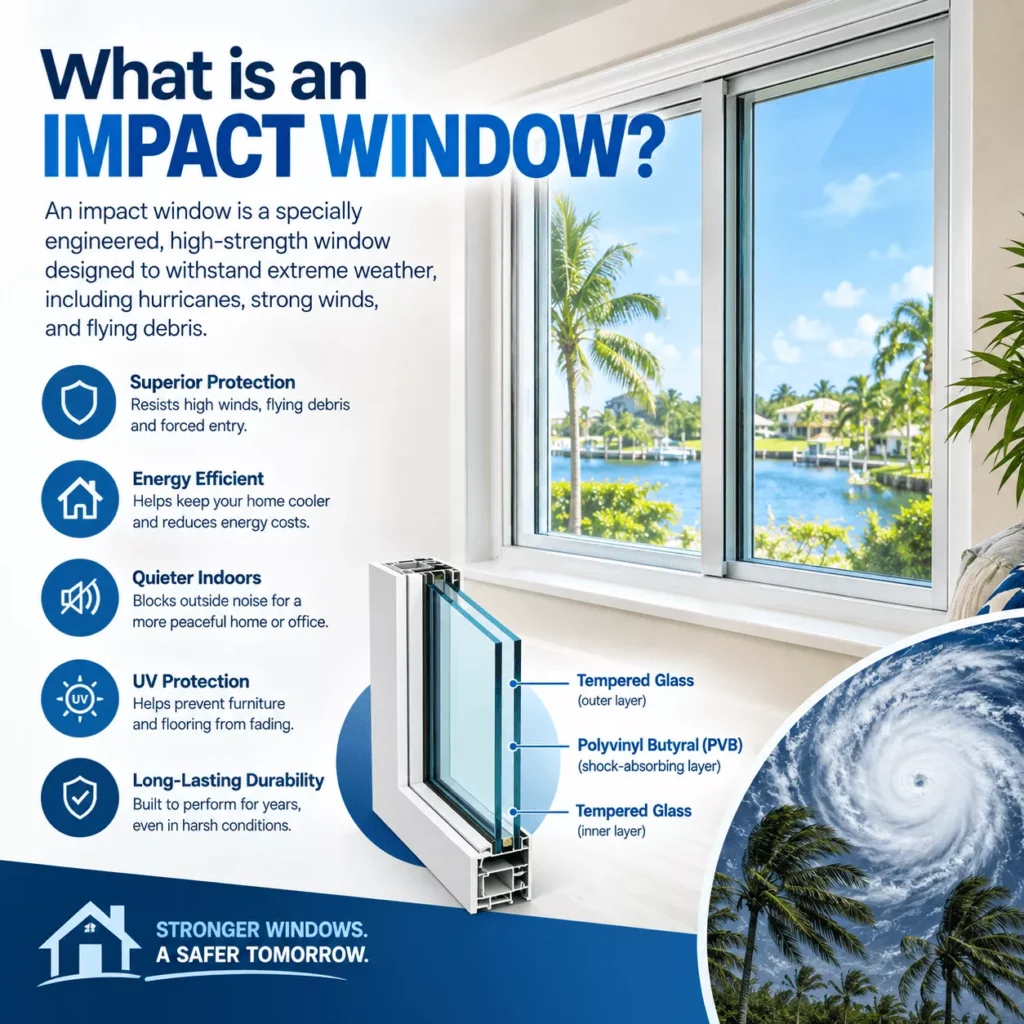
What is an impact window?
An impact window is a window that is designed and tested to resist impact by wind-borne debris while maintaining the integrity of the glazing system. It often is made of laminated glass with a tough interlayer that is designed to help hold the glass together if it cracks. The frame, glass, seals and installation system must be designed to work together to offer the desired protection. Other benefits of impact windows include more security, less outside noise and more protection from extreme weather.
An impact window is a window made with laminated glass, two panes connected to a plastic interlayer, put in a reinforced frame and secured to endure wind pressure without the glazing blowing out of the opening.
All the idea is this layering. If laminated glass is struck by a flying branch or a roof tile, it cracks, but the pieces remain stuck to the interlayer and do not fall out of the frame. And the window is broken and the opening doesn’t open.
That’s more important than it sounds. If a window breaks , the storm pressure can go into the house . A broken window becomes a structural collapse because of the outward strain against the roof and walls . The product is intended to keep the envelope shut . Not to keep the glass nice .
Impact windows are also permanently installed. There is nothing to close, deploy or store, which is why they work for second homes, for owners who travel, and for anyone who does not want to be climbing a ladder as a storm approaches. They come in the same styles as ordinary windows; single hung, casement, horizontal roller, awning and fixed with the rating built into each.
What is a hurricane window?
Hurricane windows are window systems that are developed and tested to meet the severe wind and storm conditions that are associated with hurricanes. Tests may be conducted to determine resistance to wind pressure, impact by wind-borne debris, water penetration, air infiltration, and structural performance, depending on the code and permission. Homeowners should be aware that “hurricane window” is a term used often in marketing, so they should check the actual test results and approval for the product, not just the name.
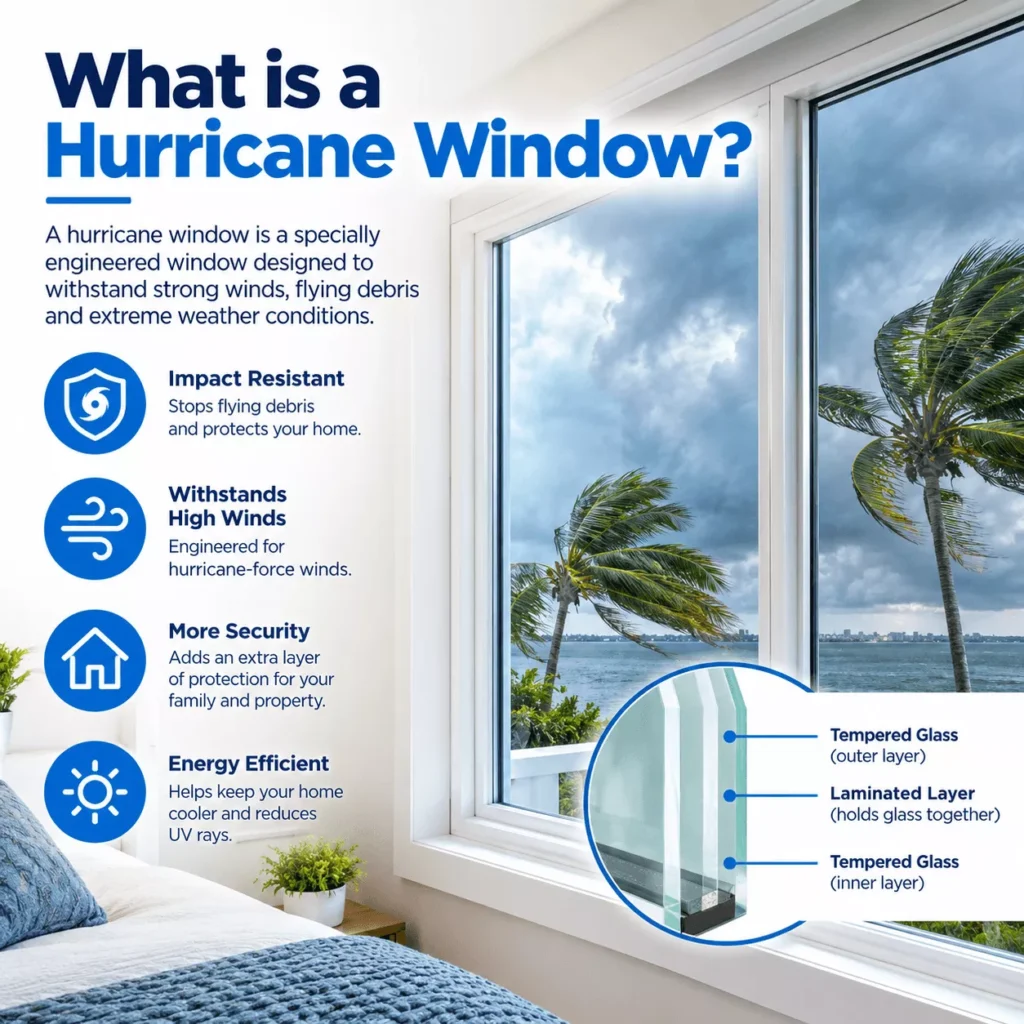
An impact window is a hurricane window. The word, in the language of the threat (not that of the building), defines the same laminated-glass, reinforced-frame product.
You will also find “hurricane-resistant window,” “storm window” and “impact-resistant window” all used to signify the same thing – though note that in colder areas “storm window” implies something quite different, a secondary sash placed on for insulation, with no impact rating at all.
It is a marketing word, not a technical one, with no guaranty. It’s nothing for a salesperson to proclaim a window a hurricane window no matter what it is rated for. The name is not the credential.
What actually determines whether a window is hurricane-rated?
A window is truly hurricane-rated only if it has passed testing and has documentation of its performance, not just because a maker or contractor calls it “hurricane,” “storm,” or “impact.” The entire window unit (glass, frame, hardware, seals and method of installation) must comply with appropriate testing and building code standards. Homeowners should review the product’s certification, testing reports and other relevant approval paperwork to ensure the window is appropriate for their individual area and project.
Three things and it’s not the product name. The approval the window carries, the design pressure it’s rated to and the missile level it was tested to.
Documentation is available for all three for every legitimate impact window. That is your answer if the provider cannot make it on demand.
Florida Product Approval vs. Miami-Dade NOA
These are two different approval systems and labeled differently. In Miami-Dade, approvals are issued as a NOA – a Notice of Acceptance. Under the Florida Product Approval system, statewide approvals are issued in the form of a FL # . The two are never interchangeable in a document, and a supply that mixes the labels is a supplier that has not read the paperwork.
The Miami-Dade NOA is the more stringent of the two. It is required in the High Velocity Hurricane Zone, which encompasses Miami-Dade and Broward counties. It is tested to Miami-Dade’s own criteria — TAS 201 for massive missile impact, TAS 202 for uniform static air pressure, and TAS 203 for cyclic wind pressure loading.
Florida Product Approval covers the balance of the state and is tested to national standards, mainly ASTM E1886 and ASTM E1996. It’s a true approval, not a reduced one – it’s just scoped to counties beyond the HVHZ.
What it means county by county A window placed in Miami-Dade or Broward needs a NOA. A window placed in Palm Beach, Collier or Lee requires Florida Product Approval appropriate to that site’s design wind speed. Products with a NOA are normally accepted statewide, but not the other way around. That is why a FL#-only product cannot be permitted in an HVHZ work.
Design pressure ratings
The wind load a window is designed to withstand, measured in pounds per square foot, is called the design pressure, or DP. The rating of the DP50 window is 50 psf.
There is a positive and a negative number for each DP rating. The wind pushes on a window and pulls on a window and often it is the negative value that prevails. A +50/-60 rated window will resist 50 psf pressure and 60 psf suction.
The DP for your residence is NOT a preference. It is dependent on the design wind speed for your area, the height and exposure category of your building, and the location of each opening – corners and gable ends have more load than the middle of a wall. The pressure for each opening will be specified in your permit drawings and the window you install must meet or exceed that pressure.
And that’s where the real distinction between two “hurricane windows” comes in. Both can be impact rated. Only one can be rated high enough for the corner opening on your house’s second level.
Large missile versus tiny missile test
Impact testing involves firing a bullet into the glazing and then putting the damaged unit through thousands of pressure cycles to verify that the opening remains shut.
For large missile testing, the usual stand-in for structural debris is a nine-pound 2×4 shot at the window. This is what is needed for openings in the bottom half of a building, usually up to 30 feet above grade, which includes pretty much every window in a one or two storey home.
Small missile testing is a spray of small steel balls at high velocity to simulate roof gravel and similar debris lofted upward. It applies to glazing above around 30 feet, which in practice means high-rise and mid-rise projects rather than dwellings.
Passing the impact test alone does not suffice. After the strike, the unit undergoes cyclic pressure loading – thousands of alternating cycles of positive and negative pressure, representing the hours of sustained wind that follow the debris. If the window clears the 2×4 but not the cycling, it is not authorized. That second phase is the bit that most product descriptions leave out.
What about "high impact windows"?
“High impact windows” is not a separate technical rating, but rather a marketing word. It usually means windows that can resist impact and are built to give you better protection from wind-blown debris. But the statement by itself does not show that a product meets a particular building-code or testing requirement. Always check the manufacturer’s documentation and the product’s official approval or certification.
You will see it constantly in advertising, and it is not dishonest so much as empty, a window is either impact-rated under an approval or it is not. There is no half-rated middle, and no premium level above rated.
The genuine variation between impact windows is in the numbers, not the adjectives: which approval the product carries, what design pressures it is rated for, the glass thickness and interlayer type, and the frame material. Those differences are large and worth paying for. The word “high” in front of “impact” tells you about none of them.
Hurricane windows vs. hurricane shutters
Hurricane shutters are protective coverings that are added to existing windows when a storm threatens. Impact or hurricane-rated windows provide permanent protection built into the window system. Impact windows are built-in to the building envelope and don’t require homeowners to install them prior to each and every storm. Shutters can be an effective alternative or additional layer of protection, but their efficacy depends on the particular shutter system, good installation and right deployment.
Both meet the code requirement for opening protection. If the protection is impact-rated glazing or an approved shutter system, the Florida Building Code considers the opening protected, thus this is a decision about how you wish to live with the protection rather than whether you are covered.
The first purchase of shutters is less expensive and they can be installed in already existing windows without the need for replacement. Impact windows are more expensive and the whole unit needs to be replaced if a storm hits, but they are always deployed, don’t need to be installed before a storm or removed after, and have the daytime benefits of laminated glass, noise reduction, UV filtering, and a meaningful security improvement over ordinary glass.
One thing to check before choosing shutters: if you are planning to use a state grant, My Safe Florida Home generally will not fund replacing code-compliant shutters with impact windows, because the opening already carries approved protection.
The insurance treatment is different as well, and it’s worth verifying with your provider before you decide.
How to check whether a window is genuinely rated?
With a hurricane-rated or impact-rated window, you want to see the official approval, testing and performance ratings of the product, not just the promotional copy. Look for the manufacturer’s product designation, approved configuration, tested design pressure, impact-test information and any applicable Florida or local approval papers. Also check that the precise glass, frame, size, configuration and installation method being installed are the same as the approved system.
Ask for the approval number yourself and verify it. Four steps. None of them require you to trust the seller.
- Locate the permanent label. Approved impact windows have a permanent marking on the glass or frame identifying the maker and the approval. It is either engraved or placed so that it cannot be pulled off after installation . Which is exactly so that it can be checked years later .
- Obtain the NOA or FL# in writing. Not “it’s Miami-Dade approved”—the number itself. This document can be obtained from any supplier that installs the product legally.
- Take a look. Florida Product Approvals can be searched at floridabuilding.org . Miami-Dade County has a product control database that allows the search of Miami-Dade NOAs. Verify it is a legitimate number, that it is current and not expired, that the manufacturer and product line match what you were quoted.
- Make sure it is for your actual window. This is the step people miss. This is the step that kills permits. Approvals are for certain setups and for specific maximum sizes. The product line may be completely approved yet the big unit you purchased for the living room is outside the approved dimensions or the mulled combination you desire was never tested as a combination. Get your approval to match your schedule of drawings, opening by opening.
Republic obtains HVHZ permits across Miami-Dade, Broward, Palm Beach, Collier and Lee counties, and we face this distinction on every job. If you have a quote and would like us to confirm the approval numbers versus your openings before you sign, we will look at it.
Frequently Asked Questions
Are hurricane windows and impact windows the same thing?
Yes. They are two names for one product. “Hurricane window” is marketing language and “impact window” describes the laminated-glass construction. No code or test standard distinguishes between them, so the difference that matters is the approval number and design pressure rating, not the name on the brochure.
What's the difference between hurricane windows and impact windows?
There is none in the product. Any real difference between two windows both sold as hurricane or impact windows lies in their approval type, their design pressure ratings, the glass and interlayer used, and the frame material. Compare those, not the terminology.
What makes a window hurricane-rated?
An approval issued after testing, a Miami-Dade NOA or a Florida Product Approval FL#, covering impact resistance and cyclic pressure loading, plus a design pressure rating that meets or exceeds what your specific opening requires. Without an approval number, “hurricane-rated” is a claim rather than a fact.
What are high impact windows?
The same product with an intensifier attached. There is no “high impact” rating tier and no test that earns the term. A window either carries an impact-rated approval or it does not.
Is a Miami-Dade NOA better than Florida Product Approval?
The NOA is the stricter standard and is required in the High Velocity Hurricane Zone of Miami-Dade and Broward counties. Florida Product Approval is a legitimate statewide approval scoped to jurisdictions outside the HVHZ. NOA-approved products are generally accepted anywhere in Florida; an FL#-only product cannot be permitted on an HVHZ job.
What does DP50 mean on a window?
It means the window is rated for 50 pounds per square foot of design pressure. Ratings carry a positive and a negative value because wind pushes against a window and pulls away from it. The pressure your opening requires is calculated from your design wind speed, building height, exposure and the position of the opening, and it will be specified on your permit drawings.
What is large missile impact testing?
A test that fires a nine-pound 2×4 at the window, then subjects the damaged unit to thousands of pressure cycles to confirm the opening stays sealed afterward. It applies to openings up to roughly 30 feet above grade, which covers every window in a typical house. Small missile testing, using small steel projectiles, applies to glazing higher than that.
How do I know if my existing windows are impact rated?
Look for a permanent etched or applied label on the glass or frame naming the manufacturer and approval. If you find a number, verify it at floridabuilding.org or in Miami-Dade’s product control database. If there is no permanent marking anywhere on the unit, assume the windows are not impact rated until documentation says otherwise.