My Safe Florida Home Grant: 2026 Guide for South Florida Homeowners
My Safe Florida Home is a Florida Department of Financial Services program that pays for a free wind mitigation inspection, then matches what you spend on hurricane protection, $2 from the state for every $1 from you, up to $10,000. It is a reimbursement: you pay your contractor in full and the state sends the money to you.
Impact windows and impact doors qualify, provided your inspection report recommends them. Your home’s original building permit must have been applied for before 1 January 2008.
How much does My Safe Florida Home pay?
Florida homeowners who qualify for the My Safe Florida Home program may receive a maximum of $10,000. Matching funds provide a return of $2 for every $1 that the homeowner contributes, with a maximum of two-thirds of qualified project expenditures. Subject to the availability of program funds and eligibility requirements, low-income homeowners who qualify may receive up to $10,000 without a matching payment.
The utmost state contribution is $10,000, with the state contributing $2 for every $1 you contribute. This equates to the state covering two-thirds of the eligible project cost and you covering one-third.
The efficient ceiling is a $15,000 impact window project. The grant is fully funded when you contribute $5,000 and the state contributes $10,000. The award is not increased by spending more than $15,000, as the $10,000 cap remains constant regardless of the size of the undertaking.
Households that are at or below 80% of the county median income and are low-income applicants are eligible to receive up to $10,000 toward their actual costs without the need for a matching contribution.
| ELIGIBLE PROJECT COST | YOUR SHARE | STATE SHARE |
|---|---|---|
| $7,500 | $2,500 | $5,000 |
| $12,000 | $4,000 | $8,000 |
| $15,000 | $5,000 | $10,000 (grant maxed) |
| $25,000 | $15,000 | $10,000 (cap reached) |
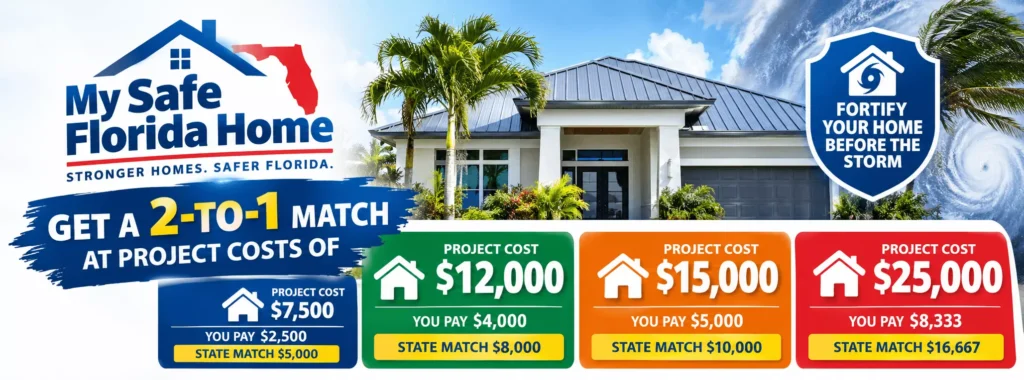
A $7,500 project returns $5,000 from the state and costs you $2,500. A $12,000 project returns $8,000 and costs you $4,000. A $15,000 project returns the full $10,000 and costs you $5,000. A $25,000 project still returns only $10,000, leaving you $15,000 out of pocket.
Most full-home impact window replacements in South Florida run well above $15,000, which means the grant is best understood as a fixed $10,000 contribution rather than a percentage discount. See what impact windows actually cost by window type and county →
Because MSFH reimburses rather than discounts, you need access to the full project cost up front. On a $15,000 job with a $10,000 grant, you pay $15,000 at completion and receive $10,000 back roughly 4–6 weeks after your Draw Request is approved. Financing can bridge that gap. You need the full project cost available at completion. [See how financing bridges the gap →]
Who qualifies for a My Safe Florida Home grant?
In general, the home must be a single-family home that is owner-occupied, site-built, and has an insured value of $700,000 or less. It must also have a homestead exemption and have been constructed before January 1, 2008. Additionally, the householder must undergo a qualifying initial wind-mitigation inspection, employ a licensed Florida contractor who is eligible, and complete the mandatory final inspection.
Three sets of conditions decide it: what kind of property you own, when it was permitted, and where your household income falls. All three have to clear.
Property Requirements
The residence must be a single-family home or townhome that is owner-occupied and constructed on the premises, and it must have a homestead exemption on file. It is necessary for you to possess and occupy it as your primary residence.
Renters are prohibited from applying, and second homes, vacation homes, and rental properties are not eligible. The homeowner grant is not available to individual condominium unit owners, as condominium associations are subject to a distinct condo pilot program with its own funding and regulations.
The dwelling amount, which is not the market value of the property, must be $700,000 or less in Coverage A of your homeowners policy. This limit is waived for applicants with low incomes. Before commencing the application, retrieve your declarations page; it is the document that petitioners frequently consult during the submission process.
The Pre-2008 Building Permit Rule
The initial construction permit application for your residence must have been submitted prior to January 1, 2008. No exceptions are made; homes that were permitted on or after that date are ineligible.
More South Florida applicants are disqualified by this rule than by any other, and the majority of program summaries omit it entirely. Before investing time in the process, confirm the permit application date with your county if your home was constructed during the 2004–2007 construction boom. The permit date is not the certificate of occupancy date. Homes that were completed in 2008 and 2009 were frequently permitted in 2007 and continue to qualify, while those that were completed in 2008 and permitted in January 2008 do not.
2026 Income Prioritization
Application windows open in phases by priority group, in this order:
- Low-income homeowners aged 60 and over
- Low-income homeowners of all ages
- Moderate-income homeowners aged 60 and over
- Moderate-income homeowners of all ages
Low income means at or below 80% of your county’s median income. Moderate income means below 120% of county median. Both thresholds are calculated against your county’s figures and adjusted for household size, so the dollar amount differs between Miami-Dade, Broward, Palm Beach, Collier and Lee.
Your group determines when your window opens, not whether you are eligible in principle. Within each group, applications are processed first-come, first-served against the funding remaining for the cycle. Low-income applicants carry two additional advantages: exemption from the $700,000 dwelling coverage cap, and exemption from the matching contribution.
Does the state pay my contractor directly?
No. The contractor is selected and managed by the homeowner under the current program. The householder pays the contractor for a standard matching grant and subsequently requests reimbursement after the eligible work is completed and inspected. Different payment requirements apply to low-income grants; however, the program does not typically function as a direct state payment to your contractor.
My Safe Florida Home reimburses the homeowner. The state does not pay contractors and never has.
The sequence is: you pay your contractor in full, you submit a Draw Request through the portal with a paid-in-full invoice and your final inspection report, and the state sends a check or ACH to you.
This matters for two reasons. Practically, it means you need the entire project cost available at completion, not just your one-third share, on a $15,000 job that is $15,000 on the day the work is signed off. And as a warning sign: any contractor who offers to “handle the grant,” bill the state directly, or take the award as partial payment is describing something the program does not permit. Republic does not receive your grant money, does not hold it, and will never ask you to assign it.
The gap between paying and being repaid is the single most common obstacle for grant recipients. Most bridge it with financing and pay the balance down when the reimbursement lands. See our impact window financing options →
What does the free wind mitigation inspection cover?
The complimentary initial inspection assesses the current hurricane and wind-mitigation features of your property, identifies potential weaknesses, and ascertains which eligible improvements may be suggested. The inspection has the potential to detect enhancements in the areas of opening protection, roof-to-wall attachment, roof deck attachment, and secondary water resistance. Additionally, it furnishes data that may assist in the identification of potential insurance discounts.
The inspection is a no-cost visit from a program-assigned inspection firm that documents your home’s existing hurricane-resistant features and identifies what is missing.
The inspector examines the same categories insurers use to price wind risk: roof covering and its age, roof deck attachment, roof-to-wall attachment, roof geometry, secondary water resistance, and opening protection on windows, doors, skylights and garage doors. The visit typically takes one to three hours, and the written Initial Inspection Report follows within days.
That report is the only document that determines what your grant can pay for. Everything downstream is scoped to it. If the inspector does not recommend opening protection for a particular window, that window cannot be reimbursed regardless of its age or condition.
The inspection has standalone value even if you never pursue a grant. It produces documentation of the wind-resistant features your home already has, and Florida law requires residential insurers to give premium credits for verified wind loss mitigation features. Homeowners who take the free inspection and hand the report to their carrier sometimes find savings without spending anything at all.
The inspection must happen before any work starts. There is no path where you install first and get inspected afterward.
What improvements does the grant cover?
Currently, the program recognizes four acceptable wind-mitigation improvements: roof-to-wall connection, roof deck attachment, secondary water resistance, and opening protection. Eligible impact-rated windows, external doors, garage doors and skylights can be included as opening protection. However, an improvement needs to be recommended in the initial inspection report and verified in the final inspection to be eligible for financing.
The program funds four improvement categories, and only the ones your Initial Inspection Report recommends:
- Improvement 1.0: Opening Protection. Impact-rated windows, impact-rated exterior doors, garage doors, skylights, and code-compliant shutters.
- Improvement 2.0: Roof-to-Wall Attachment. Clips, wraps and straps tying the roof structure to the walls.
- Improvement 3.0: Roof Deck Attachment. Upgraded nailing and sheathing.
- Improvement 4.0: Secondary Water Resistance. A sealed roof deck barrier beneath the covering.
Impact windows and impact doors sit in Improvement 1.0, which is where most South Florida grants go.
Two limits catch people out. Only the openings named in your report qualify if eleven of your fourteen windows are flagged, eleven are reimbursable and three are not. And swapping code-compliant shutters for impact windows is generally not funded, because that opening already carries compliant protection; the program pays for added mitigation, not for a like-for-like exchange you prefer aesthetically.
One scoping note worth weighing before you finalize the job: partial opening protection often reduces or eliminates the wind mitigation credit on your insurance policy. Protecting eleven openings and leaving three unprotected can mean paying for the work without earning the discount that helps pay for it. See our impact windows range →
How to apply free My Safe Florida Home, step by step?
Start by applying for the free My Safe Florida Home wind-mitigation inspection. After receiving the inspection report, eligible homeowners can proceed to the grant application when their application phase becomes available. Select a qualifying Florida-licensed contractor, obtain grant approval, complete only the recommended improvements, request the final inspection, and submit the required Draw Request documents for reimbursement. Do not start eligible construction before receiving grant approval.
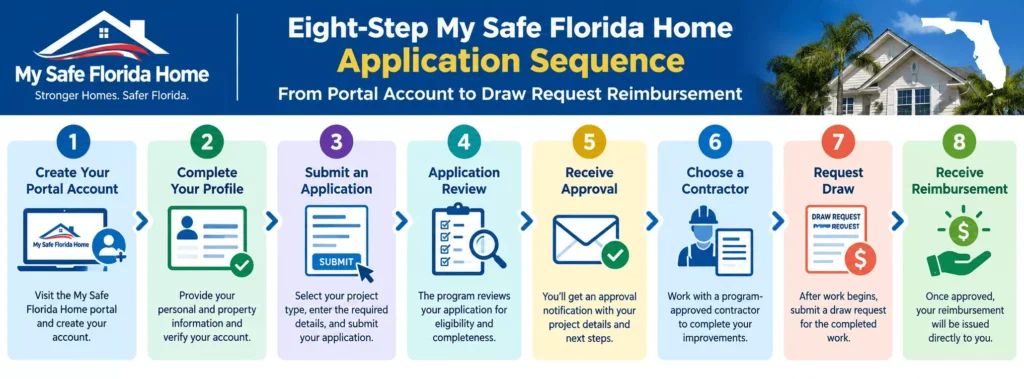
The application is two separate submissions, not one, and the order is not flexible.
- Create your portal account at mysafeflhome.com and complete the Prioritization Questionnaire. This assigns your priority group and determines when your application window opens.
- Apply for the free wind mitigation inspection when your window opens. A program-assigned firm performs it at no cost. Expect an inspector to be assigned within a few weeks and the written report to follow the visit.
- Read your Initial Inspection Report. This is the document everything else is scoped to.
- Submit the Grant Application when your group’s grant window opens. You select the recommended improvements, upload proof of homestead and your insurance declarations page, and enter your contractor’s name and state license number. The program verifies that license before approving.
- Wait for the award letter. Do not sign a start date, do not accept a delivery, do not let anyone begin work.
- Permit and install. Your contractor pulls the permits and installs products carrying the Miami-Dade NOA or Florida Product Approval your jurisdiction requires.
- Schedule the Final Inspection. The inspector confirms the recommended improvements were actually installed.
- Submit the Draw Request with your paid-in-full invoice and final inspection report.
The most common reason applications fail is not ineligibility. It is work starting before the award letter arrives. Anything begun before written approval is disqualified from reimbursement.
Where Republic comes in. We walk you through the portal rather than pointing you at it, creating the account, completing the Prioritization Questionnaire, and getting the free inspection scheduled. When the Initial Inspection Report comes back we read it with you and price a scope that matches what the inspector recommended, opening for opening, so nothing on your invoice falls outside what the grant will reimburse. We are a Florida state-certified contractor, licenses CGC-1533058 and CCC-1337395, handling High Velocity Hurricane Zone permitting across Miami-Dade, Broward, Palm Beach, Collier and Lee counties. We pull the permits and produce the itemized paid-in-full invoice your Draw Request needs.
How long does reimbursement take?
There is no singular guaranteed reimbursement timeframe, as the processing of the request is reliant upon the completion of the project, the successful completion of the final inspection, the submission of a complete Draw Request, and the review of the program. The homeowner submits the necessary documents, such as the contractor invoice and proof of payment for matching grants, after the eligible work is completed. The grant disbursement is sent to the householder upon approval of the Draw Request.
Roughly four to six weeks after your Draw Request clears, following the final inspection.
The full timeline runs longer than most applicants expect. From creating a portal account to money in your bank, allow several months: waiting for your priority window to open, a few weeks for an inspector to be assigned, days for the report, then the grant application and award, then permitting and installation, then the final inspection, then the Draw Request, then four to six weeks for payment.
Plan your budget around that. You are covering the full project cost at completion and treating the grant as money that arrives afterward, not money you can spend during the job.
What happens if funding runs out?
The My Safe Florida Home grant awards are subject to legislative appropriations and the availability of funds. Meeting the program eligibility criteria does not necessarily indicate that funding is available. The program may suspend applications or restrict access when funding runs out. Homeowners should check what funding and application status the official program has before they spend any money or undertake any work.
Each funding cycle carries a fixed appropriation, and applications are processed first-come, first-served within each priority group until it is exhausted. When it runs out, remaining applicants wait for the next cycle rather than being rejected outright.
Two things follow from that. Apply the moment your group’s window opens, with your documents already assembled, declarations page, homestead proof, contractor license number. Days matter inside a priority group. And do not build your project timeline around the grant if the work is genuinely urgent. A window that fails now costs more than the $10,000 you were waiting on.
Completing the free inspection early is the cheapest hedge available. It costs nothing, it produces insurance documentation you can use immediately, and it puts you in position to submit a grant application the moment funding opens rather than starting the process then.
Check mysafeflhome.com for your priority group’s current status before planning around the program.
My Safe Florida Home vs. paying out of pocket
The key distinction is financial aid or self payment in full. My Safe Florida Home provides up to $10,000 to eligible homeowners for qualifying wind-mitigation upgrades, subject to program restrictions and availability of funds. If you pay from your own pocket you have greater flexibility because you are not bound by the program’s recommended changes or approval process, but you will be footing the whole bill for the project yourself.
The grant is worth up to $10,000. It costs you scope control and time. For some homeowners that trade is obvious, and for others it is not.
| WITH THE GRANT | OUT OF POCKET | |
|---|---|---|
| Cost on a $15,000 job | $5000 | $15,000 |
| Time to start | Months — window, inspection, award | Weeks |
| What gets replaced | Only openings the report recommends | Whatever you choose |
| Eligibility | Pre-2008 permit, homestead, income tier, ≤$700,000 coverage | None |
| Insurance credit | Yes, once protection is verified | Yes, once protection is verified |
On a $15,000 project the grant saves you $10,000 and adds several months. If your home was permitted on or after 1 January 2008, your dwelling coverage exceeds $700,000, or your household income sits above 120% of county median, the grant is not available to you and paying out of pocket is the only path. The same is true if you need the work finished before the next storm season rather than after it.
The wind mitigation insurance credit is not tied to the grant. You earn it by protecting your openings and having that verified, whether the state contributed or not, which means a homeowner who does not qualify for a grant still gets the recurring savings.
Frequently Asked Questions
Is My Safe Florida Home still available?
Yes. The program is funded and accepting applications through mysafeflhome.com. Funding is allocated first-come, first-served within each priority group and can be exhausted before a cycle ends, so check the portal for your group’s current status before planning a project timeline around the grant.
How much is the My Safe Florida Home grant?
Up to $10,000 from the state. For most applicants the state pays $2 for every $1 you contribute, so a $15,000 project earns the full $10,000 and costs you $5,000. Low-income applicants, at or below 80% of county median income, can receive up to $10,000 with no matching contribution.
Does My Safe Florida Home pay for impact windows?
Yes, if your Initial Inspection Report recommends opening protection for those windows. Impact-rated windows and doors fall under Improvement 1.0. Windows the inspector did not flag are not reimbursable, and swapping existing code-compliant shutters for impact glass is generally not funded.
Does the state pay my contractor directly?
No. My Safe Florida Home reimburses the homeowner. You pay your contractor in full, submit a Draw Request with the paid-in-full invoice and final inspection report, and the state sends the money to you. Any contractor claiming they can collect the grant on your behalf is describing something the program does not permit.
What is the income limit for My Safe Florida Home?
Low income means at or below 80% of your county’s median income; moderate income means below 120%. Both are adjusted for household size and calculated against your county’s figures. Low-income applicants get priority in the queue, are exempt from the $700,000 dwelling coverage cap, and do not have to provide a matching contribution.
My house was built in 2010. Do I qualify?
No. The application for the original construction permit must have been submitted before 1 January 2008. If your home is near that line, check the permit application date with your county rather than relying on the year of construction — the two often differ by a year or more.
Can I start the work while I wait for approval?
No. Work started before your award letter arrives is disqualified from reimbursement, and this is the most common reason applications fail. Wait for written approval before scheduling anything, including material delivery.
How long does the reimbursement take?
Roughly four to six weeks after your Draw Request clears, following the final inspection. Budget to cover the full project cost at completion and treat the grant as money that arrives afterward.