
Impact Windows vs. Hurricane Shutters: Which Should You Choose?
Hurricane shutters cost substantially less than impact windows and earn the same insurance credit, provided they are code-approved and cover every opening. Impact windows cost more but need no deployment, protect the house when nobody is home, and improve it every day of the year. Neither is safer than the other in a storm. The decision is about budget, convenience and how long you intend to stay.
Are impact windows better than hurricane shutters?
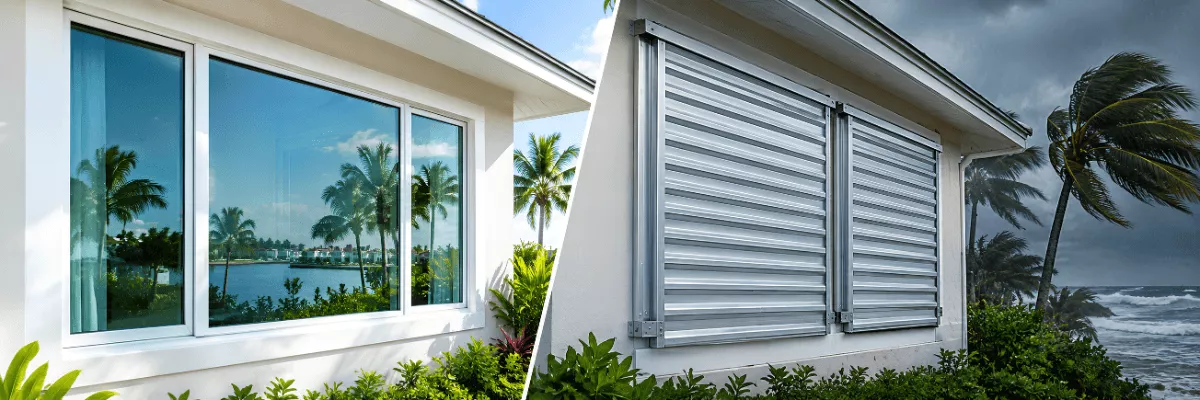
Hurricane shutters and impact windows are two different ways to protect windows and doors from hurricane conditions. Impact windows are permanently placed and offer a variety of common benefits including reduced noise, weather protection and security. Shutters, properly installed, can be deployable or detachable systems that may provide storm protection. The best option depends on your budget, the style of your home, how much upkeep you want to do and what level of protection you require.
Not in terms of protection. Both, when code-approved and correctly installed, are tested to the same standards and stop the same debris.
HVHZ-rated shutters pass the same TAS 201 large missile test that impact glass passes a nine-pound length of two-by-four fired at fifty feet per second. A shutter that carries a Miami-Dade NOA or an HVHZ-endorsed Florida Product Approval has met the same bar the glass met.
What separates them is everything around the protection: what you have to do to get it, what it costs, and what the product does when there is no storm.
Impact Windows vs. Hurricane Shutters: What Is the Difference?
Impact windows combine the window and hurricane protection into one permanently installed system, while shutters are installed or deployed over existing openings when a storm approaches. Impact windows can provide protection without requiring pre-storm installation, whereas many shutter systems require storage, preparation, installation, or deployment. Both options must meet applicable Florida building-code and product-approval requirements for the intended application.
Code-approved hurricane shutters and impact windows pass the same TAS impact testing and earn the same insurance credit when every opening is covered. Shutters cost substantially less upfront but have to be deployed before every storm, protect nothing while undeployed, and need ongoing service to tracks, motors and fasteners. Impact windows cost substantially more, protect continuously with no action required, reduce noise, UV and cooling costs year-round, and carry no hurricane-season maintenance.
Do shutters and impact windows earn the same insurance credit?
Not necessarily. Insurance mitigation credits depend on the specific protection system, installation, documentation, and the insurer’s approved rating plan. Both qualifying impact windows and hurricane shutters may contribute to opening-protection credits, but homeowners should not assume they receive identical discounts. A qualified wind-mitigation inspection and your insurance company can determine which opening-protection features qualify for credits on your policy.
The wind mitigation inspection records opening protection based on what is installed over your openings and to what standard. It does not rank glass above shutters. A home with approved shutters on every opening and a home with impact glass on every opening are documented the same way on the form.
What does change the credit is coverage. Opening protection is scored all or nothing, so every glazed opening has to be protected — windows, doors, skylights and glazed vents. Shutters on most openings and nothing on the rest earns no opening protection credit, exactly as a partial window replacement does.
One caveat worth understanding. Shutters only protect when deployed, but the inspection documents that they exist, not whether you put them up. The credit reflects the installed capability. Whether you are home to use it is a different question, and it is the one the next section is about.
Are Impact Windows or Hurricane Shutters Less Expensive?
Initial cost depends on type of product, quantity and size of openings, installation requirements and property layout. Impact windows do require a larger permanent investment, but some homes may find shutters to be a smaller expenditure up front. Homeowners should examine the initial cost, as well as the costs of storage, installation, maintenance, insurance, durability, security, energy performance and long term convenience, when comparing total costs of ownership.
Shutters, by a wide margin, and it is not close on the upfront number.
Protecting the same set of openings with code-approved shutters costs a fraction of what impact glass costs for those openings. That is the single strongest argument for shutters, and for a homeowner whose alternative is leaving openings unprotected for another three years, it is often the right argument.
The comparison changes over a longer horizon. Shutters have moving parts, tracks, motors and fasteners that need service, and panel systems need somewhere to live for the other eleven months. Impact windows have no seasonal maintenance and also reduce cooling costs and noise, which shutters do not. Neither of those closes the upfront gap quickly, and any page claiming impact windows pay for themselves against shutters is doing arithmetic it has not shown you.
Pricing: Our impact window cost guide carries installed ranges by window type, size, manufacturer and county. [See what impact windows cost in South Florida →]
What Types of Hurricane Shutters Are Available in Florida?
Common hurricane shutter systems include accordion shutters, roll down shutters, storm panels, Bahama shutters, colonial shutters and detachable fabric systems. The numerous types vary in their installation requirements, method of operation, storage requirements, look and cost. Some are permanent installations that can be swiftly deployed, while others necessitate homeowners installing panels or protective materials in advance of a storm.
Four common systems, and they differ mainly in how much work deployment takes.
Accordion shutters stay permanently mounted beside the opening and fold across it. Fast to close, no storage required, and the most common permanent system in South Florida.
Roll-down shutters mount above the opening and come down on a track, manually or by motor. Motorised sets can be closed remotely, which matters for seasonal residents who may not be in Florida when a storm forms.
Panel shutters are removable corrugated aluminium or polycarbonate panels bolted over the opening before a storm. The cheapest system and the most work, they need storage space and physical handling on every opening, every time.
Bahama and colonial shutters are permanently mounted decorative systems that swing or hinge closed. They suit historic properties and neighbourhoods with appearance restrictions.
What Does Installing and Deploying Hurricane Shutters Involve?
It depends on the shutter system . Permanently attached systems, such as accordion or roll-down shutters, can usually be opened or closed as required. Homeowners with removable systems may have to get stored panels out, put them on each aperture, secure the hardware and make sure everything is placed properly. Preparation time can consequently vary considerably between homes and shutter types.
Lorem ipsum dolor sit amet, consectetur adipiscing elit. Ut elit tellus, luctus nec ullamcorper mattis, pulvinar dapibus leo.
How much more does PGT cost than ES Windows?
There is no specific percentage that shows how much more PGT costs than ES Windows. Prices depend on the product line, window size, glass package, frame material, hardware, design requirements, quantity, difficulty of installation and the price of the dealer. A premium PGT system may be more expensive than an entry-level ES system, and identical configurations may also range in price. Always compare on an equal basis of specs and installation scope.
Closing every opening on the house before a storm arrives, by hand on most systems, and it is the factor homeowners underweight most.
A storm watch means putting shutters up on every opening, usually in heat, often in a hurry, sometimes while also trying to leave. Panel systems on a fifteen-opening house are a substantial job for two people. Accordion and roll-down systems are far faster, and motorised roll-downs are close to effortless.
The harder question is whether you will be there. Shutters protect nothing if a storm forms while you are away, if you are physically unable to deploy them, or if you leave early to avoid traffic. For seasonal residents, older homeowners and anyone who travels, that gap is the real difference between the two products, not the testing, not the credit.
Impact windows are deployed permanently. There is nothing to do when a storm forms, which is the entire proposition.
What Do Impact Windows Provide Besides Hurricane Protection?
Impact windows are installed and operate throughout the year. They offer benefits including better security, reduced noise from outside, UV protection, weather resistance and even improved energy performance in addition to hurricane protection. Impact windows differ from removable shutters because they don’t have to be stored and put up before every storm, although effectiveness will vary depending on the particular product and installation.
They cut noise, block UV and reduce cooling costs continuously, which is where the rest of their value sits.
Laminated impact glass noticeably reduces outside noise, blocks the overwhelming majority of UV that fades floors and furniture, and, with a Low-E coatin, lowers solar heat gain and cooling bills. It also makes the house considerably harder to break into, since laminated glass does not fall out of the frame when struck.
Shutters do one job, once or twice a season, and nothing on the days in between. None of that everyday difference shows up in a storm comparison, and all of it is why the price gap is not purely about hurricanes.
Can You Use Impact Windows and Hurricane Shutters on the Same House?
Yes. Some homeowners opt for both impact windows and hurricane shutters, especially if the different openings have different protection needs. Impact windows, for instance, may protect most windows, while shutters provide added protection for doors, large openings, patios or other areas. The combination must still comply with applicable building-code, product-approval, installation, and insurance requirements for the property.
The usual pattern is impact glass on the primary living areas and the largest, most exposed openings, with shutters covering secondary openings. That captures most of the everyday benefit where you spend time while protecting every opening for the insurance credit, which requires total coverage regardless of method.
You do not need shutters over impact windows. Code-approved impact glass meets the rating on its own, and adding shutters on top of it buys protection you already have.
How Do You Choose Between Impact Windows and Hurricane Shutters?
Compare the choices in terms of initial cost , opening size , hurricane protection needs , installation , deployment time , storage , maintenance , insurance implications , security , energy performance , esthetics and long term convenience . Impact windows are a permanent solution with daily use. Shutters can be a flexible solution for existing windows. Your openings can be evaluated by a certified contractor in South Florida who will explain whether systems fulfill applicable regulations.
Shutters if the constraint is budget and you are reliably home; impact windows if you travel, cannot deploy them, or plan to stay long enough for the everyday benefits to matter.
Shutters make sense if the budget will not stretch to whole-house impact glass, you are home reliably through hurricane season, you are protecting a large number of openings at once, or the property has appearance restrictions that limit window replacement.
Impact windows make sense if you travel or spend part of the year elsewhere, you would struggle to deploy shutters physically, you intend to stay in the house long enough for the energy, noise and resale benefits to matter, or you simply do not want to think about it when a storm forms.
Both make sense if you are phasing the work. Impact glass on the openings that matter most, shutters on the rest, with the shutters coming off as the remaining openings get replaced.
Frequently Asked Questions
Are impact windows better than hurricane shutters?
Not for protection, both meet the same testing standards when code-approved, including the TAS 201 large missile test in HVHZ configurations. Impact windows need no deployment and provide noise, UV and energy benefits year-round. Shutters cost considerably less.
Do hurricane shutters give the same insurance discount as impact windows?
Yes, when approved and covering every opening. The wind mitigation form records opening protection by what is installed and to what standard, and does not award more credit for impact glass than for approved shutters. Coverage is what changes the credit, not method.
Which is cheaper, shutters or impact windows?
Shutters, substantially, on the upfront cost of protecting the same openings. The gap narrows over time through shutter maintenance and the energy and noise benefits of impact glass, but not quickly enough to call it a wash.
Do I need shutters if I have impact windows?
No. Code-approved impact windows meet the storm rating on their own, and adding shutters over them provides protection you already have.
Is plywood good enough?
Plywood provides some physical protection but earns no opening protection credit on the wind mitigation form, so it does nothing for your insurance. It also has to be cut, stored, transported and fastened before every storm. As a last resort it is better than nothing, as a plan it is the most expensive option over time.
What is the cheapest hurricane protection that still earns the insurance credit?
Code-approved panel shutters covering every opening. They are the lowest-cost system that qualifies, at the cost of the most work before each storm.
Can I mix impact windows and shutters?
Yes. Impact glass on primary living areas with shutters on secondary openings is common. For the insurance credit, what matters is that every glazed opening is protected by an approved method, not that the methods match.
Do shutters need to be deployed to earn the insurance credit?
The inspection documents that approved shutters are installed, not whether you deploy them. The credit reflects installed capability, but shutters that are not closed protect nothing in an actual storm, which is a separate and more important point.