Florida Product Approval vs. Miami-Dade NOA: What Is the Difference?
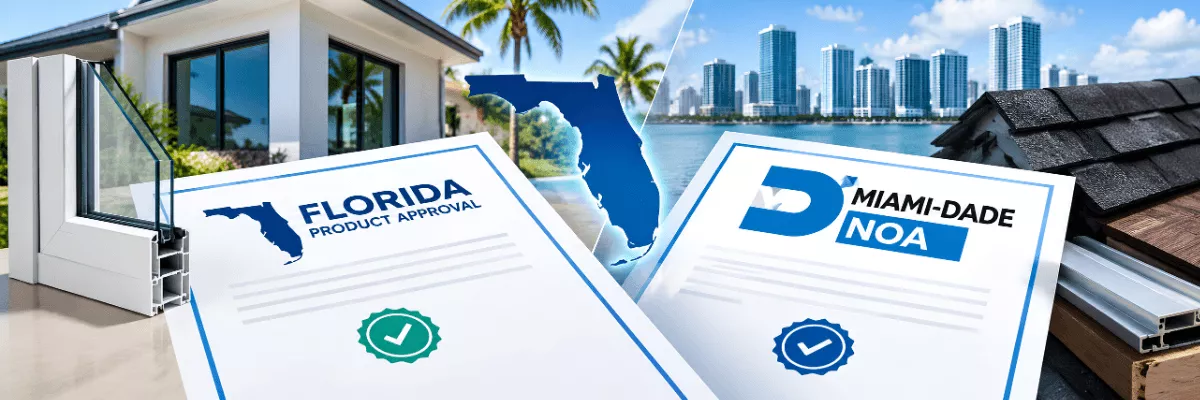
The Miami-Dade NOA is the county’s approval. A Florida Product Approval is issued by the state, has a FL number and is good anywhere in Florida. Both can be valid within the High Velocity Hurricane Zone. A statewide approval with the HVHZ endorsement has been through the same testing a NOA requires. It doesn’t matter whatever system it came from. What counts is whether your precise product, in your exact size, is approved for your location.
What Is a Miami-Dade NOA for Windows and Doors?
A Miami-Dade Notice of Acceptance, or NOA, is a product approval issued through Miami-Dade County’s Product Control Section. It verifies that a construction product or system has been reviewed under applicable requirements for use in the High Velocity Hurricane Zone. Miami-Dade’s system covers products including windows, exterior doors, glazing, shutters, roofing, and other building-envelope components.
A Notice of Acceptance is a product approval issued by the Miami-Dade County Product Control Section after a product passes the county’s testing protocols.
NOA numbers follow the format NOA 23-0714.12 — the first pair of digits is the year, the rest identifies the submission. Each NOA covers a specific product in specific configurations and sizes, carries an issue date and an expiration date, and is superseded when the manufacturer revises the product or renews the approval.
The system exists because of Hurricane Andrew. When the 1992 storm destroyed tens of thousands of South Florida homes, Miami-Dade built the most stringent product approval regime in the country, and much of the modern Florida Building Code grew out of it. The NOA is still widely treated as the benchmark, and in Miami-Dade and Broward it is the approval most plan reviewers see most often.
What Is a Florida Product Approval?
A Florida Product Approval is a statewide approval system for qualifying building products and assemblies. Products are evaluated under the Florida Building Code through approved compliance methods. The state’s online database allows homeowners and contractors to search by FL number, manufacturer, product type, impact resistance, design pressure, and whether a product is approved for use in the HVHZ.
A Florida Product Approval is the statewide system administered under the Florida Building Code, identified by an FL number such as FL29068.1.
It covers building products across the whole state, and the listing records which code edition the approval was granted under, the design pressures the product is rated for, the sizes and configurations covered, and this is the part that matters here, whether the product is approved for use in the High Velocity Hurricane Zone.
A manufacturer holding a Miami-Dade NOA can use it to support an application for statewide approval. The two systems are connected rather than competing.
Do You Need a Miami-Dade NOA in Miami-Dade and Broward County?
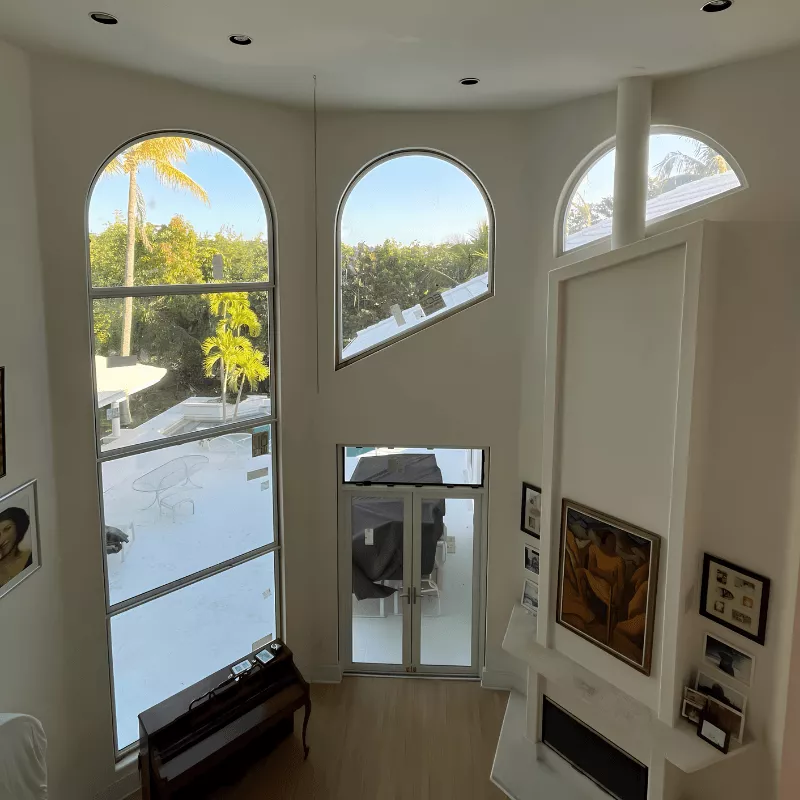
Not necessarily. Miami-Dade and Broward County are within Florida’s High Velocity Hurricane Zone, so products used there must satisfy the applicable HVHZ requirements. A Miami-Dade NOA is one way to demonstrate compliance, but a Florida Product Approval that specifically states the product is approved for HVHZ use may also satisfy applicable requirements. Always confirm the approval and installation limitations with the local building department.
This is the most common misconception in South Florida window sales.
What the code requires inside the HVHZ is a product approved for HVHZ use. There are two routes to that. A Miami-Dade NOA is one. A Florida Product Approval whose listing includes the HVHZ endorsement is the other, and a product carrying that endorsement has met the same TAS testing standards as a product carrying an NOA.
The inverse matters just as much. A product can hold a perfectly legitimate Florida Product Approval and still not be approved for the HVHZ, because the approval was granted under the standard Florida Building Code testing path rather than the HVHZ protocols. So “it’s Florida approved” tells you nothing on its own if your home is in Miami-Dade or Broward. The phrase to look for is approved for use in the HVHZ.
In practice, we install on both routes. Some of our product lines carry Miami-Dade NOAs and some run on HVHZ-endorsed Florida Product Approvals. Both pass plan review, and both pass final inspection.
Where Is the High Velocity Hurricane Zone in Florida?
Florida’s High Velocity Hurricane Zone includes Miami-Dade and Broward Counties. The HVHZ has specific hurricane-resistance requirements within the Florida Building Code, including requirements affecting building-envelope products such as windows and doors. Products installed in these areas must meet the applicable HVHZ requirements and the approved installation conditions for the specific product.
The HVHZ is defined in the Florida Building Code as Miami-Dade County and Broward County. Two counties out of sixty-seven.
It does not include Monroe County or the Florida Keys, which surprises people. It does not include Palm Beach, Collier or Lee, though all three carry serious wind-borne debris requirements of their own under the standard code. Broward maintains its own product approval as well and accepts Miami-Dade NOAs.
If your home is in Palm Beach, Collier or Lee, a Florida Product Approval at the right design pressure is generally what your permit needs, subject to local amendments. If it is in Miami-Dade or Broward, you need HVHZ approval by one of the two routes above.
What Testing Is Required for HVHZ Windows and Doors?
HVHZ products shall be tested and evaluated per approved procedures to demonstrate compliance with applicable performance criteria. These could be related to structural performance, impact resistance, air infiltration, water infiltration and other needs depending on the product. Miami-Dade’s Product Control Section provides testing instructions for products seeking HVHZ approval that includes structural and impact testing criteria.
Three protocols, applied in sequence, and the product has to survive all three as an assembled system rather than as separate parts.
TAS 201 is the large missile impact test. A nine-pound length of two-by-four timber is fired at the glazing at fifty feet per second, a direct simulation of the airborne debris that destroyed unprotected windows across South Florida in 1992.
TAS 202 applies uniform static air pressure to confirm the frame and anchors hold under sustained load.
TAS 203 is the cyclic test, running the already-impacted assembly through thousands of alternating positive and negative pressure cycles. This is what separates hurricane testing from ordinary wind testing: the point is not whether the window survives one gust, but whether it survives hours of a storm after it has already been hit.
Water intrusion and structural failure are both grounds for failing. A window that passes all three has been tested considerably harder than one approved under the standard code path
How Do You Look Up a Florida Product Approval or Miami-Dade NOA?
You can verify an approval using the official Florida Product Approval database or Miami-Dade’s Product Control search. For Florida approvals, search using the FL number, manufacturer, product category, model, impact rating, or HVHZ status. For a Miami-Dade NOA, search using the NOA file number or product information. Always check the approval status, expiration date, product description, design pressures, and approved installation details.
ou do not have to take a salesperson’s word for any of this, and checking takes a few minutes.
For a Florida Product Approval: go to the Florida Building Code Online product approval search, run by the Florida Building Commission. Search by FL number or by manufacturer, and select the code edition your permit falls under. Open the listing and look for whether it states the product is approved for use in the HVHZ.
For a Miami-Dade NOA: go to the Miami-Dade County Product Control search. Search by NOA number, manufacturer or product type. The advanced search lets you filter for High Velocity Hurricane Zone products specifically.
On either, check three things: that the approval is current rather than expired or revoked, that the issue date is recent enough to sit under the code edition your permit uses, and that the sizes and configurations listed actually cover the openings in your quote.
That third check is the one almost nobody does, and it is the one that matters most.
What Does a Product Approval Number Tell You and What Doesn't It Tell You?
An approval number identifies an approved product or system and provides access to important information about its permitted use. However, the number alone does not tell you whether a particular window size, configuration, installation method, design pressure, or jobsite condition is covered. For example, an approval may specify maximum design pressures and particular installation requirements. The complete approval documents must be reviewed.
An approval covers a product in specific sizes and configurations, not a brand and not a window in the abstract.
This is why an approval number on its own is close to meaningless as a sales claim. A window approved at 36 by 60 inches may not be approved at 72 by 60. A configuration approved as a two-panel unit may not be approved as a three-panel one. And the approval carries a design pressure rating, which has to meet or exceed what your specific opening requires based on your wind zone, your building height, and where the opening sits on the wall.
So the right question is never “is this brand approved?” It is “which approval covers this unit, at this size, in this opening, at the design pressure this elevation requires?” We pull that number per opening before ordering, and it goes on the permit application.
How Should Product Approvals Affect Your Impact Window Quotes?
When comparing impact-window quotes, don’t compare only the brand, price, or approval number. Check the exact product series, window configuration, size, design pressure, impact rating, Florida Product Approval or Miami-Dade NOA, and approved installation method. Two quotes may appear to offer similar impact windows while specifying different products or performance ratings. Ask the contractor to provide the applicable approval documentation before signing.
Three things to ask for, on every quote, from every contractor.
The approval number for each opening, not for the job. One number applied to a whole house is a shortcut, and it is the shortcut that produces failed inspections.
The design pressure required for the opening, alongside the design pressure the product is approved for. These are two different numbers and they should be shown together.
Confirmation of which route the approval takes, Miami-Dade NOA, or Florida Product Approval with HVHZ endorsement. Both are fine. A contractor who cannot tell you which one applies, or who insists one of them is not permitted, is telling you something about their permitting experience.
Frequently Asked Questions
What is the difference between an FL number and an NOA?
An FL number is a Florida Product Approval, issued by the state and valid across all sixty-seven counties. An NOA is a Notice of Acceptance, issued by Miami-Dade County. The approvals come from different authorities, and a manufacturer can hold both for the same product.
Do I need a Miami-Dade NOA for windows in Miami-Dade or Broward?
Not necessarily. You need a product approved for the High Velocity Hurricane Zone, and that can be either a Miami-Dade NOA or a Florida Product Approval whose listing carries the HVHZ endorsement. A statewide approval with that endorsement has met the same TAS testing standards.
Is a Florida Product Approval enough in the HVHZ?
Only if the listing states the product is approved for HVHZ use. A Florida Product Approval granted under the standard code testing path is not sufficient in Miami-Dade or Broward, which is why “Florida approved” on its own is not a meaningful claim in those two counties.
Which counties are in the High Velocity Hurricane Zone?
Miami-Dade and Broward only. Monroe County and the Florida Keys are not included, and neither are Palm Beach, Collier or Lee, although those counties carry substantial wind-borne debris requirements under the standard Florida Building Code.
How do I check if a window has a valid NOA?
Search the Miami-Dade County Product Control database by NOA number, manufacturer or product type. Confirm the approval is current rather than expired, and confirm that the sizes and configurations listed cover the openings in your quote.
What is TAS 201, 202 and 203?
The three testing protocols required for HVHZ approval. TAS 201 fires a nine-pound two-by-four at the glazing at fifty feet per second. TAS 202 applies sustained static pressure. TAS 203 runs thousands of alternating pressure cycles on the already-impacted assembly.
Does an NOA number apply to the whole brand?
No. Approvals cover a specific product in specific sizes and configurations. A window approved at one size may not be approved at another, which is why the approval has to be confirmed per opening rather than per house.
Do Palm Beach and Collier counties require an NOA?
No, neither is in the HVHZ. A Florida Product Approval at the design pressure your opening requires is generally sufficient there, subject to local amendments.