Florida Wind Mitigation Form (OIR-B1-1802) Explained
Officially known as form OIR-B1-1802, the Florida wind mitigation form is a statewide Uniform Mitigation Verification Inspection Form that serves to document the wind-resistant properties of your residence. It must be accepted by all Florida property insurers. Across seven sections, a qualified inspector completes it, and the results determine which mitigation credits your carrier applies. All new evaluations must utilize the revised version that became effective on April 1, 2026.
What Is the Florida Wind Mitigation Form OIR-B1-1802?
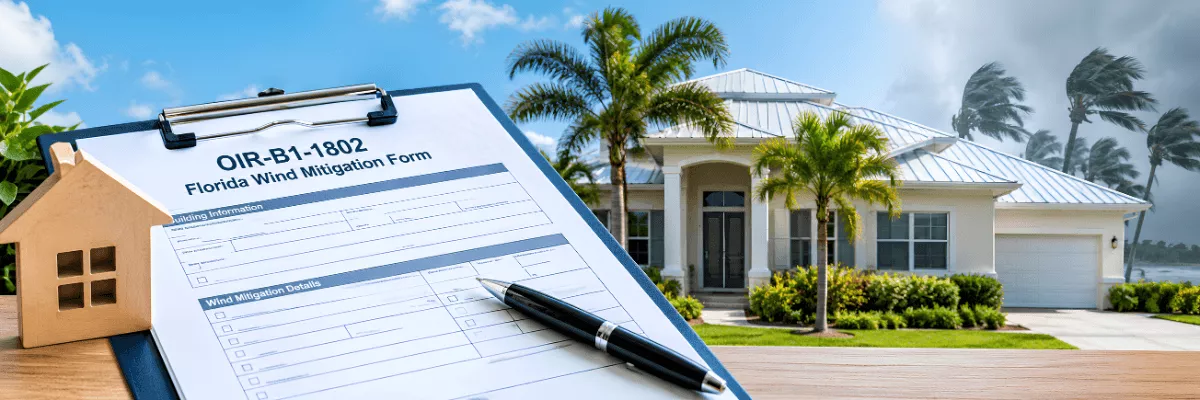
OIR-B1-1802, the Florida Uniform Mitigation Verification Inspection Form, is used to document hurricane and wind-mitigation features that may qualify a property for insurance discounts or credits. Roof construction, roof-to-wall connections, roof-deck attachment, aperture protection, and other qualifying characteristics are assessed by an authorized inspector. In order to ascertain the appropriate wind-mitigation credits, the insurance company receives the completed form.
It is a standardised state form that records how your home is built, specifically the features that affect how it performs in high wind.
The form first appeared in July 2007, when Florida moved to a single statewide document so that credits would be assessed consistently rather than carrier by carrier. Its legal basis is Florida Statute 627.0629, which requires insurers to offer discounts for windstorm mitigation features — and which also requires the Office of Insurance Regulation to reassess the form and its underlying research every five years.
The form itself does not set your premium. It records facts about the building. Your carrier then applies its own filed credit schedule to those facts.
What Changed on the Florida Wind Mitigation Form on April 1, 2026?
Florida implemented a revised OIR-B1-1802, also known as Rev. 04/26, for inspections conducted on or after April 1, 2026. Additional categories and specific documentation requirements for verifying mitigation features are included in the revised form, which is more comprehensive. Inspections that were conducted prior to April 1, 2026, may utilize the preceding version.
The most recent version is OIR-B1-1802 (Rev. 04/26), and it is mandatory for all inspections conducted on or after April 1, 2026. It replaces the version that had been in existence since 2012.
The Florida Cabinet approved the revision in September 2025, and it was subsequently adopted through an amendment to Rule 69O-170.0155 of the Florida Administrative Code. The 2024 Residential Wind-Loss Mitigation Study, which updated research that in some cases was dating back to the inception of the discount program, served as the foundation for this work.
Homeowners should consider three modifications:
The documentation requirements for opening protection have been significantly tightened. The specific Miami-Dade NOA number or Florida Product Approval number for impact glass and shutter installations must now be recorded by inspectors. The threshold for the top classification has been tightened, necessitating that each covered opening have its own product-approval reference, as general product references are no longer sufficient.
The documentation of tile, metal, and modified-bitumen systems has been altered to conform to the current Florida Building Code classifications, as a result of the revision of roof covering categories. Certain retrofit solutions that were not able to be recorded in the previous form were recognized through the introduction of performance-based alternatives for roof-to-wall attachments.
The general trend is toward increased documentation, rather than decreased documentation. The new form adds categories, expands definitions, and increases the evidence threshold. Insurers may request photographs, permits, and product approvals to substantiate the credits claimed.
What Does Each Section of the OIR-B1-1802 Form Cover?
The form is a record of many areas of a home’s wind resistance and storm protection. Sections address building code, roof covering, roof-deck attachment, roof-to-wall attachment, roof geometry, secondary water resistance, opening protection, and other mitigating characteristics depending on the applicable version. Form is completed after inspectors have used documents and photos to verify qualifying features.
Seven sections, assessed independently of one another. Five of them are about your roof.
1. Building code compliance
Records when your home was built and to which code edition. Homes built to the 2001 Florida Building Code or later generally receive baseline credits automatically, and homes in Miami-Dade and Broward are assessed against the High Velocity Hurricane Zone provisions.
2. Roof covering
Documents what your roof is made of and whether each covering meets current code requirements. This is one of the sections restructured in the 2026 revision.
3. Roof deck attachment
Records how the roof decking is fastened to the trusses — nail size, spacing and deck thickness. Older homes with widely spaced fasteners score lower here, and it is a common reason a house with new impact windows still shows a modest overall improvement.
4. Roof-to-wall attachment
Documents the connection holding the roof structure to the walls: toe nails, clips, single wraps or double wraps, in ascending order of strength. The 2026 revision added performance-based options here for retrofit solutions.
5. Roof geometry
Records the shape of the roof. Hip roofs, which slope on all sides, perform measurably better in high wind than gable roofs and are credited accordingly. This is the one section on the form you essentially cannot change without rebuilding.
6. Secondary water resistance
Records whether a sealed secondary barrier sits beneath the roof covering to limit water intrusion if the covering is lost. Present or absent; there is no middle rating.
7. Opening protection
Records what protects every glazed opening, windows, doors, skylights and glazed vents, and to what standard. This is the section impact windows affect, and the only one on the form that a window project changes.
Why Is Opening Protection Important for Impact Windows?
Opening protection is especially crucial when considering impact windows as openings and windows are exposed to windborne debris during a storm. The wind mitigation inspection records whether or not qualifying protection is present. Impact-resistant windows may be part of the opening-protection element of the inspection if the materials and installation meet the appropriate requirements and can be properly documented.
Opening protection is the seventh section, and it is scored differently from the other six.
The other sections are graded on what is there. Opening protection is graded on whether everything is protected. Every glazed opening on the house has to be covered to earn the rating, leave a sliding glass door or a skylight unprotected and the rating falls regardless of how many windows were replaced.
It is also the section the 2026 revision changed most. Because inspectors now have to record a specific NOA or Florida Product Approval number for each protected opening, the paperwork from your installation has become part of the inspection rather than something filed away afterwards.
What Documents Do You Need to Prove Opening Protection?
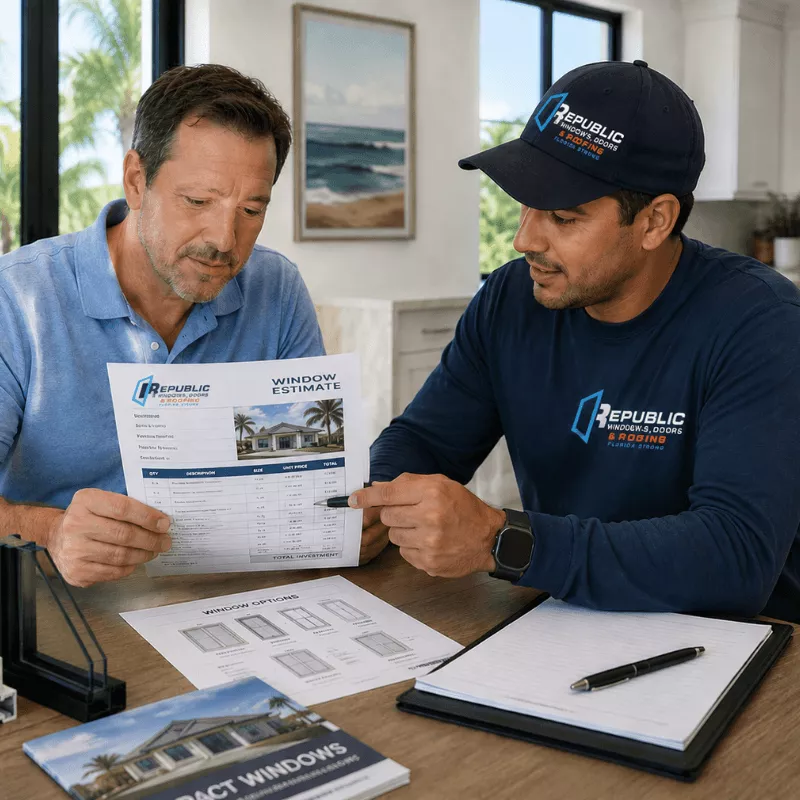
Documentation requirements vary according on the mitigation feature claimed and the current version of the form. Supporting evidence can include product approvals, manufacturer documentation, permits, invoices, installation records, photographs, and other suitable documents. The 2026 form changed to expressly call out material needed to validate mitigation attributes. Your inspector can inform you of what proof is admissible for your particular windows.
Under the current form, the inspector needs the approval number for the product installed in each opening, not a brand name.
That means the Miami-Dade NOA number for HVHZ installations in Miami-Dade and Broward, or the Florida Product Approval number, the FL number, outside the zone. It means the closed permit demonstrating the work was inspected and signed off. And it means those references matching the specific product and configuration in each opening rather than a single number applied to the whole house.
This is where a contractor’s paperwork stops being administrative. We hand over the product approval numbers and the closed permit documentation at project completion, because that package is precisely what the inspector now needs to complete section seven accurately. An installation without that documentation is harder to credit under the current form than it was under the old one.
Who Can Perform a Florida Wind Mitigation Inspection?
The wind mitigation inspection form must be filled up and signed by a trained professional. Qualified licensed home inspectors, building code inspectors, general/building/residential contractors, professional engineers and professional architects may be authorized inspectors. Florida also permits other individuals or companies designated by the insurer to perform the inspection if they have the necessary qualifications.
The form must be filled out by a trained inspector, and Florida is really specific on that.
Categories are licensed home inspectors, building code inspectors, licensed general, building or residential contractors, professional engineers and registered architects. This cannot be done by a neighbor, a handyman or the window installer acting informally and a form completed by an unqualified individual will not be honored by a carrier.
The inspection itself is rather brief, less than two hours for a single family home. The inspector will require access to the attic and the exterior elevations, plus your permit papers.
Is My Old Wind Mitigation Report Still Valid After April 1, 2026?
The new form Florida has put in place does not make an existing completed wind mitigation inspection invalid. As the Florida Department of Financial Services explains, the new form must be used for inspections completed on or after April 1, 2026, although inspections made prior to that date may utilize the prior version. When the inspection is finished, it is valid subject to the applicable regulations.
Certainly, in most situations, until it expires in five years.
Reports completed on the previous version of the form are admissible if they were completed within 5 years prior to 1 April 2026 and the structure has not changed. Some carriers, notably Citizens, have said they will continue to honor them for that duration. Either way, there are two occasions when you should arrange a new examination.
If you’ve done anything to the building new windows, new roof, new doors, the existing report represents a house that no longer exists and can’t record credits for work it never witnessed. And if your report is about to be five years old, renewing it means you’re on the current form.
How Long Is a Florida Wind Mitigation Form Valid?
A completed wind mitigation inspection form is typically valid for up to five years, assuming there are no major alterations to the structure and no mistakes are identified. If qualifying features alter or information on the form is no longer correct, the homeowner may need a new inspection. Your insurance company should be able to tell you if you need a fresh inspection.
5 years from the date of inspection provided no major alterations to the structure and no inaccuracies are detected.
If you let it lapse, the premiums associated to your coverage can come off at renewal, on a house that has not changed at all. It’s a really needless method to end up paying more.” Put a note in your calendar for roughly three months before the expiry date, so that you have time to book in the re-inspection before it matters.
How Do You Get a Wind Mitigation Form After Installing Impact Windows?
After impact windows are installed, have a competent wind mitigation inspector evaluate and document the finished opening protection improvements. The inspector shall check such appropriate characteristics, take the required photographs, obtain supporting paperwork, and complete the current OIR-B1-1802 form. Submit the completed form and supporting documentation to your insurance company to verify your eligibility for appropriate mitigation credits.
The order matters, and getting it wrong means paying for a second inspection.
1. Complete the installation and close the permit. An inspection performed before final sign-off documents the house you had rather than the house you have.
2. Collect your documentation. The product approval numbers for each opening and the closed permit. We provide both at completion.
3. Hire a qualified inspector. Any of the categories listed above. Confirm they are using the current 04/26 revision of the form.
4. Submit the completed form to your carrier. The credits apply from the point your insurer processes it, not from the date the windows went in, so submitting promptly is worth doing.
A point that catches people out: if you used a My Safe Florida Home grant, the free wind mitigation inspection that programme provides happens before any work begins and exists to establish your eligibility. It is not the inspection that documents your new windows. You need a second one afterwards.
Frequently Asked Questions
What is the OIR-B1-1802 form?
It is Florida’s Uniform Mitigation Verification Inspection Form, the single statewide document that records a home’s wind-resistant features. Every Florida property insurer is required to accept it. A qualified inspector completes seven sections covering the building code era, the roof and opening protection.
What is the new wind mitigation form for 2026?
OIR-B1-1802 (Rev. 04/26), effective 1 April 2026. It replaces the 2012 version and was adopted following the 2024 Residential Wind-Loss Mitigation Study. All inspections performed on or after that date must use it.
How long is a Florida wind mitigation inspection good for?
Five years from the inspection date, assuming no material structural changes and no inaccuracies. After that a new inspection is needed to keep the credits applied to your policy.
Who can complete a wind mitigation inspection in Florida?
Licensed home inspectors, building code inspectors, licensed general, building or residential contractors, professional engineers and registered architects. Forms completed by anyone outside those categories are not accepted by carriers.
Do I need a new wind mitigation inspection after installing impact windows?
Yes. Your existing report documents the openings you had before the work. A new inspection after the permit closes is the only way the new windows appear on the form, and under the current version the inspector needs the product approval number for each opening.
What is opening protection on a wind mitigation form?
Section seven of the form, recording what protects every glazed opening on the house and to what standard. It is scored on whether all openings are protected rather than how many, so an unprotected door or skylight affects the rating regardless of how many windows were replaced.
Is my old wind mitigation report still accepted?
Generally yes, until its five-year expiry, provided it was completed within the five years before 1 April 2026 and the structure has not changed. If you have replaced windows, doors or the roof since, order a new one — the old report cannot credit work it never inspected.
Does the My Safe Florida Home inspection count?
No. That inspection happens before work begins and establishes grant eligibility. Documenting your completed windows for insurance purposes requires a separate inspection afterwards.