
Types of Impact Windows: Which One Goes in Which Opening?
According to Florida law, insurers are required to reduce the windstorm portion of your premium when impact windows are confirmed during a wind mitigation inspection. The credit reduces a portion of your bill, rather than the entire charge, as the windstorm portion is typically 30 to 60 percent of a Florida premium and is higher near the coast. To be eligible, each glazed opening must be safeguarded.
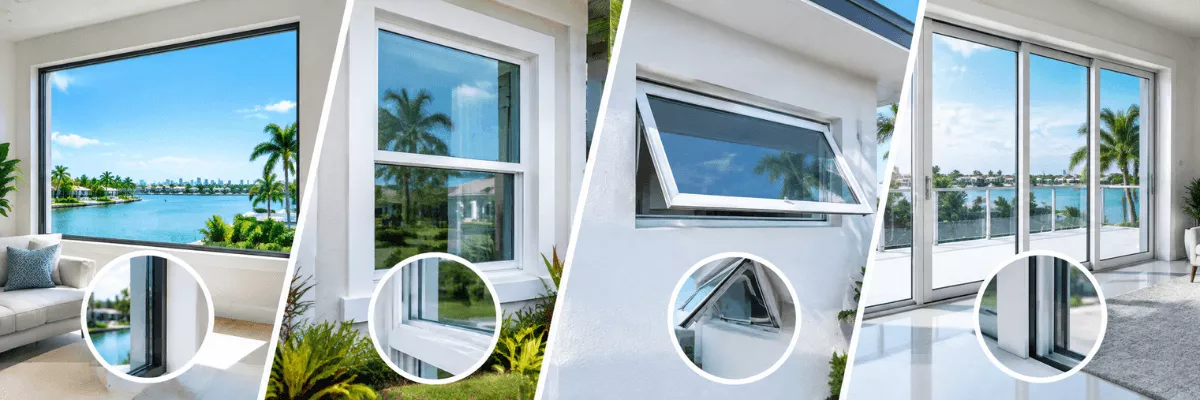
What Are the Different Types of Impact Windows?
Impact windows come in several operating styles, including single-hung, horizontal roller, casement, awning, fixed, and picture windows. Each style offers different benefits for ventilation, accessibility, views, and available wall space. All impact windows should be properly rated and installed for the intended opening. Choosing the right style depends on your home’s design, local building requirements, and how you use each room.
Five categories account for almost all of the residential openings in South Florida.
Single hung features a stationary top sash and a moveable bottom sash that moves up and down. Horizontal rollers run across a track. Casements are hinged on the side and crank outward. The awnings are hinged at the top and open from the bottom outward. Fixed windows, or picture windows, don’t open at all.
Sliding glass doors and French doors are sometimes thrown together in “window types” lists, although they are doors, they have separate certifications, and they are priced at different levels.
How Do You Choose the Right Impact Window for Each Opening?
Select an impact window based on the size and shape of the opening, location, ventilation requirements and intended usage. Decide if you need an open window in the room, a wide view without obstructions or an emergency exit. The window must be compatible with the existing structure and comply with appropriate Florida impact and installation criteria. A good window contractor can help identify what style works for each opening.
The opening chooses the window more often than the homeowner does.
A standard single hung opening has a dozen viable options and you can pick on looks and budget. A twenty-foot slider or a corner-glazed opening has two or three. The bigger and less standard the opening, the shorter the list gets, because design pressure requirements rise with size and fewer approved configurations exist at the top end.
Four questions settle it in order:
How big is the opening, and what design pressure does it need? This eliminates types before anything else is considered.
Does the room need ventilation? If not, fixed glass gives you more glass and fewer moving parts.
Is it a bedroom? Egress requirements apply and they rule out some configurations.
What is the exterior clearance? Anything that swings outward needs room to swing.
What Are Single-Hung Impact Windows?
Single-hung impact windows have two vertically arranged sashes, with one sash moving upward while the other remains fixed. They are commonly used in bedrooms, living rooms, and other residential spaces because they offer a familiar design and relatively simple operation. Single-hung impact windows can provide hurricane protection, security, and weather resistance when properly rated and installed for the specific opening.
The default for most South Florida homes, and the most widely approved configuration across manufacturers.
Only the bottom sash moves, which keeps the mechanism simple and the cost down, and because nothing protrudes it works next to walkways, patios and driveways. The trade-off is ventilation: only half the opening ever clears, which also matters for bedroom egress.
Are Horizontal Roller Impact Windows Good for Wide Openings?
Horizontal roller impact windows, which are also known as sliding or gliding windows, are designed to open by sliding one sash horizontally along a track. They are advantageous in situations where vertical clearance is restricted, such as beneath overhangs or in specific kitchen and living room configurations. The utmost size and configuration must be verified with the manufacturer and installer, but these windows offer convenient operation and ventilation.
The standard answer for openings that are wider than they are tall.
Sashes slide sideways rather than vertically, so a roller fills a wide opening without the sash height a hung window would need. Like single hung, nothing protrudes outside. On very wide openings, look at how the unit is divided, a two-panel and a three-panel roller in the same opening behave differently on both sightlines and design pressure.
What Are Casement Impact Windows, and How Do They Work?
Casement impact windows are hinged on one side and open outward using a crank or operating mechanism. Their design can provide a wide ventilation opening and allow homeowners to direct airflow into a room. Casement windows are suitable for many bedrooms, kitchens, and living spaces, provided the opening, exterior clearance, hardware, and required impact ratings are appropriate for the installation.
The best ventilation of any type, and usually the strongest seal.
A casement swings fully open on a crank, so the entire opening clears rather than half of it. That full clear opening is why casements are often the simplest way to satisfy bedroom egress. Closed, the sash pulls tight against the frame on all sides rather than sitting in a track, which is why casements typically seal better than sliding types.
Two constraints. It swings outward, so it needs exterior clearance and does not belong over a walkway. And the hardware does more work than on any other type, which puts a ceiling on the size available.
Are Awning Impact Windows Good for Ventilation?
Awning impact windows are hinged at the top and expand outward from the bottom. While the window is open, their design provides ventilation and protects the opening from some rain. They are effective in bathrooms, kitchens, and other spaces that require adequate ventilation. Nevertheless, it is imperative to assess the window’s placement, opening size, exterior clearance, and building requirements prior to installation.
The type that addresses a particular issue: ventilation during rainy weather.
An awning is designed to shed water while open, allowing it to remain open during a South Florida afternoon rainfall. It is hinged at the top and opens outward from the bottom. That is why it is the preferred option for high wall openings, bathrooms, and kitchens, where privacy is more important than view. They are typically specified in lesser sizes, frequently located above or beside a fixed unit.
What Are Fixed and Picture Impact Windows?
Fixed and picture impact windows do not open or provide natural ventilation. Instead, they are designed to deliver natural light, expansive views, and a more unobstructed appearance. They are often used in living rooms, stairwells, entry areas, and large architectural openings. Fixed impact windows must be correctly sized, rated, and installed to meet the structural and hurricane-protection requirements of the opening.
The choice wherever you want glass rather than airflow.
With no sash, no track and no hardware, a fixed unit puts more glass in the same rough opening, gives the cleanest sightlines, and has nothing to wear out or leak through. It is also generally the least expensive type per opening for exactly those reasons.
The obvious limitation is that it never opens, so it cannot serve a bedroom egress requirement and cannot ventilate a room on its own. The common solution is pairing: a large fixed unit flanked by casements or topped with an awning gives you the glass and the airflow in the same opening.
Which Impact Windows Are Best for Large Openings?
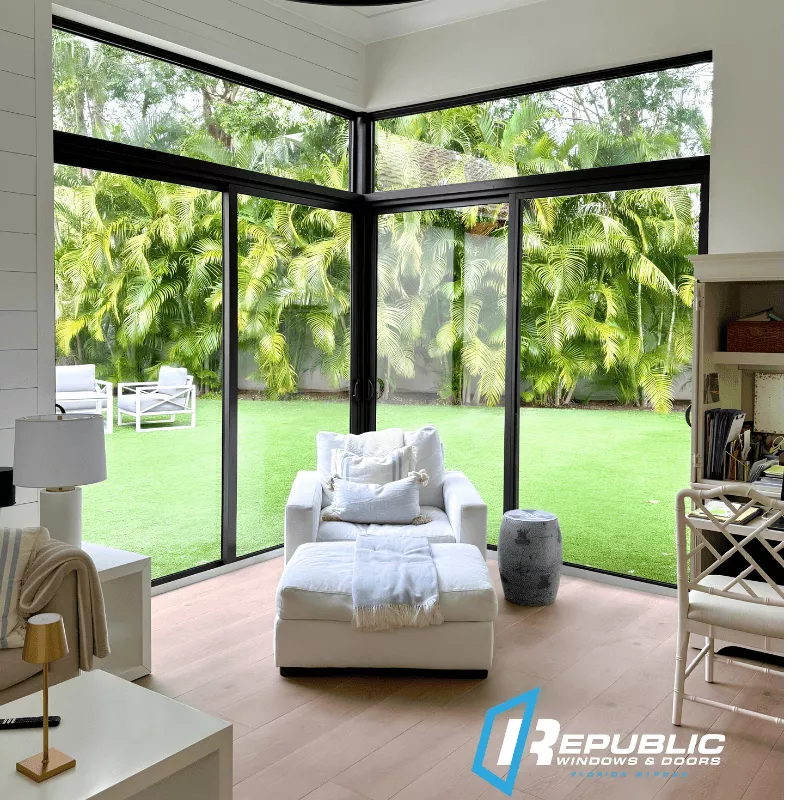
Fixed or picture impact windows, large sliding configurations, or other engineered window systems may be appropriate for large openings. The optimal choice is contingent upon the opening dimensions, wind-load requirements, structural support, and desired operation. Fixed windows can offer expansive views, while operable systems provide ventilation. Before advocating a solution, a qualified contractor should confirm product sizes, approved configurations, and installation requirements.
Fixed units and horizontal rollers are the reason, and it is structural rather than esthetic.
As an opening expands, the design pressure it must endure increases, and operable types reach their approved limits sooner than fixed types due to the constraints of sashes, tracks, and hardware. None of these are present in a fixed unit, which is why it can maintain the highest pressures at the greatest sizes. The standard method for partitioning a large opening that still requires opening is to use operable units at the edges and use fixed glass across the center, rather than attempting to locate a single, enormous operable unit. It is also at this point that the type of approval is less important than the specific approval.
This is verified for each opening prior to ordering any items, as a configuration that has been approved for one size may not be approved for another.
Which Impact Windows Are Best for Ventilation?
Casement, awning, single-hung, and horizontal roller impact windows can all provide ventilation when properly designed and installed. Casement windows may offer a broad airflow opening, while awning windows can help provide ventilation during light rain. Single-hung and roller windows offer familiar operating styles. The best option depends on room layout, opening dimensions, weather exposure, and how much airflow you want.
Casements first, then awnings, then the sliding types.
A casement clears the entire opening. A single hung or horizontal roller clears half of it, because one sash always sits in front of the other. If airflow through a particular room matters to you, that difference is the whole decision and it is not a small one.
Awnings sit slightly apart from this ranking: less airflow than a casement, but the only type that stays usable in rain.
What Impact Windows Meet Bedroom Egress Requirements?
Bedroom impact windows must meet applicable emergency-escape and rescue opening requirements when the window serves as an egress opening. The required clear opening, opening height, opening width, and sill height depend on the applicable building code and the specific installation. Not every impact window qualifies for bedroom egress. Before ordering, have a qualified professional verify the opening and select a compliant window configuration.
Bedrooms are required to have an opening that is sufficiently large to facilitate escape; this requirement pertains to the clear opening, not the window’s dimensions.
This is the point at which the distinction between half and full becomes a code question rather than a comforting one. A casement is able to egress from a smaller overall dimension because it clears its entire opening. In order to provide the same escape route, a single suspended or roller must be physically larger, as it only clears half of the space. This can be the deciding factor in a bedroom with a modest opening.
The precise dimensions are determined by the code edition that is currently in effect for your permit. Therefore, it is advisable to verify them with us or your building department rather than relying on a number that was obtained online.
Frequently Asked Questions
What are the different types of impact windows?
Five types cover most South Florida homes: single hung, horizontal roller, casement, awning, and fixed or picture. Sliding glass doors and French doors are sometimes listed alongside them but are doors, carrying separate approvals.
Which type of impact window is best?
There is no single best type, because the decision is made per opening rather than per house. Opening size and required design pressure narrow the options first, then ventilation needs, egress requirements and exterior clearance settle it.
What is the difference between single hung and casement impact windows?
A single hung slides vertically and only its lower sash opens, so half the opening ever clears. A casement swings outward on a crank and clears the entire opening, giving better ventilation and a tighter seal, but it needs room to swing outward.
Which impact windows are best for large openings?
Fixed and picture units, because they have no sash or hardware to limit the design pressure they can carry at size. Large openings that also need to open are usually divided, with fixed glass in the centre and operable units at the edges.
Can you mix window types in one house?
Yes, and most South Florida homes do. Choosing per opening is normal and correct — fixed glass where you want a view, casements or awnings where you want airflow, single hung or rollers everywhere else.
Do all types carry the same hurricane rating?
All types are available impact-rated, but the design pressures they reach differ, and approvals are issued per product, per size and per configuration. The type is not what makes a window compliant — the specific approval for that unit in that opening is.
Are awning windows worth it?
They are, in the specific situation they solve: ventilation during rain. Because they shed water while open, awnings suit bathrooms, kitchens and high openings where you want airflow without watching the weather.