How to Calculate Design Pressure for Impact Windows in South Florida
If you’ve started searching for impact windows in South Florida, you’ve probably seen the word “design pressure” on spec sheets and contractor bids. It seems scientific, but understanding what it means, and how it’s calculated for your home, can make a huge difference in selecting the correct windows for permanent storm protection. This tutorial breaks down design pressure, discusses how it is derived, and what to look for when analyzing window ratings.
What Is Design Pressure?
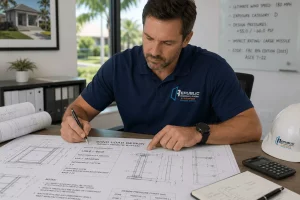
Design pressure (commonly abbreviated DP) is a number that evaluates how much wind force a window, door or other opening product can sustain before it collapses. It is measured in pounds per square foot (psf) because it includes both positive pressure, the wind pushing in on the glass, and negative pressure, the suction force pulling out as the wind moves past the structure.
Pressure in both directions is important in a cyclone. When a storm passes over a structure, the pressure varies swiftly and repeatedly, thus impact-rated windows must be tested and certified for both positive and negative load circumstances. For example, a window with a DP rating of +40/-50 means it can handle 40 psf of inward pressure and 50 psf of outward suction.
Design pressure standards in South Florida are defined by the Florida Building Code and enforced at the county level. Miami-Dade NOA approved impact windows have passed Miami-Dade’s testing processes and are widely regarded as the gold standard for hurricane protection across the state, with Miami-Dade County having some of the toughest criteria in the nation.

Key Factors That Determine Design Pressure Requirements
Design pressure is not a single, constant figure that applies to every home. How much rating your windows require relies on a number of factors particular to your house.
- Geographic Wind Zone. South Florida is in a High-Velocity Hurricane Zone (HVHZ) that covers all of Miami-Dade and Broward counties. Homes in these zones are required to be built to higher minimum DP ratings than homes further inland or further north in Florida. Palm Beach County has a similar criterion for coastal regions, but reduces the standards as you go inland.
- Building Height and Story. “The higher you go, the stronger the wind. Wind loads on openings in a single-story residence are lower than on openings on an upper level of a multi-story home. The Florida Building Code has accounted for this disparity using wind speed maps and height adjustment factors.
- Distance from the Coast. Enhanced intensity of sustained winds and gusts during a storm nearer to the beach. Properties located near a specific distance from open ocean (the exposure category) require higher design pressures.
- Opening Size and Location. The larger the window opening, the higher the DP-rated items required, since more surface area equals more overall force on the frame and glass. The position of the opening on the structure is also important. Windows and doors located in corners or at the extremities of walls are often subjected to higher levels of localized pressures than those located in the center of a wall.
How Design Pressure Is Calculated
To calculate the design pressure for a given building, calculations from ASCE 7 (a national standard for wind loads on buildings), modified for local conditions under the Florida Building Code, must be used. The entire engineering process is carried out by qualified experts, generally your contractor, a structural engineer or the permit-review procedure. But understanding the essentials allows you to read product specs and ask the proper questions.
The general formula works like this:
Design Pressure = Basic Wind Speed × Exposure Factor × Height Factor × Pressure Coefficient
Each of these variables is looked up from standardized tables based on your home’s location, construction type, and geometry:
- Basic Wind Speed comes from wind speed maps in the Florida Building Code. For most of South Florida, this is 170–185 mph or higher in coastal areas.
- Exposure Category reflects how open or sheltered the terrain around your home is—coastal properties in open exposure face higher adjusted pressures than homes in established neighborhoods with trees and nearby structures providing some wind buffer.
- Height Adjustment Factor increases the pressure requirement for windows above a certain elevation, reflecting the fact that wind speeds climb with height.
- Pressure Coefficient accounts for whether the opening is on a windward wall (facing the wind), a leeward wall (sheltered side), or a sidewall, each of which experiences different pressure patterns during a storm.
The result of these factors combined gives you the minimum DP rating a window product must carry to be code-compliant for that specific opening in your home.
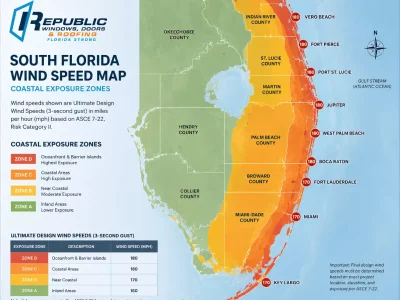
When you compare impact windows, you’ll most often find DP ratings such as DP 30, DP 40, DP 50 or above. How to read them:
- DP 30 is on the low side and may be appropriate for some inland locations or protected lower floor openings with smaller sizes.
- DP 40-50 is used in substantial parts of residential use in South Florida, especially in established communities in Miami-Dade and Broward counties.
- DP 50+ is often required for openings that face the coast, upper-floor windows on multi-story residences, or bigger openings where the increased surface area increases the overall load.
What DP Ratings Mean in Practice
A product’s DP rating is indicated on its NOA documentation, which is the certification granted by Miami-Dade County that proves the window has passed testing for a certain pressure range, glass configuration, and frame size. To avoid issues with your new impact window, verify that the precise product-and-size combination has a NOA that covers the DP rating necessary for your home’s openings before you purchase it.
One very essential thing to note is that a window’s DP rating is for a tested window size. For example, a product rated DP 50 for a 36” × 60” opening may receive a DP 40 rating when the same frame and glass system is used in a larger 48” × 72” configuration. Always verify the rating against exact measurements of your openings, not simply the product line in general.
Why Getting Design Pressure Right Matters for Insurance and Permitting
Choosing windows that meet or exceed the specified design pressure for your home is not just about storm performance, but also impacts your permitting and insurance results.
Permitting.
Impact window replacements in South Florida require a permit and the inspection procedure validates that the installed product’s NOA matches the design pressure requirements for each opening. If you install a product in an opening larger than its rated DP, it will fail inspection.
Wind Mitigation Inspection.
Once it is installed, a qualified inspector can create a wind mitigation report that your insurance carrier utilizes to determine your hurricane impact windows insurance discount. Windows with the requisite DP ratings and acceptable NOA paperwork are eligible for these credits; incorrectly rated or uncertified products are not.
Storm Claim Protection.
If a storm strikes, valid insurance claims may be made if you have rated and fitted impact windows correctly. Damage might be complicated by a product installed without proper permits or not meeting the required design pressure for the aperture.
Don't Try to Calculate Design Pressure Alone
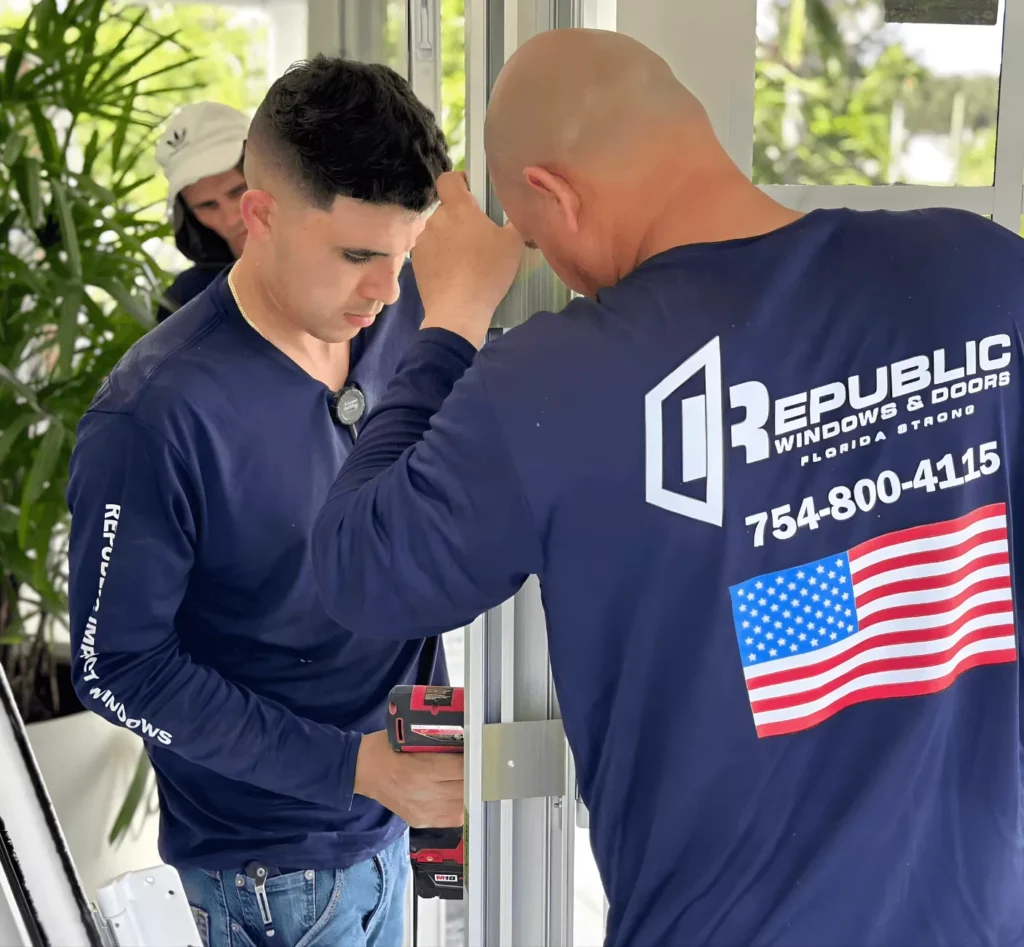
This tutorial will provide a good basis for the notion of design pressure, but determining the actual minimum DP requirements for each opening in your home is a process that entails looking up local code, wind speed maps, building geometry measurements and county-specific restrictions. That’s why it’s important to deal with a qualified, professional contractor.
A certified installer will retrieve the exact design pressure requirements for each opening in your home as part of the proposal and approval process, so you can be assured every window you install is code-compliant and completely eligible for insurance wind mitigation benefits.
Why Choose Republic Windows, Doors & Roofing
Republic Windows, Doors & Roofing handles the technical part of each project for homeowners, so they don’t have to. For every impact window project we execute in Miami-Dade, Broward and Palm Beach counties, we check the design pressure requirements for each opening, choose the appropriate NOA-approved product to meet those criteria and oversee the permitting and inspection process from beginning to end.
Whether it is a single story concrete block home in Coral Gables or a multi story property along the Boca Raton beachfront, we make sure that the hurricane rated windows Florida residents require are not only fitted correctly, but also properly documented for insurance and code compliance.
Frequently Asked Questions
What is a good design pressure rating for impact windows in South Florida?
For most South Florida homes, a DP rating of 40 to 50 covers the majority of residential openings, though coastal properties, upper-floor windows, and larger openings often require DP 50 or higher. Your contractor should calculate the exact minimum rating for each opening based on your home’s location and construction.
Do all impact windows have the same design pressure rating?
No. DP ratings vary by product line, frame material, glass configuration, and—critically—the tested size of the window. The same product may carry a different DP rating for different opening dimensions, so always verify the rating for your specific opening sizes.
Is a Miami-Dade NOA required for impact windows in Broward or Palm Beach County?
Miami-Dade NOA approval is the most rigorous standard available and is accepted throughout Florida, including Broward and Palm Beach counties. Some Palm Beach County areas may accept Florida Product Approvals that don’t carry a Miami-Dade NOA, but NOA-approved products give homeowners the most confidence in performance and eligibility for insurance discounts.
Can I calculate my home's design pressure requirements myself?
You can learn the concepts involved, but the accurate calculation requires local wind speed maps, building code tables, and opening-specific measurements—work best handled by a licensed contractor or structural engineer who understands South Florida’s specific requirements.
Will my impact windows pass inspection if the DP rating is close but not exact?
The installed product’s DP rating for the actual opening dimensions must meet or exceed the minimum required rating for that opening. A product that falls short—even slightly—will not pass inspection and will need to be replaced, so getting the specifications right before ordering is essential.
Ready to Get the Right Impact Windows for Your Home?
Design pressure doesn’t have to be complex. At Republic Windows, Doors & Roofing, we’ll conduct the calculations, identify the correct NOA-approved product for every opening and make sure your installation passes inspection the first time. Call us immediately for your free no obligation estimate for impact windows in South Florida – and give your home the protection it needs before the next hurricane season.